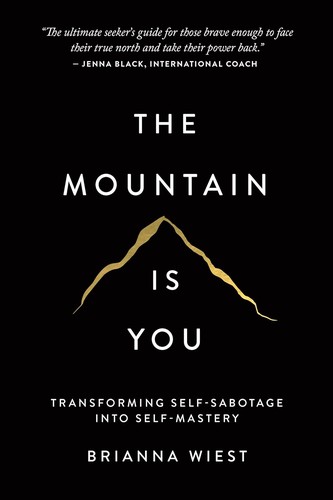
The Mountain Is You
by Brianna Wiest · 2020
The self-sabotage book that treats procrastination, perfectionism, and self-doubt as one problem wearing different masks.
Worth reading? The Mountain Is You is the clearest popular framing of self-sabotage as a single underlying pattern, fear of change, need for control, unprocessed emotion, rather than a list of unrelated bad habits. It won't replace therapy for a real trauma history, but as a mirror for recognizing your own patterns, it's sharper than most books in the genre. Skip it if you want research citations and clinical rigor; this stays in essay and aphorism territory throughout.
| Full Title | The Mountain Is You: Transforming Self-Sabotage Into Self-Mastery |
|---|---|
| Author | Brianna Wiest |
| Published | 2020 |
| Publisher | Thought Catalog Books |
| Category | Self-Improvement & Psychology |
| Favorite quote | “You will never find peace standing in the ruins of what you used to be.” |
The Verdict
Wiest’s core move is refusing to treat procrastination, perfectionism, and self-doubt as separate problems needing separate fixes. Her argument is that they’re the same fear wearing different outfits, usually a fear of change, discomfort, or losing control, and that treating the symptom without naming the fear just moves the sabotage somewhere else.
The book works best as a mirror. It won’t hand you a clinical protocol, and it doesn’t try to, this is essay and aphorism, not a research text. But recognizing your own pattern described back to you clearly is often the first real step, and that’s what this delivers better than most books in the genre.
Skip it if you want citations and clinical structure, or if you’re working through genuine trauma that needs actual therapeutic support rather than a self-help framework. For everyday self-sabotage, the recurring habit you can’t seem to shake, it’s a sharper diagnostic than most of the shelf.
you keep hitting the same self-created obstacle across different areas of your life and can't name why
you want clinical, research-heavy psychology -- this is essayistic and aphoristic, closer to a journal companion than a study
Book Summary
Self-sabotage isn't random, it's usually a self-protective mechanism, avoiding change, discomfort, or a feared outcome, dressed up as procrastination, perfectionism, or self-doubt. The specific habit varies, but the underlying fear is often the same one showing up repeatedly.
Emotional resilience comes from processing feelings, not avoiding them. Numbing behaviors (busyness, distraction, blame) delay discomfort without resolving it, and the discomfort tends to resurface in a new form until it's actually addressed.
Real change costs you something on the way in, comfort, old relationships, a familiar identity, before it gives you anything back. Expecting transformation to be painless is itself part of what keeps people stuck at the base of their own mountain.
Top 8 Lessons from The Mountain Is You
- Self-sabotage is usually self-protection in disguise -- ask what the behavior is protecting you from, not just how to stop it.
- The same underlying fear can show up as procrastination in one area and perfectionism in another -- look for the pattern, not just the symptom.
- Busyness and distraction are often ways to avoid feeling something, not neutral habits.
- Real transformation costs you comfort, old identity, and sometimes relationships before it gives anything back.
- Intuitive thoughts tend to solve problems; invasive, looping thoughts tend to create them -- learn to tell them apart.
- Your circumstances are often a feedback mechanism reflecting your own patterns back at you, not just bad luck.
- You'll spend more energy trying to impress people who don't value you than nurturing people who already do -- notice where your effort goes.
- Grieving your old comfort zone is a normal part of change, not a sign you're doing it wrong.
Top 4 Quotes from The Mountain Is You
"Being busy is the ultimate way to distract ourselves from what's really wrong."
Brianna Wiest, The Mountain Is You
"You will never find peace standing in the ruins of what you used to be."
Brianna Wiest, The Mountain Is You
"Your new life is going to cost you your old one. It's going to cost you your comfort zone and your sense of direction. It's going to cost you relationships and friends. It's going to cost you being liked and understood."
Brianna Wiest, The Mountain Is You
"Intuitive thoughts solve problems; invasive thoughts create them."
Brianna Wiest, The Mountain Is You
Frequently Asked Questions
Is The Mountain Is You worth reading?
Yes, if you keep hitting the same self-created obstacle in different areas of life. It reframes procrastination, perfectionism, and self-doubt as one pattern instead of unrelated bad habits.
What is the main idea of The Mountain Is You?
Self-sabotage is usually a self-protective response to fear of change or discomfort, dressed up as procrastination or perfectionism, and resolving the underlying fear, not just the surface habit, is what actually breaks the pattern.
Is this book research-based?
It leans essayistic and aphoristic rather than clinical or citation-heavy. It's a mirror for recognizing patterns, not a research text.
Who should read The Mountain Is You?
Anyone who notices the same obstacle recurring across different parts of their life. Skip it if you need clinical rigor or you're working through serious trauma, which needs actual therapy.
Ready to read it?
Get The Mountain Is You on Amazon