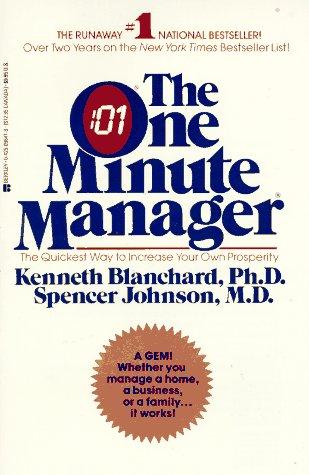
The One Minute Manager
by Kenneth Blanchard & Spencer Johnson · 1982
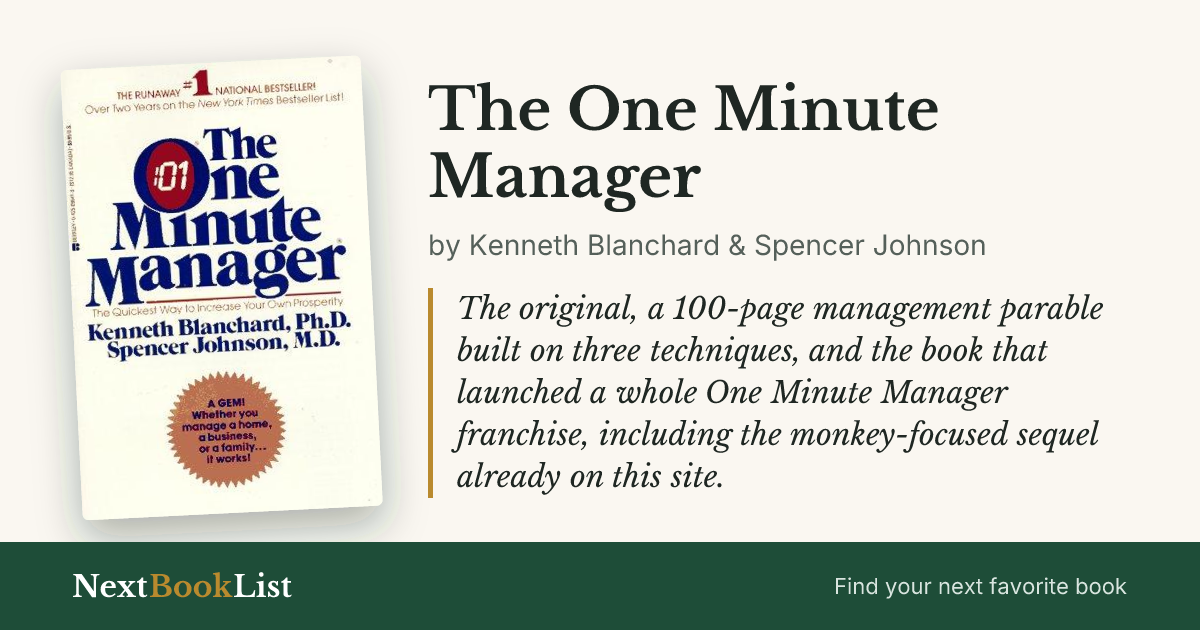
The original, a 100-page management parable built on three techniques, and the book that launched a whole One Minute Manager franchise, including the monkey-focused sequel already on this site.
Worth reading? The One Minute Manager is intentionally tiny -- a business fable you can finish in an hour -- built around three techniques: one-minute goals, one-minute praisings, and one-minute reprimands. It's thin compared to research-driven books like The Leadership Challenge, but that's the point: it's meant as a fast, memorable starting framework, not a comprehensive management text. If you've already read the monkey-focused sequel on delegation, this is the foundational text that sequel builds on.
| Author | Kenneth Blanchard & Spencer Johnson |
|---|---|
| Published | 1982 |
| Category | Business & Money |
| Favorite quote | “Everyone is a potential winner. Some people are disguised as losers, don't let their appearances fool you.” |
The Verdict
Blanchard and Johnson built the book’s brevity into its own argument – a management book about the power of short, immediate feedback that takes an hour to read is making its point through its own form. If you’ve already got the sequel on delegation, this fills in the foundational three techniques it assumes you know.
you want the shortest, simplest possible introduction to feedback-based management before diving into anything more complex
you've read The One Minute Manager Meets the Monkey, that sequel covers delegation specifically and builds on this book's foundation, so reading both back to back can feel repetitive on the core framework
Book Summary
Effective management, in Blanchard and Johnson's compressed framework, comes down to three brief but consistent techniques: setting clear one-minute goals so people know exactly what's expected, giving one-minute praisings immediately after catching someone doing something right, and delivering one-minute reprimands immediately after a mistake -- specific, brief, and followed by a reaffirmation of the person's value, not a lingering punishment.
The underlying principle across all three techniques is immediacy and brevity: feedback loses its power the longer it's delayed and the more it gets padded with unrelated commentary. A manager who catches people doing things right, on the spot, briefly and specifically, shapes behavior more effectively than one relying on annual reviews or vague general praise.
Top 7 Lessons from The One Minute Manager
- Set one-minute goals: clear, written, specific expectations everyone can review in under a minute.
- Deliver praise immediately after catching someone doing something right, not saved for a later review.
- Keep praise specific to the exact behavior, not generic ('good job').
- Deliver reprimands immediately after a mistake too, briefly, focused on the behavior not the person.
- End a reprimand by reaffirming the person's value, separate from the specific mistake.
- Feedback loses power the longer it's delayed -- immediacy matters more than formality.
- Catching people doing things right shapes behavior more reliably than only correcting mistakes.
Top 5 Quotes from The One Minute Manager
"Everyone is a potential winner. Some people are disguised as losers, don't let their appearances fool you."
Kenneth Blanchard & Spencer Johnson, The One Minute Manager
"The best minute I spend is the one I invest in people."
Kenneth Blanchard & Spencer Johnson, The One Minute Manager
"Goals begin behaviors. Consequences maintain behaviors."
Kenneth Blanchard & Spencer Johnson, The One Minute Manager
"Feedback is the breakfast of champions."
Kenneth Blanchard & Spencer Johnson, The One Minute Manager
"People who feel good about themselves produce good results."
Kenneth Blanchard & Spencer Johnson, The One Minute Manager
Frequently Asked Questions
Is The One Minute Manager worth reading?
Yes, as a fast, simple introduction to feedback-based management. It's short and light on research compared to books like The Leadership Challenge, but the three techniques are genuinely usable starting points.
What are the three techniques in The One Minute Manager?
One-minute goals (clear, brief expectations), one-minute praisings (immediate, specific positive feedback), and one-minute reprimands (immediate, brief correction followed by reaffirming the person's value).
Is The One Minute Manager the same as The One Minute Manager Meets the Monkey?
No -- this is the original 1982 book covering the core three techniques. The Monkey sequel applies the same brevity principle specifically to delegation and managing upward task-creep.
How long does it take to read The One Minute Manager?
About an hour. It's written as a short business parable, roughly 100 pages, deliberately brief in keeping with its own philosophy.
Ready to read it?
Get The One Minute Manager on Amazon