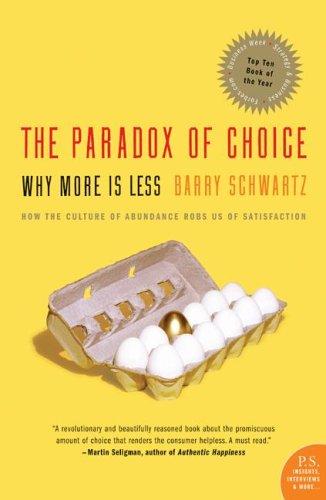
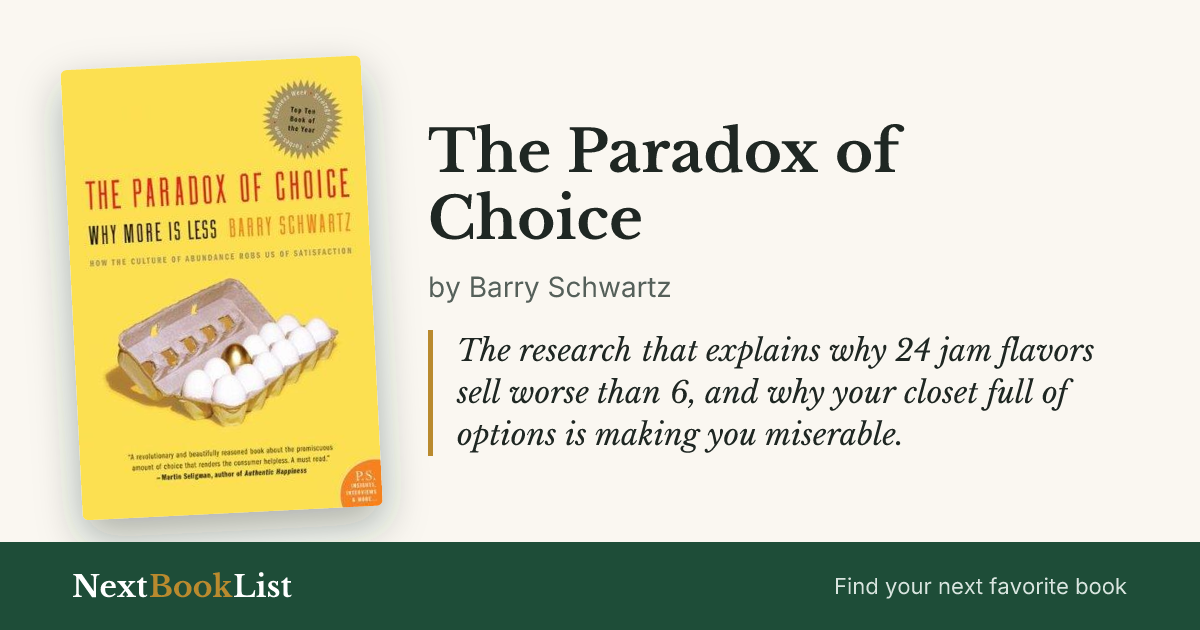
The Paradox of Choice
by Barry Schwartz · 2004
The research that explains why 24 jam flavors sell worse than 6, and why your closet full of options is making you miserable.
Worth reading? The Paradox of Choice makes a counterintuitive case with real research behind it: past a certain point, more options don't make you freer, they make you more anxious, less satisfied with what you pick, and more prone to regret. Schwartz's maximizer-vs-satisficer distinction (do you search for the best possible option, or a good-enough one?) is the single most practical takeaway, and it's worth adopting even if you don't read the rest of the book.
| Full Title | The Paradox of Choice: Why More Is Less |
|---|---|
| Author | Barry Schwartz |
| Published | 2004 |
| Category | Self-Improvement & Psychology |
| Favorite quote | “Learning to choose is hard. Learning to choose well is harder. And learning to choose well in a world of unlimited possibilities is harder still, perhaps too hard.” |
The Verdict
Schwartz writes as a psychologist marshaling research, not a guru offering opinions, and the jam study alone has become one of the most cited findings in behavioral economics for a reason. The maximizer-satisficer distinction is the kind of idea that changes how you shop, date, and job-hunt the moment you actually apply it.
you're overwhelmed by decisions (career, dating, shopping, anything) and want the research on why more options make it worse
you need to make one specific hard decision right now, this is the theory behind decision fatigue, not a step-by-step decision framework
Book Summary
Choice overload is real: past a certain number of options, decision quality and satisfaction both drop, because the cognitive cost of comparing options outpaces any benefit from having more of them. Schwartz backs this with research (including the famous jam-tasting study) showing fewer options often lead to more purchases and higher satisfaction than an overwhelming array.
The deeper distinction is between maximizers, who try to find the objectively best option and exhaustively compare alternatives, and satisficers, who settle for "good enough" and move on. Maximizers, despite often making objectively better choices, report lower satisfaction and more regret -- because they can never be sure they picked the actual best, and they spend more time comparing than enjoying what they chose.
Top 7 Lessons from The Paradox of Choice
- Past a certain point, more options reduce satisfaction and increase anxiety rather than improving outcomes.
- Decide in advance whether you're a maximizer (searching for the best) or a satisficer (good enough and move on) -- and deliberately choose satisficing for low-stakes decisions.
- Set a threshold for 'good enough' before you start comparing options, not after.
- Limit how many options you actively consider, even if more are technically available.
- Make some decisions irreversible on purpose -- removing the option to change your mind reduces regret and second-guessing.
- Comparing your choice to what you gave up (opportunity cost) actively lowers satisfaction with what you have.
- Lower your expectations deliberately for low-stakes decisions to protect your satisfaction.
Top 5 Quotes from The Paradox of Choice
"Learning to choose is hard. Learning to choose well is harder. And learning to choose well in a world of unlimited possibilities is harder still, perhaps too hard."
Barry Schwartz, The Paradox of Choice
"The secret to happiness is low expectations."
Barry Schwartz, The Paradox of Choice
"Autonomy and freedom of choice are critical to our well-being, and choice is critical to freedom and autonomy. Nonetheless, though modern Americans have more choice... than any group of people ever has before... we don't seem to be benefiting from it psychologically."
Barry Schwartz, The Paradox of Choice
"Choice no longer liberates, but debilitates. It might even be said to tyrannize."
Barry Schwartz, The Paradox of Choice
"The more options there are, the easier it is to regret anything that is disappointing about the option that you chose."
Barry Schwartz, The Paradox of Choice
Frequently Asked Questions
Is The Paradox of Choice worth reading?
Yes, especially if you notice yourself paralyzed by options in shopping, career, or dating decisions. The maximizer-vs-satisficer framework alone is worth the read.
What is the main idea of The Paradox of Choice?
Beyond a certain point, having more options reduces rather than increases satisfaction and well-being, because the cognitive cost of comparing alternatives and the regret of foregone options outweighs the benefit of choice.
What's the difference between a maximizer and a satisficer?
A maximizer searches exhaustively for the objectively best option; a satisficer sets a 'good enough' threshold and stops once it's met. Satisficers report higher satisfaction despite often choosing 'worse' objective outcomes.
Does The Paradox of Choice argue for having no options at all?
No -- Schwartz isn't arguing against choice itself, just against unlimited choice past the point where it stops helping. Some choice is clearly better than none; the argument is about diminishing and eventually negative returns.
Ready to read it?
Get The Paradox of Choice on Amazon