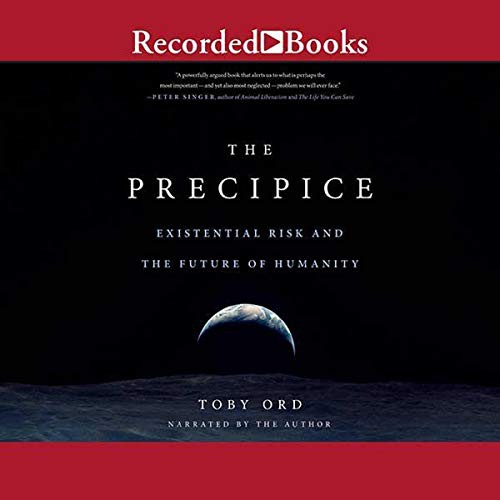
The Precipice
by Toby Ord · 2020
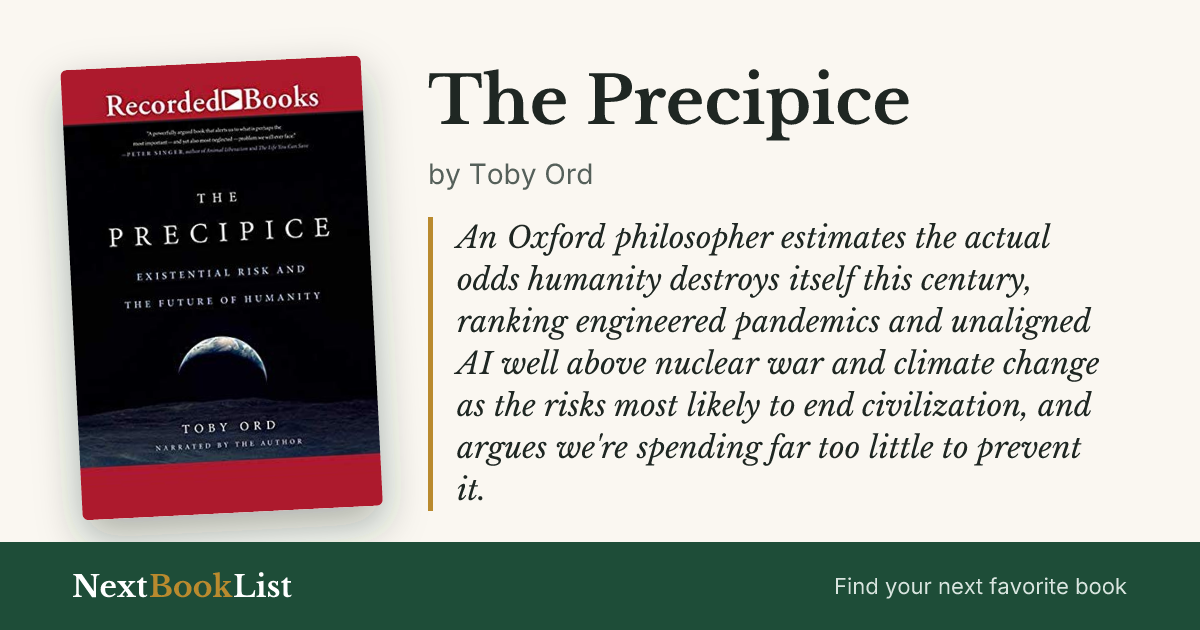
An Oxford philosopher estimates the actual odds humanity destroys itself this century, ranking engineered pandemics and unaligned AI well above nuclear war and climate change as the risks most likely to end civilization, and argues we're spending far too little to prevent it.
Worth reading? Ord's project is to put actual numbers on humanity's risk of extinction or civilizational collapse this century, and his estimates are genuinely striking: he rates engineered pandemics and unaligned artificial intelligence as far more dangerous over this century than nuclear war or climate change, which get more public attention but, in his assessment, pose comparatively lower existential risk. Written before ChatGPT-era AI made his AI chapter look prescient rather than speculative, the book holds up well, and its core argument, that humanity spends more on ice cream research than existential risk reduction, is a genuinely useful provocation. It's dense and probability-heavy, more think tank report than narrative nonfiction, but it's one of the more rigorous single-book treatments of the subject available.
| Full Title | The Precipice: Existential Risk and the Future of Humanity |
|---|---|
| Author | Toby Ord |
| Published | 2020 |
| Publisher | Hachette Books |
| Category | Sociology & Culture |
| Favorite quote | “In the middle of the twentieth century we came through a high mountain pass and found that the only route onward was a narrow path along the cliff-side: a crumbling ledge on the brink of a precipice.” |
The Verdict
Ord’s project is unusual in a field full of vague doom-saying: he actually tries to put numbers on it. Roughly one in six, by his considered estimate, is the chance humanity doesn’t make it through this century intact. That’s not a hook designed to scare you into buying the book, it’s the output of a career spent trying to quantify risks most people only gesture at.
The ranking is the part that reorders your priorities. Nuclear war and climate change get the headlines and the movies, but in Ord’s assessment they’re not actually the top two existential threats. Engineered pandemics and unaligned artificial intelligence are, and he wrote the AI chapter years before large language models made the concern feel urgent to a general audience rather than speculative. That chapter has aged unusually well.
The argument that sticks is the spending one: by his accounting, humanity spends less on reducing these risks than the world spends on ice cream. Whatever the precise number, the underlying point, that the stakes are civilization-scale and the budget is rounding-error scale, is hard to shake once you’ve sat with it.
Read it if you want the most rigorous single-book treatment of existential risk available, written by someone whose job is literally estimating these probabilities for a living, not a journalist’s tour of the topic.
Skip it if you want narrative or drama. This reads like a very well-written risk-assessment report, dense with probability estimates, historical case studies, and policy argument. If you need character and plot to stay engaged with nonfiction, this will feel like a lecture. If you want the clearest map available of what could actually end things and in what order of likelihood, it’s one of the best available.
you want a rigorous, numbers-first case for why reducing existential risk (engineered pandemics, unaligned AI, nuclear war) deserves far more attention and resources than it currently gets, from someone who has spent a career quantifying it
you want a narrative page-turner -- this is closer to a risk-assessment report than a story, with probability estimates, historical case studies, and policy argument doing most of the work rather than character or drama
Book Summary
Ord estimates roughly a one-in-six chance of existential catastrophe (human extinction or irrecoverable collapse of civilization) this century, and argues the risk is concentrated overwhelmingly in anthropogenic (human-caused) rather than natural sources, a sharp reversal from most of human history.
His risk ranking surprises many readers: he places engineered pandemics and unaligned artificial intelligence as the two largest existential risks this century, well above nuclear war and climate change, arguing the latter two, while genuinely dangerous, are less likely to cause full extinction or irrecoverable collapse even in worst-case scenarios.
Ord argues humanity currently spends a strikingly small amount, by his accounting, less than global spending on ice cream, on reducing these risks, and makes the case that even modest increases in existential risk reduction spending would be extraordinarily high-value given the stakes: the permanent loss of all future human potential.
He grounds the argument in "longtermism," the idea that the sheer scale of a potential human future (trillions of people across thousands of generations, if civilization survives and expands) means preserving that future should be weighted far more heavily in present-day priorities than conventional cost-benefit thinking usually allows.
Top 8 Lessons from The Precipice
- Ord estimates roughly a one-in-six chance of existential catastrophe this century, concentrated overwhelmingly in human-caused rather than natural risks.
- Engineered pandemics and unaligned artificial intelligence rank, in Ord's assessment, as the two largest existential risks this century, above nuclear war and climate change.
- Nuclear war and climate change, while severe, are less likely in Ord's analysis to cause full extinction or irrecoverable civilizational collapse than engineered pandemics or advanced AI misalignment.
- Humanity currently spends comparatively little on existential risk reduction relative to the scale of what's at stake -- by Ord's accounting, less than the world spends on ice cream.
- The 'longtermist' argument holds that the sheer scale of a potential human future (trillions of people, thousands of generations) justifies weighting existential risk reduction far more heavily than typical near-term cost-benefit analysis would.
- Most of history's existential risk came from nature (asteroids, supervolcanoes, pandemics); the balance has shifted decisively toward human-created risk (nuclear weapons, engineered pathogens, advanced AI) within the last century.
- Irrecoverable civilizational collapse, not just literal extinction, counts as an existential catastrophe in Ord's framework, since it would permanently foreclose humanity's long-term potential even if some humans survived.
- Modest, well-targeted investment in existential risk reduction (biosecurity, AI safety research, nuclear risk reduction) could be extraordinarily high-value given how disproportionately large the downside being avoided is.
Top 3 Quotes from The Precipice
"In the middle of the twentieth century we came through a high mountain pass and found that the only route onward was a narrow path along the cliff-side: a crumbling ledge on the brink of a precipice."
Toby Ord, The Precipice
"To neglect existential risk might thus be to wrong not only the people of the future, but the people of the past."
Toby Ord, The Precipice
"If all goes well, human history is just beginning."
Toby Ord, The Precipice
Frequently Asked Questions
Is The Precipice worth reading?
Yes, especially if you want a rigorous, numbers-first treatment of existential risk rather than a doom-scrolling news cycle's version of it. Ord's AI chapter, written before the ChatGPT era, reads as unusually prescient rather than dated.
What does Toby Ord say is the biggest existential risk?
He ranks engineered pandemics and unaligned artificial intelligence as the two largest existential risks facing humanity this century, above nuclear war and climate change, which get more public attention but pose comparatively lower risk of full extinction or irrecoverable collapse in his assessment.
What is Ord's estimate of extinction risk this century?
Roughly one in six, in his overall estimate across all existential risk categories combined -- a number he's explicit is a considered judgment rather than a precise calculation, meant to convey the seriousness of the risk rather than false precision.
What is longtermism, as used in The Precipice?
The idea that the scale of humanity's potential future, trillions of people across thousands of generations if civilization survives, means existential risk reduction deserves far more weight in present-day priorities than typical near-term cost-benefit thinking gives it.
Ready to read it?
Get The Precipice on Amazon