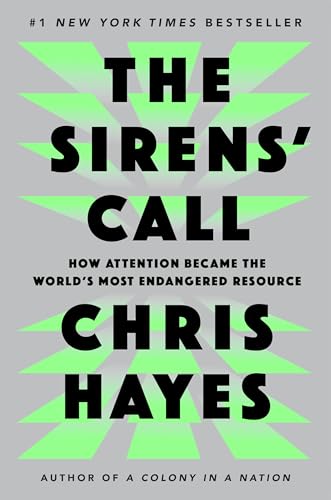
The Sirens' Call
by Chris Hayes · 2025
An MSNBC anchor argues that human attention is now the central commodity of the entire economy, that the industries fighting for it have gotten terrifyingly good at capturing it against our own interests, and that he's watched this happen from inside cable news and social media himself.
Worth reading? Hayes's angle on the attention economy is his own uncomfortable proximity to it: he hosts a cable news show built to capture and hold attention, and he's frank about how that system works from the inside, and how it resembles addiction mechanics more than journalism. His core argument is that attention has become the scarce resource that money, politics, and technology now all compete over, more fundamental than any single platform or app, and that the resulting capture economy is degrading both individual mental health and collective political functioning. It's a well-written, well-argued entry in a now-crowded genre, distinguished mainly by Hayes's insider vantage point and his willingness to indict his own industry, rather than by a wholly new mechanism.
| Full Title | The Sirens' Call: How Attention Became the World's Most Endangered Resource |
|---|---|
| Author | Chris Hayes |
| Published | 2025 |
| Publisher | Penguin Press |
| Category | Sociology & Culture |
The Verdict
Hayes’s version of the attention-economy argument earns its shelf space for one reason: he’s not writing about this from outside. He hosts a cable news show engineered, like every other attention-capture product, to hold your eyes on the screen, and he’s candid, more candid than you’d expect, about how much that mechanism resembles addiction design rather than journalism.
The thesis itself, that attention has replaced money or information as the actual scarce resource driving the modern economy, isn’t brand new territory. You’ve read some version of this in Stolen Focus or Irresistible over the last several years. What Hayes adds is the insider’s willingness to turn the critique on his own industry and, by extension, on himself, rather than pointing only at social media platforms as if cable news is somehow exempt.
The political argument is the sharper contribution: a media system built to capture attention will always reward outrage and conflict over nuance and accuracy, because outrage is what keeps people watching, regardless of which side is generating it. That’s a structural explanation for polarization that doesn’t require either side to be uniquely bad-faith, just responsive to the same incentives everyone else in the system faces.
Read it if you want a media insider’s honest account of how the attention economy actually works from someone paid to compete in it, and a serious argument for why it’s degrading politics along with individual focus.
Skip it if you’ve already read the last few years of attention-economy books and are looking for a fundamentally different mechanism rather than a well-written synthesis with a fresh vantage point. The insider’s honesty is the real reason to pick this one over its predecessors, not novel research.
you want a media insider's honest account of how attention-capture actually works from someone who profits from it professionally, paired with a serious argument for why this is reshaping politics and mental health
you've already read the last decade's other attention-economy books (The Shallows, Stolen Focus, Irresistible) and want fundamentally new mechanics rather than a fresh, well-written synthesis with a media-insider's specific vantage point
Book Summary
Hayes argues that attention itself, not information, not even money directly, has become the central scarce resource of the modern economy, with media, technology, and political industries increasingly built around capturing and monetizing it rather than serving any other stated purpose.
Writing from inside cable news, Hayes draws a direct, self-critical parallel between the mechanics of holding a television or social media audience and the mechanics of behavioral addiction, arguing the industries that compete for attention have converged on the same variable-reward, urgency-driven techniques regardless of whether they're selling news, outrage, or entertainment.
He argues this attention-capture economy has degraded collective political functioning specifically, because a media and political ecosystem optimized for holding attention systematically rewards conflict, novelty, and outrage over the slower, less stimulating work of accurate information and governance.
The book also treats attention capture as a personal and psychological cost, not just a systemic one, arguing that a life lived inside constant attention-capture technology erodes the individual capacity for sustained thought, presence, and even self-knowledge.
Top 7 Lessons from The Sirens' Call
- Attention, not information or even money directly, has become the central scarce resource that media, technology, and political industries now compete to capture and monetize.
- The mechanics of holding a cable news or social media audience closely resemble the mechanics of behavioral addiction -- variable rewards, manufactured urgency, novelty-seeking.
- A media ecosystem optimized to capture attention systematically rewards conflict, outrage, and novelty over the slower, less stimulating work of accurate information and sound governance.
- Hayes argues his own industry, cable news, is not exempt from this critique -- he explicitly implicates the mechanics of his own show in the same attention-capture dynamics he criticizes elsewhere.
- Political polarization is partly a downstream effect of attention economics, not purely ideological: outrage captures attention more reliably than nuance, so the system selects for outrage regardless of political side.
- Constant exposure to attention-capture technology erodes individual capacity for sustained thought and presence, a psychological cost layered on top of the political and informational one.
- The attention economy's business model creates a structural incentive to escalate emotional intensity over time, since yesterday's level of stimulation stops working as a hook.
Frequently Asked Questions
Is The Sirens' Call worth reading?
Yes, particularly for the insider vantage point -- Hayes hosts a cable news show and is unusually candid about how his own industry's attention-capture mechanics work, which gives the argument more bite than an outside observer's version.
What is The Sirens' Call's main argument?
That attention itself has replaced information or even money as the central scarce resource modern media, technology, and political industries compete over, and that the resulting capture economy degrades both individual mental health and collective political functioning.
How is this different from other attention-economy books?
The core mechanics overlap with books like Stolen Focus or Irresistible, but Hayes's distinct contribution is his position as a cable news anchor willing to indict his own industry's role in the same dynamics he's criticizing.
Does the book blame one political side for the attention economy's effects?
No -- Hayes argues the incentive to reward outrage and novelty over nuance is structural to the attention-capture business model itself, and applies across the political spectrum rather than being unique to one side.
Ready to read it?
Get The Sirens' Call on Amazon