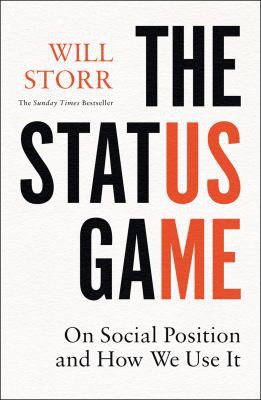
The Status Game
by Will Storr · 2021
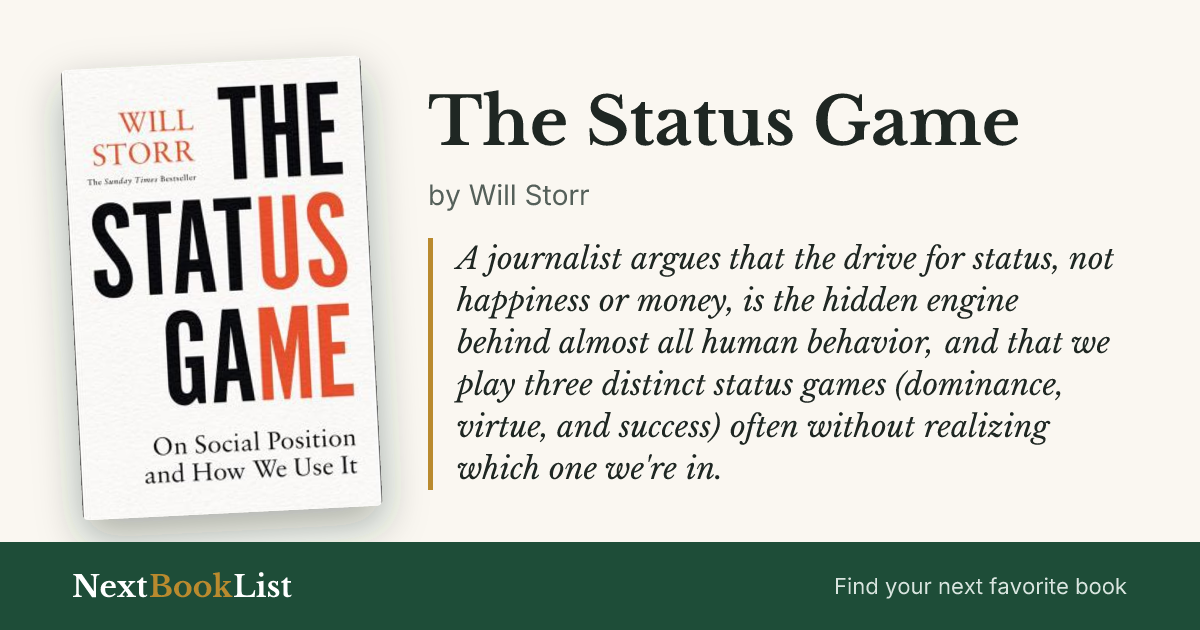
A journalist argues that the drive for status, not happiness or money, is the hidden engine behind almost all human behavior, and that we play three distinct status games (dominance, virtue, and success) often without realizing which one we're in.
Worth reading? Storr's thesis is that status, not wealth or pleasure, is the currency human psychology is actually optimizing for, and he identifies three distinct games people play for it: dominance (status through fear and force), virtue (status through moral standing within a group), and success (status through skill and achievement). The genuinely uncomfortable and useful insight is that virtue games, the ones that feel most moral from the inside (religious purity, political tribes, online activism, cancel culture on any side) can produce some of the ugliest group behavior specifically because participants believe they're above status-seeking, not engaged in it. It's rigorously reported, drawing on psychology, history, and Storr's own interviews, and lands as one of the more genuinely explanatory books about tribalism and moral panic published in recent years.
| Full Title | The Status Game: On Human Life and How to Play It |
|---|---|
| Author | Will Storr |
| Published | 2021 |
| Publisher | Harper Collins |
| Category | Sociology & Culture |
The Verdict
Storr’s premise sounds almost too simple to carry a whole book: status, not happiness, not money, is the thing your brain is actually keeping score on, in every room you walk into. Then he spends three hundred pages proving it’s not simple at all, because there isn’t just one status game. There are three, and most of the conflict in your life comes from people playing different ones at each other without noticing.
The sharpest chapter is the one on virtue games, status won by looking morally pure to your group, because it’s the one that explains behavior otherwise hard to explain. Religious purity spirals, political purity spirals, online pile-ons: different targets, same mechanic. People escalate because in a virtue game, standing still looks like backsliding, and because everyone involved sincerely believes they’re motivated by principle, not status. That’s what makes virtue games uglier than dominance games. Nobody thinks they’re the bully.
Read it if you want a genuinely useful lens for the last decade of online tribalism, cancel culture, and political sorting, one that applies the same mechanism regardless of which side is doing it. It’s rare to find a book on this territory that doesn’t quietly flatter one political tribe while diagnosing the other, and Storr mostly manages it.
Skip it if you want a self-help book with an exit plan. The honest, slightly bleak takeaway here is that you can’t fully leave the status game, you can only get better at noticing which one you’re in and choosing the least destructive version available to you. If you need a program with five steps and a happy ending, this isn’t it. If you want to actually understand why smart, well-meaning people keep tearing each other apart over things that look small from outside the group, it’s one of the better books written on the subject.
you want a sharp, well-researched lens for understanding why people behave irrationally in status-obsessed environments (offices, social media, politics, religion, activism), including your own behavior
you're looking for a self-help book with a clean action plan -- this is descriptive social psychology and cultural history, not a program, and its most uncomfortable insight is that you can't fully opt out of the game, only choose which version you play
Book Summary
Storr argues that status, not happiness, money, or even survival directly, is the core drive underlying most human social behavior, and that humans are hardwired to constantly, often unconsciously, track their relative standing within every group they belong to.
He identifies three distinct "status games": dominance games (status won through fear, force, and intimidation), virtue games (status won through perceived moral or ideological purity within a group), and success games (status won through demonstrated skill or achievement), arguing most real-world conflict comes from people playing different games without recognizing it, or playing the same game with incompatible rules.
The book's sharpest and most uncomfortable argument concerns virtue games specifically: because virtue-game players believe their status-seeking is actually principled moral action, they're often less self-aware about their own status-seeking than dominance or success players, which Storr argues explains the particular cruelty and purity-spiraling seen in religious persecution, political tribalism, and online callout culture across the political spectrum.
Storr draws on psychology research, historical case studies (from witch trials to cult dynamics to modern social media pile-ons), and his own reporting to argue that understanding which status game is actually being played, in a workplace conflict, an online controversy, a political movement, is more explanatory than any single ideology's own account of what's happening.
Top 8 Lessons from The Status Game
- Status, not happiness or wealth directly, is the underlying currency most human social behavior is actually optimizing for, according to Storr's synthesis of psychology research.
- There are three distinct status games -- dominance (fear and force), virtue (moral standing), and success (skill and achievement) -- and most social conflict comes from people playing different games without realizing it.
- Virtue games are the most dangerous precisely because their players believe they're acting on pure principle rather than status-seeking, which removes the self-awareness that might otherwise check the behavior.
- Purity spirals (in religious communities, political movements, or online activism) follow a predictable pattern: virtue-signaling escalates because standing still relative to the group looks like backsliding.
- You cannot fully opt out of status games -- even claiming to be above status-seeking is itself a status move within a virtue game.
- Groups implicitly punish members who try to exit the group's status game rather than compete within its rules, which is why leaving a tribe (religious, political, professional) often costs more socially than losing within it.
- Success games are the least destructive of the three because they're the most transparently and objectively measurable, which limits (though doesn't eliminate) the ambiguity that fuels dominance and virtue conflicts.
- Recognizing which status game is actually in play during a conflict -- a workplace dispute, an online pile-on, a political rift -- is more explanatory of the actual behavior than any side's stated ideology.
Frequently Asked Questions
Is The Status Game worth reading?
Yes -- it's one of the sharper, better-researched explanations available for why modern tribalism, cancel culture, and moral panics on any side of the spectrum happen, and it applies to your own behavior, not just other people's.
What are the three status games in the book?
Dominance (status through fear and force), virtue (status through perceived moral or ideological purity), and success (status through demonstrated skill or achievement) -- Storr argues most conflict comes from people playing different games, or the same game by incompatible rules.
Why does the book say virtue games are the most dangerous?
Because participants in a virtue game believe they're acting from pure moral principle rather than status-seeking, which removes the self-awareness that might otherwise limit escalation -- explaining purity spirals from historical witch trials to modern online pile-ons.
Is The Status Game politically biased?
Storr applies the framework across the political spectrum -- religious purity movements, left-coded online activism, and right-coded tribalism all get treated as instances of the same underlying virtue-game mechanic, rather than singling out one side.
Does the book offer a way to escape status games?
Not really, and it says so honestly -- the book's most useful move is descriptive, not prescriptive. You can't fully opt out of status-seeking, but you can get better at recognizing which game you're actually in.
Ready to read it?
Get The Status Game on Amazon