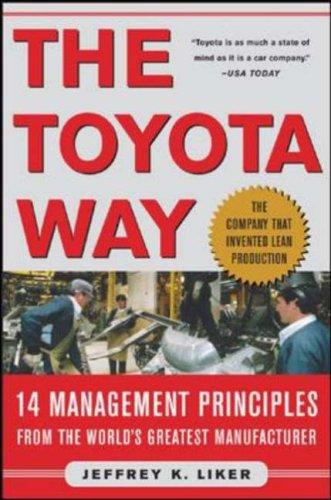
The Toyota Way
by Jeffrey K. Liker · 2004
Toyota didn't win with a better car. It won with a better way of thinking about work.
Worth reading? The Toyota Way is the source text lean startup culture keeps quoting without reading. Liker's 14 principles are what Eric Ries's The Lean Startup borrowed and shrank down for software teams, but Liker's version is deeper, slower, and built for physical production lines, not MVPs. Read The Toyota Way if you actually run operations or manufacturing and want the real system, not the diluted 'build-measure-learn' version. Skip it if you want something you can finish on a flight -- this is a dense, academic book, not a quick-start guide.
| Full Title | The Toyota Way: 14 Management Principles from the World's Greatest Manufacturer |
|---|---|
| Author | Jeffrey K. Liker |
| Published | 2004 |
| Publisher | McGraw-Hill |
| Category | Business & Money |
| Favorite quote | “Base your management decisions on a long-term philosophy, even at the expense of short-term financial goals.” |
The Verdict
Liker wasn’t hired by Toyota to write a puff piece – he’s an industrial engineering professor who spent years inside their plants trying to figure out why nobody could successfully copy their system despite Toyota publishing plenty of it openly. The answer, laid out here, is that companies copy the tools and skip the philosophy underneath them.
you run operations, manufacturing, or any process and want the real source of 'lean,' not the diluted consultant version
you just want a quick lean checklist -- this is a deep, academic dive into 14 principles, not a quick-start guide
Book Summary
Liker spent two decades studying Toyota and distills it into 14 principles across four categories he calls the 4 Ps: philosophy, process, people and partners, and problem solving. The core philosophy principle is long-term thinking over short-term financial results -- base management decisions on a long-term philosophy, even at the expense of short-term financial goals.
The process principles are what most companies actually copy, and usually botch: create continuous flow, use pull systems to avoid overproduction, level the workload (heijunka), stop and fix problems immediately (jidoka), standardize tasks, use visual controls, and only adopt reliable, thoroughly tested technology. Most "lean" programs stop here and call it done.
The people and problem-solving principles are what most companies skip, and Liker argues they're the actual engine: grow leaders who live the philosophy, develop exceptional people and teams, respect and challenge your partners and suppliers, go see the problem yourself (genchi genbutsu), make decisions slowly by consensus but implement rapidly, and become a learning organization through relentless reflection (hansei) and continuous improvement (kaizen).
Top 12 Lessons from The Toyota Way
- Base decisions on long-term philosophy, even against short-term financial pressure.
- Create continuous flow to surface problems instead of hiding them in inventory.
- Use pull systems -- produce to actual demand, not forecasts.
- Level the workload (heijunka) instead of batching it into spikes.
- Stop production the moment a problem is found (jidoka) -- quality first, output second.
- Standardize tasks as the foundation for improvement, not as bureaucracy.
- Go see the actual problem yourself (genchi genbutsu) instead of trusting a report.
- Grow leaders from inside who live and teach the philosophy.
- Respect your suppliers and partners enough to challenge them to improve.
- Make decisions slowly, by consensus, then implement fast.
- Reflect honestly on failures (hansei) to fuel continuous improvement (kaizen).
- Adopt new technology only once it's proven reliable -- never chase it for its own sake.
Top 4 Quotes from The Toyota Way
"Base your management decisions on a long-term philosophy, even at the expense of short-term financial goals."
Jeffrey K. Liker, The Toyota Way
"Create a culture of stopping to fix problems, to get quality right the first time."
Jeffrey K. Liker, The Toyota Way
"Go and see for yourself to thoroughly understand the situation (genchi genbutsu)."
Jeffrey K. Liker, The Toyota Way
"Become a learning organization through relentless reflection (hansei) and continuous improvement (kaizen)."
Jeffrey K. Liker, The Toyota Way
Frequently Asked Questions
Is The Toyota Way worth reading?
Yes, if you run operations, manufacturing, or any repeatable process and want the original system behind 'lean,' not the shrunk-down software version. Skip it if you just want a quick checklist -- this is a dense, academic study, not a weekend read.
What are the 14 principles in The Toyota Way?
They break into four groups: long-term philosophy, the right process (continuous flow, pull systems, leveling, built-in quality, standardization, visual controls, proven technology), developing people and partners, and continuous problem solving (genchi genbutsu, consensus decisions, kaizen).
Is The Toyota Way the same as Lean or Six Sigma?
It's the source Lean drew from, but broader. Lean methodology usually extracts the process tools (flow, pull, kaizen); The Toyota Way insists those tools don't work without the long-term philosophy and people-development principles underneath them.
Does The Toyota Way apply outside manufacturing?
Many of the process principles have been adapted for software and services (this is where Lean Startup borrows from), but the book's own case studies and depth are built for physical production -- expect to do some translation work if you're not running a factory floor.
Ready to read it?
Get The Toyota Way on Amazon