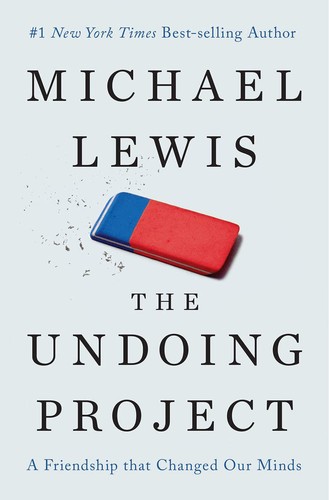
The Undoing Project
by Michael Lewis · 2016
The friendship between two psychologists that quietly rewired how economics understands human decision-making.
Worth reading? Unlike Flash Boys or The Big Short, which are about systems and money, The Undoing Project is a character study -- specifically, the intense, difficult friendship between Daniel Kahneman and Amos Tversky, the two psychologists whose work founded behavioral economics. If you want the ideas (loss aversion, anchoring, prospect theory) in their purest, most citable form, read Kahneman's own Thinking, Fast and Slow. Lewis's book is the story of how those ideas got made, and why the partnership that made them eventually fell apart. Read it if you're more interested in how two people think together than in a checklist of biases. Skip it if you already know the concepts cold and just want application -- this book is light on "here's how to use loss aversion in your own decisions" and heavy on the relationship that produced the theory.
| Full Title | The Undoing Project: A Friendship That Changed Our Minds |
|---|---|
| Author | Michael Lewis |
| Published | 2016 |
| Publisher | W. W. Norton & Company |
| Category | Business & Money |
| Favorite quote | “It was almost as if they were the same person, split in two.” |
The Verdict
Lewis usually writes about markets and outsiders who see the truth first. Here the market is academic psychology, and the outsiders are two men who couldn’t work with anyone else the way they worked with each other – until, eventually, they couldn’t work together either.
you want the human story behind behavioral economics -- the collaboration, not just the concepts
you already want the concepts straight from the source -- read Kahneman's own Thinking, Fast and Slow instead
Book Summary
Kahneman and Tversky's collaboration produced the foundational insight of behavioral economics: humans don't reason like the rational actors classical economics assumes. Instead, we rely on mental shortcuts -- heuristics -- that are usually useful but predictably fail in specific, identifiable ways, from anchoring on irrelevant numbers to weighing losses roughly twice as heavily as equivalent gains.
Lewis frames their partnership itself as the real subject: two men with radically different temperaments and thinking styles -- Tversky confident and quick, Kahneman anxious and doubt-ridden -- who did their best work by arguing every idea into shape together, to the point that colleagues couldn't tell whose idea was whose.
The book is also a quiet tragedy about how even history-making creative partnerships have a shelf life. Credit disputes, differing needs for recognition, and simple exhaustion eventually pulled the two apart, right around the time their work was gaining the wider recognition it deserved.
Top 10 Lessons from The Undoing Project
- Humans rely on mental shortcuts (heuristics) that are usually useful but fail in specific, predictable ways.
- Loss aversion means people weigh losses roughly twice as heavily as equivalent gains.
- Anchoring means an irrelevant number seen first can skew a later, unrelated judgment.
- Prospect theory replaced the assumption of a purely rational economic actor with a model of how people actually decide under risk.
- The best creative partnerships often work because two very different temperaments argue every idea into shape together.
- Tversky's confidence and Kahneman's self-doubt were complementary, not just contrasting, working styles.
- Even foundational, field-defining collaborations can fracture over credit and recognition.
- Original thinking often requires two people arguing an idea apart before it's strong enough to survive contact with critics.
- The gap between how people think they decide and how they actually decide is where behavioral economics lives.
- A field-founding partnership isn't always a happy one -- these two barely spoke for years by the end.
Top 1 Quotes from The Undoing Project
"It was almost as if they were the same person, split in two."
Michael Lewis, The Undoing Project
Frequently Asked Questions
Is The Undoing Project worth reading?
Yes, if you want the human story behind behavioral economics, not just the concepts. Skip it if you want the ideas alone -- go to Kahneman's own Thinking, Fast and Slow for that.
What is the main idea of The Undoing Project?
It's the story of Daniel Kahneman and Amos Tversky's friendship and collaboration, which produced the core insights behind behavioral economics, and how that partnership eventually broke down.
Who should read The Undoing Project?
Anyone curious about how Kahneman and Tversky actually worked together, or anyone who likes Lewis's outsider-who-sees-the-truth-first storytelling applied to psychology instead of finance.
Should I read this or Thinking, Fast and Slow first?
If you want the concepts to actually use, start with Thinking, Fast and Slow. Come to The Undoing Project after, for the story of how those concepts were built.
Ready to read it?
Get The Undoing Project on Amazon