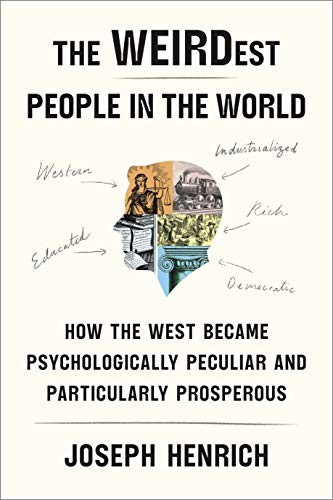
The WEIRDest People in the World
by Joseph Henrich · 2020
A Harvard evolutionary biologist argues that people from Western, educated, industrialized, rich, democratic societies (WEIRD, for short) aren't the psychological default for humanity -- they're the outlier, and a specific medieval church policy is why.
Worth reading? Henrich's argument is that WEIRD psychology -- individualistic, guilt-driven, analytically minded, trusting of strangers -- isn't the species baseline researchers have long treated it as. It's a historical accident, and he traces it to the medieval Catholic Church's marriage and family policies (banning cousin marriage, polygamy, and clan-based inheritance), which he argues dismantled Europe's extended kin networks and pushed people toward voluntary associations, guilds, and impersonal trust. It's a genuinely bold thesis backed by an enormous amount of comparative data, but the book asks a lot of its reader -- this is closer to a textbook with a thesis than a breezy narrative.
| Full Title | The WEIRDest People in the World: How the West Became Psychologically Peculiar and Particularly Prosperous |
|---|---|
| Author | Joseph Henrich |
| Published | 2020 |
| Publisher | Farrar, Straus and Giroux |
| Category | Sociology & Culture |
The Verdict
Henrich’s pitch is simple to state and hard to prove: the psychology you probably think of as “normal human nature” – guilt over shame, individual over clan, analysis over context – is actually a weird historical accident, and he’s got seven hundred pages of cross-cultural data to back it up.
The mechanism he lands on is genuinely surprising. Not colonialism, not capitalism, not the Enlightenment. A medieval Church policy banning cousin marriage and polygamy, which broke apart Europe’s extended kin clans a thousand years before anyone wrote about individualism as a philosophy. Once clans stopped being the unit that organized your whole life, Europeans built voluntary institutions instead – guilds, universities, charter towns – and those institutions trained people to trust and cooperate with strangers. That trained psychology, Henrich argues, is what eventually made markets, democracy, and the Industrial Revolution possible.
Read it if you want a real explanatory theory instead of just a description of cultural difference. Most books that tell you “the West thinks differently” stop at description. This one tries to explain why, with a specific historical mechanism and centuries of comparative data to test it against.
Skip it if you’re looking for something you can finish in a weekend. This is closer to reading a very good academic monograph than a magazine-length pop-science book – the payoff is real, but it asks for real time and patience with data-heavy chapters. If you just want the headline thesis, you can get 80% of it from a good long-form review or the book’s own introduction and skip the middle three hundred pages.
One more honest caveat: Henrich’s thesis is influential but not uncontested. Some historians and anthropologists have pushed back on how much causal weight a single Church policy can bear, and on how cleanly “WEIRD vs. non-WEIRD” maps onto messier historical reality. Treat it as a compelling, well-argued hypothesis, not a settled fact.
you want a genuinely new explanation for why Western psychology (individualism, guilt over shame, analytic over holistic thinking) looks so different from most of human history and most of the world today
you want a breezy pop-science read -- this is 700-plus pages of anthropology, economic history, and cross-cultural psychology data, dense even by the standards of academic trade nonfiction

Book Summary
Most psychology research treats WEIRD subjects (overwhelmingly American undergraduates) as representative of "human nature," when cross-cultural data shows WEIRD populations are psychological outliers on measures like individualism vs. collectivism, analytic vs. holistic reasoning, guilt vs. shame orientation, and trust in strangers versus trust only in kin.
Henrich traces this divergence to the medieval Catholic Church's "Marriage and Family Program" -- policies banning cousin marriage, polygamy, remarriage to a dead spouse's relative, and adoption as inheritance workaround -- which he argues systematically weakened Europe's intensive kin-based clans starting around 500 AD, centuries before the Industrial Revolution or the Enlightenment.
With extended kinship networks weakened, Europeans increasingly formed voluntary associations -- guilds, universities, charter towns, and self-governing institutions -- built on impersonal trust and cooperation among non-relatives, which Henrich argues seeded the psychological and institutional preconditions for markets, democracy, and eventually the Industrial Revolution.
The book's second half applies this framework broadly, arguing that differences in analytic vs. holistic thinking, self-concept, and moral reasoning across societies today are downstream of how intensive or loose a society's traditional kinship structures were, not fixed racial or cultural essences.
Top 9 Lessons from The WEIRDest People in the World
- WEIRD psychology (individualist, guilt-based, analytically minded) is a historical outlier, not the human default -- most of history and most living humans think more holistically and collectively.
- The medieval Catholic Church's ban on cousin marriage and polygamy dismantled intensive kin-based clans across Europe, starting centuries before the Enlightenment.
- Weakened kinship networks pushed Europeans toward voluntary, non-kin institutions -- guilds, charter towns, universities -- built on trust among strangers rather than trust only within family.
- Trust in strangers (impersonal trust) is a specific psychological adaptation, not automatic -- it had to be culturally built, and most societies historically didn't build it.
- Analytic thinking (categorizing objects by shared properties) versus holistic thinking (categorizing by relationships and context) tracks measurably with how kin-based a society's traditional structure was.
- Guilt cultures (bad behavior violates an internalized standard) and shame cultures (bad behavior damages your standing with a specific group) are different psychological equilibria, not moral maturity levels.
- Cultural evolution can outpace genetic evolution in shaping widespread psychological traits across a population within centuries, not millennia.
- Much of psychology's claimed 'universal' findings about cognition, fairness, and cooperation don't replicate outside WEIRD populations, which undermines a lot of textbook psychology's generalizability.
- Voluntary associations (universities, guilds, joint-stock companies) function as psychological training grounds for cooperating with strangers, which in turn make markets and impersonal institutions viable.
Frequently Asked Questions
Is The WEIRDest People in the World worth reading?
Yes, if you want a genuinely novel, well-evidenced explanation for why Western psychology looks so different from the rest of the world and most of history. It's a serious commitment though -- over 700 pages of dense argument, not a quick read.
What does WEIRD stand for in the book?
Western, Educated, Industrialized, Rich, Democratic -- Henrich's shorthand for the population psychology research has treated as the human default, when it's actually a statistical and historical outlier.
What is Henrich's main argument?
That the medieval Catholic Church's marriage and family policies -- banning cousin marriage and polygamy -- broke up Europe's kin-based clans, and that this, not the Enlightenment or Industrial Revolution, is the root cause of WEIRD individualist psychology.
Is this book hard to read?
It's long and dense -- written by an academic for a general but serious audience. If you want the thesis without the full data walkthrough, expect to skim; if you want the evidence, budget real time.
Ready to read it?
Get The WEIRDest People in the World on Amazon