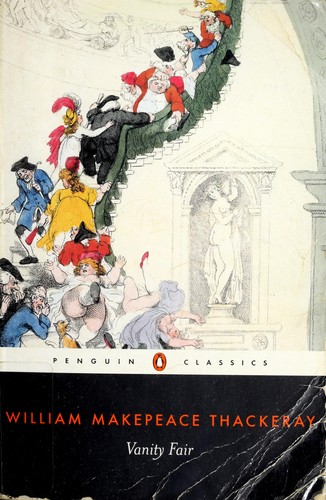
Vanity Fair
by William Makepeace Thackeray · 1848
Becky Sharp claws her way up Regency society on wit and nerve alone, and two centuries later she's still more fun to read than anyone trying to stop her.
Worth reading? Vanity Fair beats most 19th-century social satire because Thackeray refuses to let anyone off the hook, hero, heroine, or reader. If you want a Regency novel with a genuinely good person at the center, read Austen instead. If you want to watch ambition and hypocrisy get equal-opportunity mockery for 800 pages, narrated by a author who keeps reminding you it's all a puppet show, start here.
| Full Title | Vanity Fair: A Novel without a Hero |
|---|---|
| Author | William Makepeace Thackeray |
| Published | 1848 |
| Publisher | Penguin Classics |
| Category | Fiction |
| Favorite quote | “The world is a looking-glass, and gives back to every man the reflection of his own face.” |
The Verdict
What holds up isn’t the plot machinery, it’s Becky Sharp herself. She’s one of the first anti-heroines in English fiction who’s genuinely more compelling than the “good” characters around her, and Thackeray knows it, letting her outwit nearly everyone for 800 pages without ever fully condemning or excusing her.
Read this instead of a straight Austen novel when you want the marriage-market satire with more cynicism and less romance. Thackeray isn’t interested in rewarding virtue, he’s interested in showing you that the whole game is rigged, and that the people who play it best are rarely the people you’d want to be.
you want satire with real teeth, a novel that mocks its own heroine's ambition and the society that rewards it in equal measure
you need a likable protagonist and a tidy happy ending, this book refuses both on purpose
Book Summary
The novel follows two contrasting women through Regency-era English society: Becky Sharp, poor, clever, and ruthlessly ambitious, and Amelia Sedley, wealthy, gentle, and almost entirely passive. Becky claws her way toward money and status through charm and manipulation; Amelia waits, suffers, and gets rewarded for very little of it.
Thackeray isn't really attacking Becky's immorality. He's attacking the entire society that manufactures the conditions she's exploiting, a marriage market dressed up as romance, a class system dressed up as virtue. The title, borrowed from Bunyan's Pilgrim's Progress, names English high society itself as the fair: a marketplace of vanity where everyone is for sale.
The narrator keeps breaking in to remind you this is a puppet show, that there's no hero here, that he's just the man managing the strings. That structural cynicism is the point. Nobody, virtuous or scheming, escapes the author's judgment, and nobody gets a clean ending either.
Top 10 Lessons from Vanity Fair
- Becky Sharp rises from poverty to high society through wit, charm, and ruthless self-interest, with no capital except her own cleverness.
- Amelia Sedley's passive goodness gets her almost nothing, Thackeray refuses to reward pure virtue with a happy outcome.
- The title, taken from Bunyan's Pilgrim's Progress, frames English high society as a marketplace of vanity dressed up as respectability.
- The narrator addresses readers directly, calling the cast puppets and denying them a conventional hero, on purpose.
- Marriage functions as the era's central financial transaction, and the novel treats it that way from the first proposal to the last.
- Becky's manipulation of Rawdon Crawley, Lord Steyne, and Jos Sedley shows how thin the line is between social charm and outright deception.
- The Battle of Waterloo happens mostly offstage, a reminder that national history barely interrupts the characters' small, selfish concerns.
- Money, far more than morality, determines who gets forgiven and who gets shunned by this society.
- William Dobbin's decades of quiet, unrequited loyalty to Amelia undercuts the idea that patient devotion is automatically rewarded.
- By the end nobody, Becky included, gets a clean resolution, success and failure land almost arbitrarily.
Top 4 Quotes from Vanity Fair
"The world is a looking-glass, and gives back to every man the reflection of his own face."
William Makepeace Thackeray, Vanity Fair
"Ah! Vanitas Vanitatum! which of us is happy in this world? Which of us has his desire? or, having it, is satisfied?"
William Makepeace Thackeray, Vanity Fair
"Vanity Fair is a very vain, wicked, foolish place, full of all sorts of humbugs and falsenesses and pretensions."
William Makepeace Thackeray, Vanity Fair
"The moral world has no particular objection to vice, but an insuperable repugnance to hearing vice called by its proper name."
William Makepeace Thackeray, Vanity Fair
Frequently Asked Questions
Is Vanity Fair worth reading?
Yes, if you want the sharpest satire of Regency-era social climbing ever written, and don't mind that nobody in it is really likable. Skip it if you want a warm, conventional heroine.
What is Vanity Fair about?
It follows Becky Sharp, a poor but brilliant social climber, and her wealthy but passive friend Amelia Sedley through marriage, war, and social ambition in early 19th-century England, narrated by a author who insists there's no hero in the story.
Is Vanity Fair hard to read?
It's long (over 800 pages) and Victorian in its sentence structure, but the satire is sharp and the pace picks up once Becky starts scheming, it reads faster than its length suggests.
Who is the main character of Vanity Fair?
Becky Sharp is the closest thing the novel has to a protagonist, though Thackeray subtitled it 'A Novel without a Hero' on purpose, refusing to give either her or Amelia Sedley an uncomplicated claim to that role.
Ready to read it?
Get Vanity Fair on Amazon