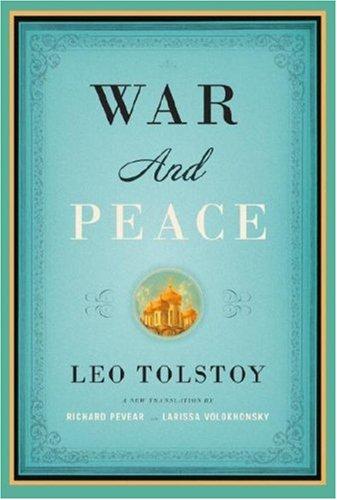
War and Peace
by Leo Tolstoy · 1869
Napoleon invades Russia, five aristocratic families live through it, and Tolstoy uses all 1,200 pages to argue that history isn't actually driven by great men.
Worth reading? War and Peace has survived a century and a half because Tolstoy pulls off something almost no one else has: a genuinely epic scope (Napoleon's invasion of Russia) told through characters small and flawed enough to feel real. It beats other 'big Russian novel' entry points because the war sections and the domestic sections both work, instead of one propping up the other. Skip it only if you truly can't tolerate the historical-essay digressions -- they're not optional in the full text.
| Full Title | War and Peace (Pevear & Volokhonsky Translation) |
|---|---|
| Author | Leo Tolstoy |
| Published | 1869 |
| Publisher | Vintage Classics |
| Category | Fiction |
| Favorite quote | “We can know only that we know nothing. And that is the highest degree of human wisdom.” |
The Verdict
The war sections get the reputation, but the domestic scenes – Natasha’s first ball, Pierre’s aimless wandering through Moscow society – are just as essential to what Tolstoy’s doing. He’s arguing that ordinary life carries the same historical weight as battles, and the structure of the book only works if you buy into both halves.
Go in for Pierre, Andrei, and Natasha, and let the historical-essay chapters slow you down on purpose. This isn’t a book to rush – it rewards the reader willing to sit in it for weeks, not days.
you want the single biggest, most ambitious novel in the Western canon, and you're willing to track a large cast through war, marriage, and a genuine philosophical argument about how history works
you want a tight, plot-driven war novel -- Tolstoy periodically stops the story entirely for essay-length arguments about historical causation, and the unabridged text does not skip these
Book Summary
The novel follows several interconnected Russian aristocratic families -- the Rostovs, the Bolkonskys, the Bezukhovs -- through the Napoleonic Wars, especially the 1812 French invasion of Russia. Pierre Bezukhov's search for meaning, Prince Andrei's disillusionment with glory, and Natasha Rostov's growth from impulsive girl to mature woman are the emotional core running through the historical sweep.
Tolstoy's real argument, stated outright in the novel's later sections, is that history isn't driven by great men making decisive choices -- it's the aggregate result of millions of small individual actions that no single leader, including Napoleon, actually controls. The novel keeps deflating Napoleon's supposed genius by showing how little control any commander actually has once a battle starts.
Peace sections aren't a break from the war sections -- they're the other half of the same argument. Salons, marriages, and inheritance disputes get the same careful, unsentimental attention as battles, because Tolstoy is making the case that ordinary domestic life is just as historically real and consequential as war.
Top 8 Lessons from War and Peace
- Pierre Bezukhov's arc, from directionless heir to prisoner of war to a man who finds meaning in ordinary life, is the novel's clearest argument that meaning comes from simple, direct experience rather than grand ambition.
- Prince Andrei's disillusionment after being wounded at Austerlitz (staring at the sky and realizing how small his ambitions for glory were) reframes the entire novel's attitude toward military heroism.
- Napoleon is repeatedly shown making decisions that have little actual effect on the battles he supposedly commands -- Tolstoy uses this to argue against the 'great man' theory of history.
- Natasha Rostov's arc, from impulsive romantic near-ruin with Anatole Kuragin to mature partnership, tracks personal growth on the same scale the novel gives historical events.
- The Battle of Borodino is depicted through confusion and chaos rather than clear strategy, reinforcing Tolstoy's argument that no commander truly controls a battle once it starts.
- Kutuzov, the Russian general, is portrayed positively precisely because he does less -- Tolstoy frames his patience and refusal to force events as wiser than Napoleon's aggressive control.
- The burning of Moscow is framed as an act with no single clear author -- neither fully a Russian strategy nor fully a French accident -- reinforcing the novel's thesis about diffused historical causation.
- Tolstoy's epilogue essays argue directly that free will and historical determinism coexist uncomfortably, and that individual choices matter less to outcomes than people like to believe.
Top 4 Quotes from War and Peace
"We can know only that we know nothing. And that is the highest degree of human wisdom."
Leo Tolstoy, War and Peace
"There is no greatness where there is not simplicity, goodness, and truth."
Leo Tolstoy, War and Peace
"The strongest of all warriors are these two -- Time and Patience."
Leo Tolstoy, War and Peace
"If everyone fought for their own convictions there would be no war."
Leo Tolstoy, War and Peace
Frequently Asked Questions
Is War and Peace worth reading?
Yes, if you want the most ambitious novel in the Western canon and are willing to commit to it. The domestic and war sections both work, which is rarer than it sounds for a book this size.
How long is War and Peace?
The unabridged translations run over 1,200 pages, with a large cast to track across roughly a decade of Russian history.
Do I need to know Russian history to read War and Peace?
No -- Tolstoy explains the Napoleonic Wars context as the story unfolds, though a basic sense of the 1805-1812 period helps the historical essays land.
What is the main theme of War and Peace?
Whether history is driven by great individual leaders or by the aggregate of countless small human choices -- Tolstoy argues firmly for the latter.
Ready to read it?
Get War and Peace on Amazon