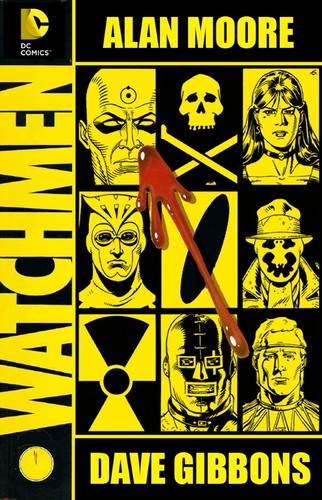
Watchmen
by Alan Moore and Dave Gibbons · 1987
A washed-up masked vigilante's murder unravels into a conspiracy to save the world by nuking millions of New Yorkers -- the graphic novel that proved comics could carry literary weight.
Worth reading? Watchmen is still the best answer to 'can comics be literature,' and decades of imitators -- most of them just aping the grimness without the formal rigor -- haven't topped it. If you want superhero deconstruction with more humor, try The Boys; if you want more of Moore's own work after this, From Hell is bleaker still. Watchmen remains the one to actually start with.
| Author | Alan Moore and Dave Gibbons |
|---|---|
| Published | 1987 |
| Publisher | DC Comics |
| Category | Fiction |
| Favorite quote | “I'm not locked in here with you. You're locked in here with me.” |
The Verdict
What holds up best after this many imitators is the craft, not just the cynicism – the nine-panel grid, the interlocking timelines, the pirate comic running underneath the main story as commentary. Most “dark” superhero comics since have copied the mood and skipped the structure. Read this before any of them.
you want the superhero deconstruction every 'grim and gritty' comic since has been chasing, with a formal structure (the nine-panel grid, the pirate comic-within-a-comic) that rewards close, slow reading
you want a fun, uncomplicated superhero story -- Watchmen is bleak and morally ambiguous by design, and it's a bad first comic to hand someone new to the medium
Book Summary
Moore and Gibbons deconstruct the superhero by making costumed vigilantes messy, damaged, and morally compromised people instead of idealized heroes -- washed-up, retired, or quietly unstable adults who never stopped needing to put on a mask.
The book's central ethical question sits with Ozymandias: he engineers a fake alien attack that kills millions of New Yorkers in order to unite the world against a common enemy and avert full nuclear war. Whether that "greater good" math justifies mass murder is left for the reader to sit with, not resolve.
Formally, the nine-panel grid gives the book a rigid visual discipline that makes the rare full-page splash land much harder, and the recurring blood-stained smiley face ties the cynicism of the opening murder to the moral rot running through the whole story.
Top 10 Lessons from Watchmen
- The story opens with the murder of the Comedian, a violent ex-hero, which unravels into a much larger conspiracy.
- Rorschach's absolutist, unwavering morality makes him the story's most quotable and most disturbing character.
- Doctor Manhattan's godlike powers isolate him from humanity as he increasingly experiences time non-linearly and loses touch with human concerns.
- Ozymandias fakes an alien invasion, killing millions in New York, to unite the world against a common enemy and avert nuclear war.
- The pirate comic 'Tales of the Black Freighter,' read by a background character, mirrors and comments on the main plot's themes of complicity and self-justification.
- The blood-stained smiley face becomes the book's central visual symbol, tying the Comedian's cynicism to the whole story's moral rot.
- Nite Owl and Silk Spectre's romance and eventual return to costumed vigilantism suggest the addictive, identity-defining pull of being a hero.
- The book ends on an ambiguous note -- Rorschach's journal, which could expose Ozymandias's plot, sits in a newspaper office's crank-submissions pile.
- Moore and Gibbons use a rigid nine-panel grid throughout, a formal discipline that makes the rare full-page splash hit much harder.
- The book interrogates whether 'who watches the Watchmen' applies to any power structure, not just costumed vigilantes.
Top 5 Quotes from Watchmen
"I'm not locked in here with you. You're locked in here with me."
Alan Moore and Dave Gibbons, Watchmen
"Never compromise. Not even in the face of Armageddon."
Alan Moore and Dave Gibbons, Watchmen
"The world will look up and shout 'Save us!'... and I'll look down and whisper 'No.'"
Alan Moore and Dave Gibbons, Watchmen
"Nothing ends, Adrian. Nothing ever ends."
Alan Moore and Dave Gibbons, Watchmen
"Dog carcass in alley this morning, tire tread on burst stomach."
Alan Moore and Dave Gibbons, Watchmen
Frequently Asked Questions
Is Watchmen worth reading?
Yes -- it's the graphic novel that proved comics could carry real literary weight, and its formal structure (the nine-panel grid, the comic-within-a-comic) still hasn't been topped.
Is Watchmen a good first comic book?
No. It's a deconstruction of a genre it assumes you already understand, and the tone is bleak by design. Read some straightforward superhero comics first if you're new to the medium.
What is Watchmen about?
The murder of a retired vigilante unravels into a conspiracy by one of the world's smartest men to prevent nuclear war by faking an alien attack that kills millions of New Yorkers.
Do I need to see the movie or the show first?
No -- the original graphic novel stands completely on its own and is generally considered stronger than either adaptation.
Ready to read it?
Get Watchmen on Amazon