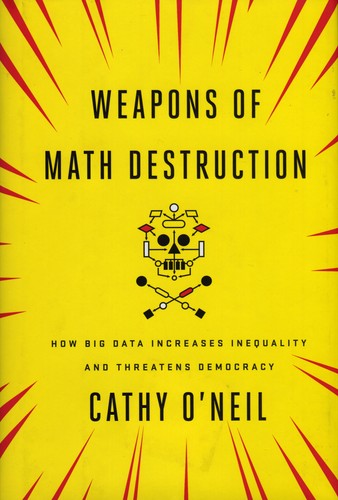
Weapons of Math Destruction
by Cathy O'Neil · 2016
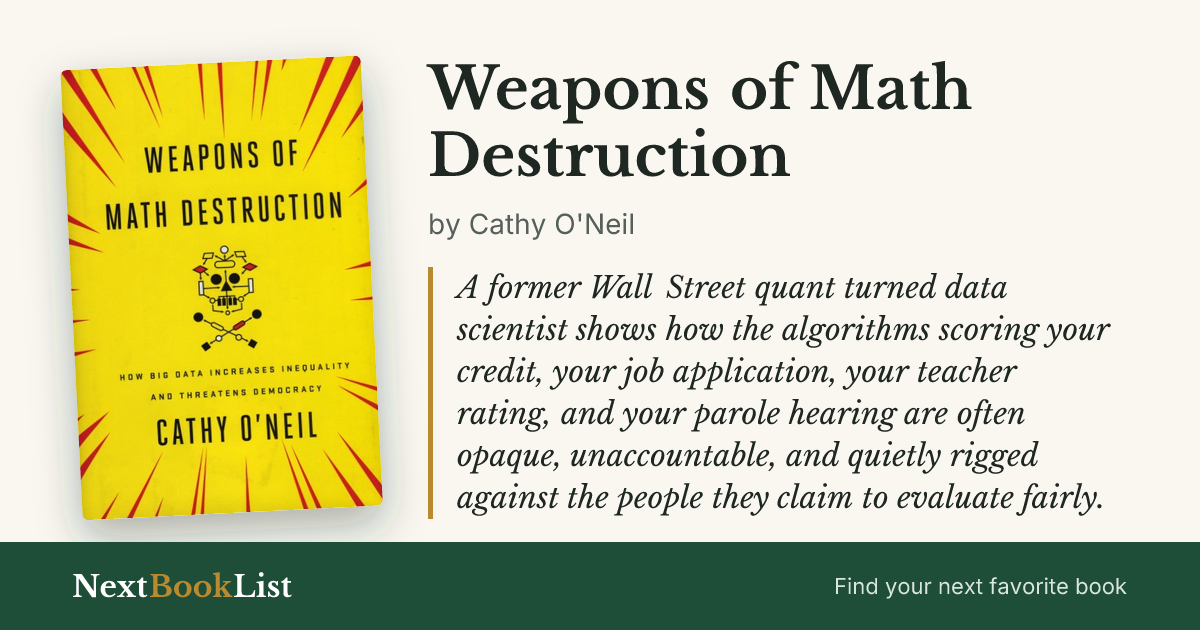
A former Wall Street quant turned data scientist shows how the algorithms scoring your credit, your job application, your teacher rating, and your parole hearing are often opaque, unaccountable, and quietly rigged against the people they claim to evaluate fairly.
Worth reading? O'Neil's core move is naming a category most people don't have a word for: the 'WMD,' a mathematical model that is opaque (nobody can inspect why it made a decision), unaccountable (nobody outside the company can challenge it), and destructive at scale (it damages real lives, and does so disproportionately to the poor). She's not anti-algorithm -- she's a former quant who ran models for a hedge fund and worked in ad tech, and the book is sharpest exactly because she knows how these systems get built and where the shortcuts happen. Case by case (teacher value-added scores, recidivism risk models, payday-loan targeting, insurance pricing), she shows the same pattern: a flawed proxy stands in for something hard to measure, the model gets treated as objective because it's math, and the people it scores have no way to see or contest it. It's a 2016 book and some of her specific examples (a particular hiring tool, a particular recidivism algorithm) have since been retired or revised, but the underlying argument about opacity and accountability has only gotten more relevant as more of daily life runs through automated scoring.
| Full Title | Weapons of Math Destruction: How Big Data Increases Inequality and Threatens Democracy |
|---|---|
| Author | Cathy O'Neil |
| Published | 2016 |
| Publisher | Crown |
| Category | Sociology & Culture |
| Favorite quote | “Big Data processes codify the past. They do not invent the future.” |
The Verdict
O’Neil isn’t writing this as an outside critic throwing stones at Silicon Valley – she built models like this herself, and that’s exactly why the book lands. She knows where the corners get cut, what gets left out of a model because it’s inconvenient to measure, and why “the algorithm decided” became such a convenient way to avoid accountability. If you work anywhere near a scoring system – hiring, lending, insurance, risk assessment – this is the book that gives you the vocabulary to name what’s wrong with it.
Read it if you interact with or build algorithmic scoring systems and want language for what makes one dangerous versus merely imperfect. Skip it if you’re after a technical guide to auditing models yourself – this is a case-study argument for a general reader, not a how-to manual.
you use, build, or are affected by algorithmic scoring systems (hiring software, credit models, insurance pricing, predictive policing) and want a rigorous, insider explanation of how they go wrong
you want a technical machine-learning textbook -- O'Neil deliberately writes for a general audience and skips the math, focusing on case studies and consequences rather than how to build or audit a model yourself
Book Summary
A "Weapon of Math Destruction" is a model with three specific traits: it's opaque (the people affected can't see how it works), it operates at scale (a single flawed model can affect millions), and it's damaging (it produces real harm, and that harm compounds for people who are already disadvantaged). Not every algorithm qualifies -- a well-designed model with feedback and transparency isn't a WMD -- but the ones that hit all three traits are common in hiring, credit, insurance, and criminal justice.
Models encode the values and blind spots of the people who build them, then launder those choices as objective math. A model that uses "zip code" as a proxy for creditworthiness or "criminal record in the family" as a proxy for recidivism risk isn't neutral -- it's importing existing social inequality into a system that then treats its own output as unbiased fact, because it's a number instead of a stated opinion.
Feedback loops make bad models worse over time, especially when they act on the poor. A predictive policing model that sends more patrols to a neighborhood based on past arrest data will generate more arrests there (because more police are present), which the model then reads as confirmation the neighborhood is high-crime -- reinforcing its own prediction rather than testing it.
Top 9 Lessons from Weapons of Math Destruction
- A 'Weapon of Math Destruction' is defined by three traits together: opacity, scale, and damage -- not every algorithm qualifies, but the combination is common in scoring systems that affect millions.
- Models are opinions embedded in mathematics -- the choice of what to measure and what to use as a proxy reflects the values of whoever built the model, even when the output looks objective.
- Proxies for hard-to-measure qualities (zip code for creditworthiness, family criminal history for recidivism risk) often just reimport existing social inequality into a supposedly neutral system.
- Feedback loops let flawed models confirm their own predictions -- more policing in a neighborhood produces more arrests there, which the model then reads as evidence the neighborhood is dangerous.
- Teacher value-added scoring models were adopted despite being statistically unstable (the same teacher could score wildly differently year to year) because they gave administrators an appearance of objective measurement.
- People with the least power -- job applicants, loan seekers, defendants -- are the ones least able to see, question, or appeal the models scoring them, while people with resources can often opt around automated scoring entirely.
- Scale is what turns a flawed local judgment into a systemic problem -- one biased loan officer affects a handful of applicants, one biased algorithm can affect an entire country's applicant pool simultaneously.
- Being 'evidence-based' is not the same as being fair -- a model can be statistically accurate on average and still produce systematically unjust outcomes for a specific group.
- O'Neil's insider background in quantitative finance and ad tech is part of the book's case -- she's describing shortcuts and incentives she watched or took part in, not speculating from outside.
Top 5 Quotes from Weapons of Math Destruction
"Big Data processes codify the past. They do not invent the future."
Cathy O'Neil, Weapons of Math Destruction
"A model is nothing more than an abstract representation of some process, be it a baseball game, an oil company's supply chain, a foreign government's actions, or a movie theater's attendance."
Cathy O'Neil, Weapons of Math Destruction
"Models are opinions embedded in mathematics."
Cathy O'Neil, Weapons of Math Destruction
"The human victims of WMDs, we'll see time and again, are held to a far higher standard of evidence than the algorithms themselves."
Cathy O'Neil, Weapons of Math Destruction
"Our livelihoods increasingly depend on our ability to make our case to machines."
Cathy O'Neil, Weapons of Math Destruction
Frequently Asked Questions
Is Weapons of Math Destruction worth reading?
Yes -- it's the clearest general-audience explanation of how algorithmic scoring systems can be opaque, unaccountable, and quietly biased at scale, written by a former Wall Street quant who understands the shortcuts from the inside.
What is Weapons of Math Destruction about?
Cathy O'Neil's argument that many of the algorithms scoring credit, hiring, teaching, and criminal risk are 'Weapons of Math Destruction' -- opaque, large-scale, and damaging models that launder human bias as objective math.
Do you need a math background to read Weapons of Math Destruction?
No. O'Neil writes for a general audience and explains the concepts through case studies and consequences rather than equations or code.
Is Weapons of Math Destruction still relevant since it was published in 2016?
Some specific examples (particular hiring tools, particular recidivism models) have since been revised or retired, but the core argument about opacity and accountability in scoring systems has only become more relevant as automated decisions have spread further into daily life.
Is O'Neil against using algorithms at all?
No. She argues for transparency, accountability, and feedback in model design, not for abandoning algorithms -- her target is the specific combination of opacity, scale, and damage, not mathematical modeling itself.
Ready to read it?
Get Weapons of Math Destruction on Amazon