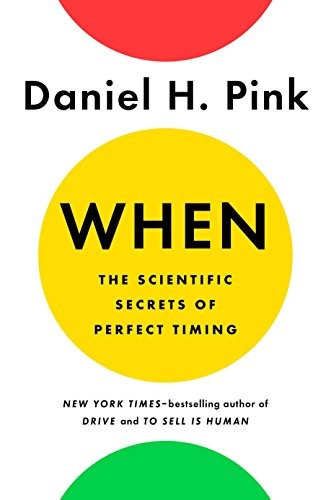
When
by Daniel H. Pink · 2018
Your to-do list has the right tasks on the wrong hours, and Pink's got the research to prove it.
Worth reading? When and Cal Newport's Deep Work both attack the same problem -- most people schedule their day backwards -- but from different angles. Newport tells you to protect blocks of time for focused work and guard them fiercely. Pink tells you which hours to put that block in, and why the "afternoon trough" wrecks analytical work for almost everyone regardless of willpower. Read Deep Work for the discipline of protecting time. Read When for the science of which time to protect. Skip it if you've already mapped your own chronotype and built your schedule around it -- the book's core insight (peak, trough, recovery) is the kind of thing that, once you know it, doesn't need 250 more pages of confirmation. For anyone still scheduling their hardest thinking for 2pm because that's when the meeting was free, it's a genuinely useful reset.
| Full Title | When: The Scientific Secrets of Perfect Timing |
|---|---|
| Author | Daniel H. Pink |
| Published | 2018 |
| Publisher | Riverhead Books |
| Category | Business & Money |
| Favorite quote | “Afternoons are the Bermuda Triangle of our days.” |
The Verdict
Daniel Pink followed Drive by turning the same research-backed style on a factor most people never examine: when they do things, not just how or why. The peak-trough-recovery pattern he lays out is simple enough to apply the same day you read it, which is more than most productivity books can claim.
you schedule your day by convenience instead of your body's actual peak hours
you already track your energy and chronotype and structure your calendar around it
Book Summary
Pink's core claim is that timing isn't a soft factor around performance -- it's a hard, measurable input, and most people ignore it entirely because it's invisible. His main evidence is the "peak-trough-recovery" pattern most people move through daily: sharp analytical thinking in the morning, a slump in the early afternoon (the "Bermuda Triangle" of the day), and a rebound later that favors looser, more associative thinking.
He extends this to beginnings, midpoints, and endings -- arguing that when something starts (a semester, a diet, a Monday) shapes momentum more than people realize, that midpoints can either demoralize or motivate depending on how you frame them, and that endings prompt people to evaluate and push harder (the "marathon effect" that makes people run their fastest in a race's final stretch). None of this is really about clocks; it's about matching the type of task to the type of mental state you're actually in.
The practical upshot is scheduling by task type, not convenience: analytical work in your peak hours, insight-driven or creative work in your recovery period, and naps or breaks to survive the trough instead of pushing through it. Group and team timing matters too -- synchronizing breaks and using shared "temporal landmarks" (a new year, a new week) to reset motivation collectively.
Top 10 Lessons from When
- Most people move through a daily peak-trough-recovery pattern, whether they notice it or not.
- Analytical work goes best in your peak hours -- usually mid-morning for most chronotypes.
- The early afternoon trough is real and near-universal -- schedule around it instead of fighting it.
- Creative, associative thinking often works better in your recovery period than your peak.
- Beginnings set momentum -- a bad start is worth actively resetting, not just pushing through.
- Midpoints can demoralize or motivate depending entirely on how you frame them.
- The 'marathon effect': people push hardest right before a finish line, real or perceived.
- Shared temporal landmarks (Mondays, new years) are useful reset points for motivation.
- A short nap plus caffeine beats either one alone for beating the afternoon slump.
- Naps and breaks aren't laziness -- they're how you survive the trough without wrecking the rest of the day.
Top 2 Quotes from When
"Timing is everything. But we don't know much about timing itself."
Daniel H. Pink, When
"Afternoons are the Bermuda Triangle of our days."
Daniel H. Pink, When
Frequently Asked Questions
Is When worth reading?
Yes, if you schedule your hardest work by whatever slot was free rather than your actual energy pattern. Skip it if you've already mapped your chronotype and built your calendar around peak, trough, and recovery.
What is the main idea of When?
Timing is a measurable performance factor, not a soft one. Most people move through a daily peak-trough-recovery cycle, and matching task type to the right part of that cycle changes results more than most productivity advice.
What is the afternoon trough in When?
The dip in alertness and analytical performance most people hit in the early afternoon -- Pink calls it the 'Bermuda Triangle' of the day and recommends scheduling breaks or naps there instead of pushing through it.
Is When better than Deep Work?
They solve different problems. Deep Work is about protecting blocks of focused time; When is about which hours to put that block in. They pair well together rather than compete.
Ready to read it?
Get When on Amazon