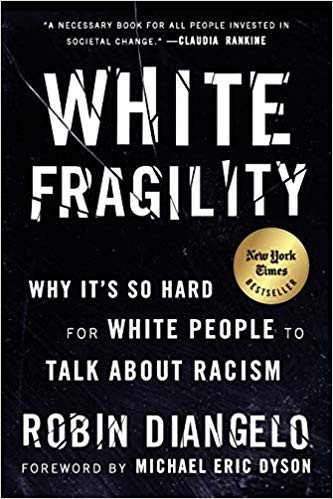
White Fragility
by Robin DiAngelo · 2018
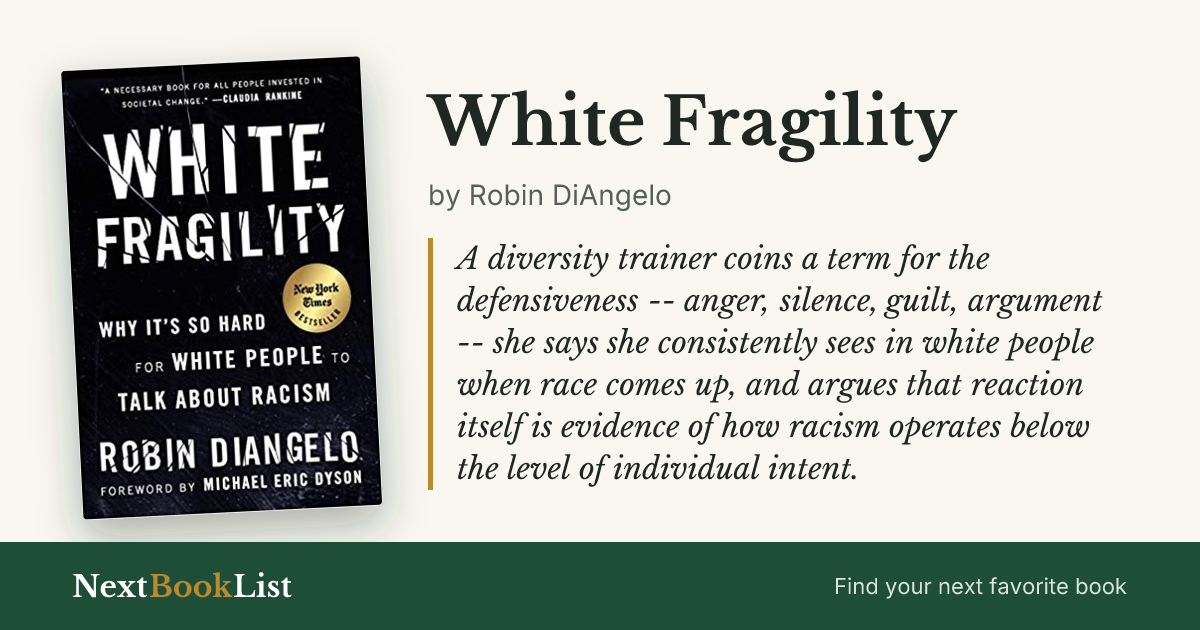
A diversity trainer coins a term for the defensiveness -- anger, silence, guilt, argument -- she says she consistently sees in white people when race comes up, and argues that reaction itself is evidence of how racism operates below the level of individual intent.
Worth reading? DiAngelo's core claim is that white Americans are socialized inside a system that insulates them from race-based stress, so that even mild challenges to that comfort -- a coworker naming a racial pattern, being asked to examine assumptions -- trigger a defensive reaction she calls 'white fragility': anger, denial, guilt, or argument. The book became a massive bestseller and a fixture of corporate and educational diversity training, and it names something real that many people of color report experiencing in these conversations. It has also drawn serious, non-partisan academic criticism -- notably from scholars who study race and psychology -- for a framework that's largely unfalsifiable (any pushback confirms the thesis, any agreement confirms the thesis) and for treating white people as a psychologically uniform category. Read it for what it actually argues, not for the culture-war shorthand it's become on either side.
| Full Title | White Fragility: Why It's So Hard for White People to Talk About Racism |
|---|---|
| Author | Robin DiAngelo |
| Published | 2018 |
| Publisher | Beacon Press |
| Category | Sociology & Culture |
The Verdict
DiAngelo’s book made a specific, testable-sounding claim into a household phrase: white fragility, the defensiveness she says shows up reliably when white people get challenged on race. It became one of the most influential nonfiction books of the last decade, largely because it gave corporate America and school districts a ready-made vocabulary and training curriculum for a conversation many institutions wanted a framework for.
Here’s the honest version of what’s actually in it. DiAngelo, a longtime diversity trainer, argues that most white Americans grow up racially insulated enough that even mild racial feedback triggers disproportionate reactions, anger, tears, silence, walking out, and that this reaction pattern itself protects the racial status quo, whatever the person’s stated intentions. That’s a real claim about a real pattern many people of color report experiencing, and it’s worth taking seriously on those terms.
Where the book gets genuinely shaky, and where the criticism is worth taking just as seriously as the thesis, is structural. DiAngelo builds the argument so that objecting to it is itself proof of it, if you push back, that’s fragility; if you agree, that confirms the framework too. Serious scholars who study race and psychology, not just ideological opponents, have flagged this as a textbook unfalsifiable structure, along with the book’s tendency to treat white people as a single psychological category rather than engaging with the real variation among them.
Read it if you sit through DEI training and want the actual source material instead of the secondhand version, or if you want DiAngelo’s own case laid out in full rather than the compressed, politically loaded version that circulates online. It’s short, and it’s genuinely more interesting read as primary source than as headline.
Skip it if you’re looking for a rigorously evidenced sociological study. This is an argument built from a trainer’s anecdotes and case studies, dressed in academic language, and it doesn’t seriously grapple with its own critics inside the text. Read the critiques alongside it, from people like Black academics who’ve pushed back hard on the framework’s assumptions about race and psychology, and you’ll come away with a much more honest picture than either the fans or the culture-war dismissers give you.
you run or sit through corporate diversity training and want to understand the theoretical framework behind it, or you want DiAngelo's own case for why good intentions aren't the same as absence of racial bias
you want a book that engages seriously with its critics, or a research-driven sociological study -- this is a practitioner's argument built on DiAngelo's own diversity-training experience and case studies, not a peer-reviewed empirical study, and it treats disagreement with its framework as further proof of the framework
Book Summary
DiAngelo argues that most white Americans are raised in racially insulated environments -- segregated neighborhoods, schools, and social circles -- that leave them without the "racial stamina" to sit with discomfort when race is discussed, unlike people of color who navigate race-related stress regularly.
She argues that this low stamina produces predictable defensive reactions when white people are challenged on race -- anger, argumentation, silence, tears, or leaving the conversation -- and that these reactions function to protect the racial status quo by shutting down the conversation, regardless of the individual's conscious intent.
A central and controversial move in the book is treating disagreement with its framework as itself evidence of fragility -- DiAngelo explicitly argues that white people's objections to being called racially biased are a symptom of the bias, which critics have flagged as making the thesis unfalsifiable by design.
The book's practical chapters, drawn from DiAngelo's career running corporate diversity trainings, offer scripts and reframes meant to help white readers sit with racial feedback without becoming defensive, positioning ongoing self-examination rather than a fixed "I'm not racist" identity as the healthier goal.
Top 8 Lessons from White Fragility
- DiAngelo's central term, 'white fragility,' describes a pattern of defensive reactions (anger, denial, silence, argument) she says white people commonly show when challenged on race.
- She argues racial segregation in daily life leaves many white Americans without practiced tolerance for race-related discomfort, unlike people of color who navigate it routinely.
- The book frames racism as a system operating independent of individual intent or conscious belief, not simply a matter of individual bigots holding bad views.
- DiAngelo explicitly treats objection to the framework as confirming evidence of fragility -- a structure critics have identified as making the thesis difficult to falsify.
- The book positions 'I'm not racist' as itself part of the problem, arguing ongoing self-examination is more honest than claiming a fixed non-racist identity.
- Corporate and educational diversity training has widely adopted DiAngelo's framework and vocabulary, making this the theoretical backbone behind a large share of real-world DEI programming.
- Serious academic critics -- including scholars who study race, several of them Black academics and psychologists -- have challenged the book for treating white people as psychologically uniform and for offering therapeutic anecdote in place of rigorous evidence.
- DiAngelo argues comfort itself can be a mechanism of racial power, not a neutral state -- discomfort in a difficult conversation isn't automatically a sign something has gone wrong.
Frequently Asked Questions
Is White Fragility worth reading?
Read it if you want to understand, firsthand, the theoretical framework behind a huge share of modern corporate DEI training -- it's genuinely influential. Go in knowing it's a practitioner's argument, not a peer-reviewed study, and that serious scholars (not just partisan critics) have real objections to its structure.
What does 'white fragility' mean?
DiAngelo's term for the defensive reactions -- anger, denial, silence, guilt, argument -- she argues white people commonly display when their racial assumptions or behavior are challenged, which she says functions to shut down the conversation and protect the status quo.
What is the main criticism of White Fragility?
The most serious academic criticism, including from scholars who study race and psychology, is that the book's framework treats disagreement as proof of its own thesis (making it largely unfalsifiable) and treats white people as a psychologically uniform group rather than engaging with individual variation or competing research.
Is White Fragility based on scientific research?
It draws on DiAngelo's career running corporate diversity trainings and cites academic literature on race, but it is fundamentally a practitioner's argument and case-study collection, not a peer-reviewed empirical study -- a distinction worth knowing going in.
Should I read White Fragility if I'm skeptical of its premise?
It's worth reading specifically if you're skeptical -- you'll get the actual argument instead of the culture-war shorthand version, and you can weigh it against the real academic critiques rather than against a strawman.
Ready to read it?
Get White Fragility on Amazon