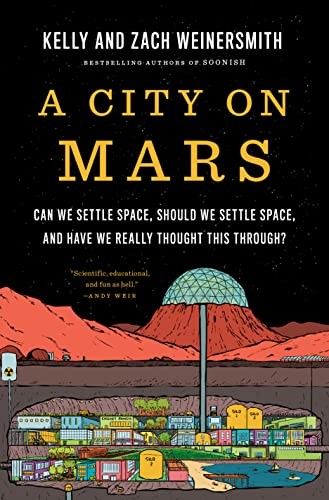
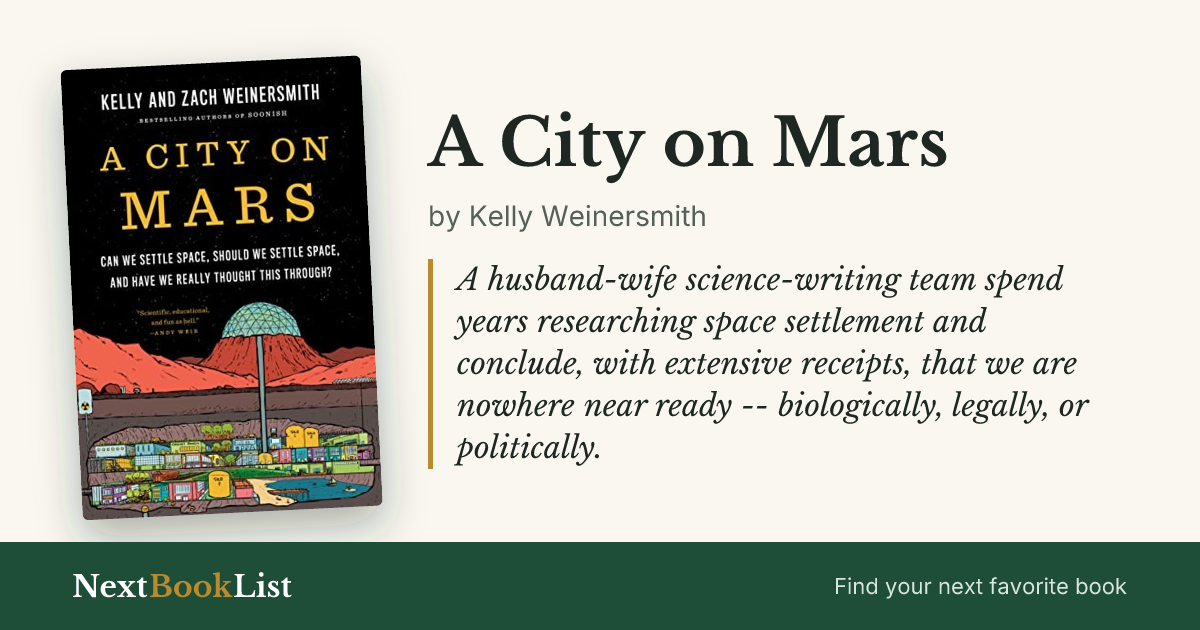
A City on Mars
by Kelly Weinersmith · 2023
A husband-wife science-writing team spend years researching space settlement and conclude, with extensive receipts, that we are nowhere near ready -- biologically, legally, or politically.
Worth reading? The Weinersmiths spent years actually researching what space settlement would require -- not just rocket engineering, but human reproduction in low gravity, radiation exposure, closed-loop life support, space law, and geopolitics -- and their conclusion is a well-earned 'not yet, and not for the reasons you'd guess.' It beats the typical space-optimism book by taking the hard, unglamorous questions seriously: nobody has ever tested whether mammals can safely reproduce in partial gravity, current space law is a legal mess nobody's fixed, and permanent settlements able to survive without Earth resupply are decades further away than most Mars enthusiasts claim. This is skepticism built from genuine research, not reflexive doubt -- and it's a necessary corrective to how casually 'let's just go to Mars' gets thrown around.
| Full Title | A City on Mars: Can We Settle Space, Should We Settle Space, and Have We Really Thought This Through? |
|---|---|
| Author | Kelly Weinersmith |
| Published | 2023 |
| Publisher | Penguin Press |
| Category | Science & Nature |
| Favorite quote | “We've been to space, but we've never lived there, and the gap between visiting and living is enormous.” |
The Verdict
The Weinersmiths’ real service here is doing the unglamorous homework nobody else bothered with – reproduction in partial gravity, actual space law, whether closed-loop life support has ever really worked. If you’ve absorbed the “let’s just go to Mars” pitch uncritically, this is the corrective.
you want a rigorously researched, skeptical counterweight to breathless space-colonization hype, covering the biology, law, and politics nobody else asks about
you want a pro-colonization case for Mars settlement -- this book's whole point is that the case is far weaker and more complicated than advocates admit
Book Summary
Space settlement advocates routinely underestimate biological unknowns that haven't been tested at all -- nobody knows whether mammalian reproduction and fetal development can happen safely in partial gravity (Mars gravity is about 38% of Earth's), and radiation exposure on the Martian surface and during transit poses serious, unresolved health risks.
Existing space law (principally the 1967 Outer Space Treaty) was written for a Cold War context of flags-and-footprints missions, not permanent settlements with property rights, resource extraction, and sovereignty questions -- and the legal framework for actual settlement is largely unresolved and could produce serious conflict.
Closed-loop life support systems -- growing food, recycling air and water indefinitely without Earth resupply -- have never been successfully sustained at the scale a real settlement would require; the most ambitious attempt (Biosphere 2) revealed how much harder this is than expected.
The Weinersmiths argue the timeline pushed by space advocates and companies is dramatically optimistic relative to the actual unsolved problems, and that rushing settlement without addressing biology, law, and self-sufficiency first risks serious harm to any settlers involved.
Top 8 Lessons from A City on Mars
- No one has tested whether mammalian reproduction and fetal development can happen safely in Mars's partial gravity.
- Radiation exposure during Mars transit and on the surface poses serious, still-unresolved health risks to settlers.
- The 1967 Outer Space Treaty was written for Cold War flag-planting missions, not permanent settlements with property and resource rights.
- Closed-loop life support (growing food, recycling air and water indefinitely) has never been sustained at settlement scale -- Biosphere 2 showed how hard this actually is.
- Current space law leaves major questions about settlement sovereignty and resource extraction unresolved and open to conflict.
- Space advocates' settlement timelines are dramatically optimistic relative to the unsolved biological and legal problems.
- Genuine, research-backed skepticism about space settlement is different from reflexive anti-space sentiment -- the Weinersmiths support space exploration while doubting near-term settlement claims.
- Rushing toward settlement without solving reproduction, radiation, and self-sufficiency risks serious harm to the people involved.
Top 3 Quotes from A City on Mars
"We've been to space, but we've never lived there, and the gap between visiting and living is enormous."
Kelly Weinersmith, A City on Mars
"Space is looking more promising every day. There's no political corruption on Mars, no war on the Moon, no juvenile jokes on Uranus."
Kelly Weinersmith, A City on Mars
"So, humans are squishy and weak. The real estate options are toxic. And pointy. And cold. You'll be growing vegetables in your own waste, tending your food bugs, and fighting off bark scorpions while drunk on beet wine."
Kelly Weinersmith, A City on Mars
Frequently Asked Questions
Is A City on Mars worth reading?
Yes -- it's a rigorously researched, genuinely skeptical counterweight to space-settlement hype, covering biology, law, and politics that most pro-colonization books skip entirely.
What is A City on Mars about?
Kelly and Zach Weinersmith's multi-year research into whether humanity is actually ready to settle space, concluding that major unsolved problems in reproduction, radiation, closed-loop life support, and space law make near-term settlement far less feasible than advocates claim.
Is A City on Mars anti-space?
No -- the authors support space exploration generally, but argue specifically that permanent settlement is being oversold relative to genuinely unsolved biological and legal problems.
Does A City on Mars cover space law?
Yes -- a significant portion covers how the 1967 Outer Space Treaty and current international law fail to address settlement, property rights, and resource extraction questions.
Ready to read it?
Get A City on Mars on Amazon