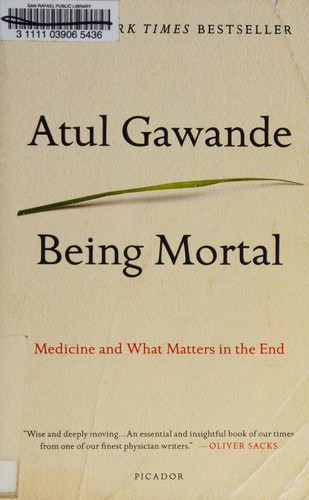
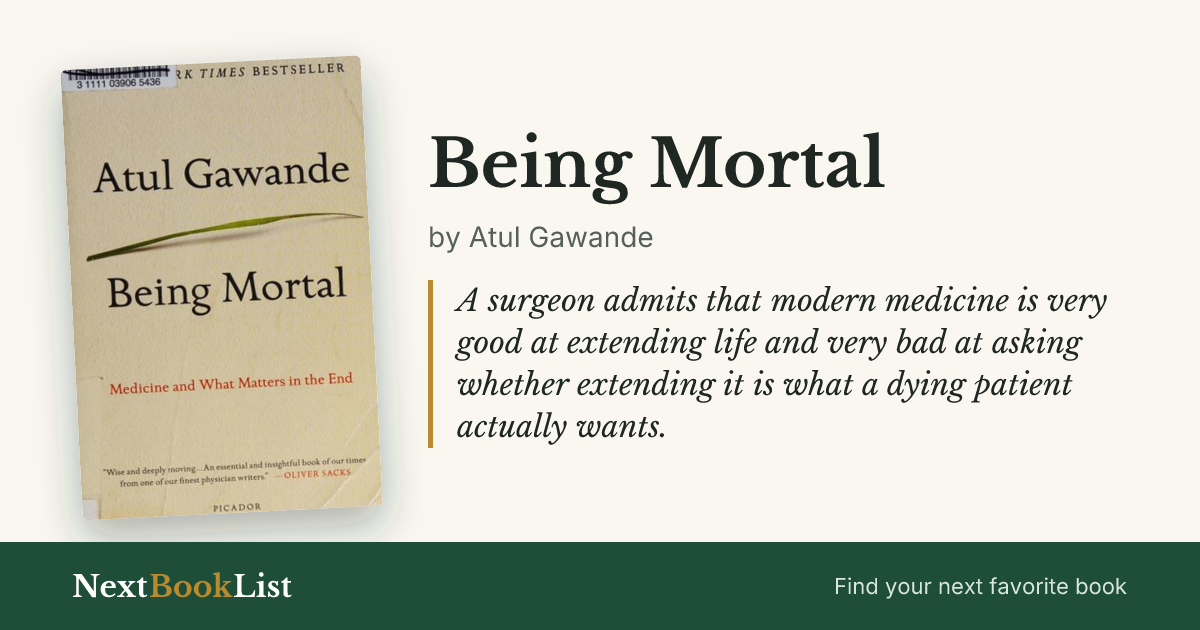
Being Mortal
by Atul Gawande · 2014
A surgeon admits that modern medicine is very good at extending life and very bad at asking whether extending it is what a dying patient actually wants.
Worth reading? Gawande's argument is uncomfortable and precise: medicine trained to fight death treats every decline as a problem to solve, when what dying patients actually need most of the time is a conversation about tradeoffs, not another treatment. It's not an easy read, but it's one of the few books that will change how you handle a hospital conversation for someone you love.
| Full Title | Being Mortal: Medicine and What Matters in the End |
|---|---|
| Author | Atul Gawande |
| Published | 2014 |
| Publisher | Metropolitan Books |
| Category | Science & Nature |
| Favorite quote | “We want autonomy for ourselves and safety for those we love.” |
The Verdict
Gawande doesn’t soften this one. He includes his own father’s decline and death, and lets it go exactly as messily as these things tend to go, because the point isn’t reassurance, it’s honesty about a system that keeps defaulting to more treatment when what a patient actually needs is a real conversation about tradeoffs.
The argument holds up because it’s specific. Not “medicine should care more,” but a precise diagnosis of where the conversation breaks down between doctor, patient, and family, and what asking better questions actually looks like in a hospital room.
Read it if you’re facing decisions about aging or end-of-life care and want something honest rather than comforting. Skip it if you need a hopeful read right now, this book earns its impact by not flinching, and that’s exactly what makes it hard going in places.
you're facing decisions about aging or end-of-life care for yourself or someone you love, and want an honest, specific account of what the medical system gets wrong
you want a hopeful, feel-good read about aging -- Gawande is compassionate but unflinching, and several patient stories end exactly as badly as you'd fear
Book Summary
Modern medicine is built to fight disease and extend life, which makes it structurally bad at a different, more common problem: managing the slow decline of aging and terminal illness, where more treatment often means more suffering for marginal or no gain in quality time.
Gawande argues the critical failure is a conversation gap -- doctors, patients, and families rarely have honest discussions about what someone actually wants from their remaining time (comfort, independence, being home) before defaulting to "try everything," which often produces exactly the traumatic, medicalized death patients say they fear most.
Institutions built around aging (nursing homes, assisted living) largely optimize for safety and liability rather than for autonomy or meaning, and the book profiles alternative models that prioritize giving people a reason to get up in the morning over simply keeping them alive longer.
Top 8 Lessons from Being Mortal
- Medicine is structurally better at fighting disease than at managing decline, because decline has no fixable endpoint the way a treatable illness does.
- Doctors and families frequently avoid honest conversations about a dying patient's actual priorities, defaulting instead to more treatment as the path of least resistance.
- Asking a patient what tradeoffs they're willing to accept (more time versus more suffering, independence versus safety) produces better decisions than assuming everyone wants maximum life-extension at any cost.
- Institutions for the elderly (nursing homes especially) are frequently designed around staff convenience and liability avoidance rather than resident autonomy or dignity.
- A sense of purpose (a reason to get up, some responsibility, even something as small as caring for a pet or plant) measurably improves quality of life for elderly and dying patients.
- Hospice and palliative care, often perceived as 'giving up,' can in some studies extend life as long or longer than aggressive treatment, while improving quality of life.
- Aggressive end-of-life treatment frequently fails to deliver the outcome patients actually wanted, producing a more traumatic death than a more limited, comfort-focused approach would have.
- Gawande includes his own father's decline and death in the book, using it to show that even a physician trained in these exact failures struggles to apply the lessons to his own family.
Top 4 Quotes from Being Mortal
"We want autonomy for ourselves and safety for those we love."
Atul Gawande, Being Mortal
"Our reluctance to honestly examine the experience of aging and dying has increased the harm we inflict on people and denied them the basic comforts they most need."
Atul Gawande, Being Mortal
"Whatever we can offer, our interventions, and the risks and sacrifices they entail, are justified only if they serve the larger aims of a person's life."
Atul Gawande, Being Mortal
"You don't have to go along with reducing your ambitions to your test scores, but you should letting go be your choice."
Atul Gawande, Being Mortal
Frequently Asked Questions
Is Being Mortal worth reading?
Yes, especially if you're facing decisions about aging or end-of-life care for yourself or someone you love -- it's honest and specific rather than reassuring, which is exactly its value.
What is Being Mortal about?
Surgeon Atul Gawande's argument that modern medicine is structurally better at fighting disease than managing decline, and that honest conversations about a dying patient's actual priorities produce better outcomes than defaulting to more treatment.
Is Being Mortal a sad book?
Yes, in places -- Gawande includes patient stories, including his own father's decline, that don't end well, but the book uses them to make a clear, actionable argument rather than for pure emotional effect.
Is Being Mortal only for medical professionals?
No -- it's written for a general audience, and much of its practical value is for families making decisions about an aging or dying relative, not just clinicians.
Does Being Mortal offer practical advice?
Yes -- Gawande gives concrete guidance on the kinds of questions to ask a doctor or a dying patient to clarify real priorities, alongside the broader argument.
Ready to read it?
Get Being Mortal on Amazon