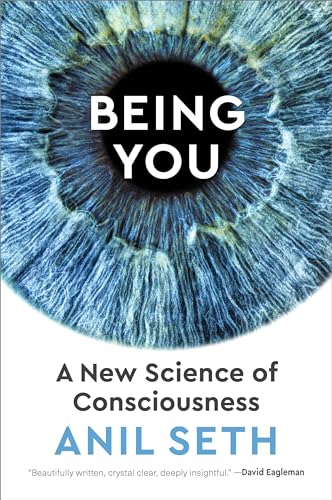
Being You
by Anil Seth · 2021
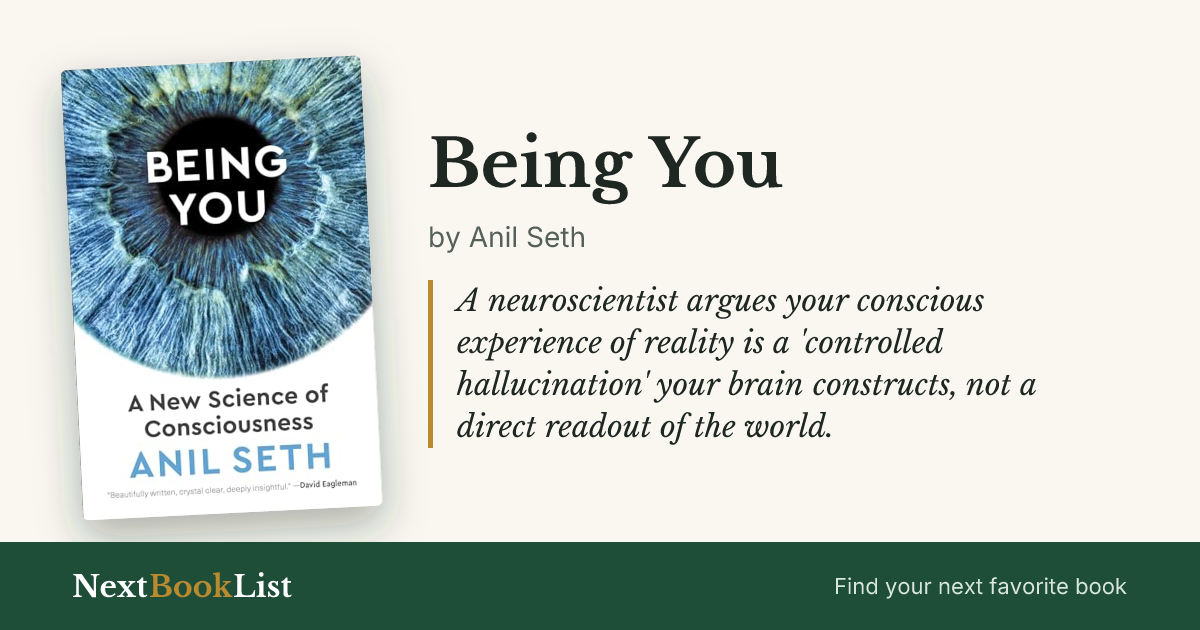
A neuroscientist argues your conscious experience of reality is a 'controlled hallucination' your brain constructs, not a direct readout of the world.
Worth reading? Seth's central claim, and the book's most useful reframe, is that perception isn't your brain passively recording an external world -- it's a 'controlled hallucination,' a best-guess prediction your brain constantly generates and corrects using sensory input as error-correction rather than raw data. He backs this with his own lab's research alongside the broader predictive-processing framework in neuroscience, and he's careful to distinguish this from wilder pop-science claims about consciousness by staying close to testable mechanism. It beats the usual consciousness book by refusing to chase the 'hard problem' (why there's subjective experience at all) and instead building a genuinely useful, falsifiable model of how conscious experience is actually constructed moment to moment.
| Full Title | Being You: A New Science of Consciousness |
|---|---|
| Author | Anil Seth |
| Published | 2021 |
| Publisher | Dutton |
| Category | Science & Nature |
| Favorite quote | “We're all hallucinating all the time; when we agree about our hallucinations, we call it 'reality'.” |
The Verdict
Seth’s discipline in refusing to chase the unanswerable “why does experience exist at all” question is what makes this book more useful than most consciousness books on the shelf. You walk away with an actual, testable model of how your sense of self gets built, moment to moment, rather than another round of philosophical hand-waving.
you want a rigorous, research-grounded theory of consciousness that treats perception as prediction, not passive recording
you want a philosophy-first take on the 'hard problem' of consciousness -- Seth is explicitly more interested in mechanism and prediction than in solving that philosophical puzzle
Book Summary
Perception is not a passive recording of external reality -- it's a "controlled hallucination," a continuous best-guess prediction generated by the brain, which sensory input then corrects rather than directly supplies; what you experience as seeing, hearing, or feeling is your brain's model, constantly updated but never a raw feed.
This predictive-processing framework extends to the sense of selfhood itself: Seth argues that the feeling of being a coherent "I" inhabiting a body is also a predictive model the brain constructs, one that can be selectively disrupted (as in certain neurological and psychiatric conditions) to reveal how constructed and revisable it actually is.
Seth deliberately sidesteps philosophy's "hard problem of consciousness" (why subjective experience exists at all, rather than the lights being off) as likely unanswerable in its current framing, and instead focuses on building falsifiable, mechanistic models of how specific features of conscious experience -- like a sense of selfhood, or the vividness of a hallucination -- actually arise in the brain.
Consciousness is tied closely to being a living, biological organism regulating itself (not just processing information), which is part of why Seth is skeptical that consciousness will simply emerge from sufficiently advanced computation in machines, distinguishing intelligence from sentience.
Top 8 Lessons from Being You
- Perception is best understood as a 'controlled hallucination' -- a brain-generated prediction, corrected by sensory input, not a direct recording of reality.
- The sense of having a coherent self or 'I' is itself a predictive model the brain constructs, and it can be selectively disrupted.
- Seth deliberately avoids trying to solve the philosophical 'hard problem' of consciousness, focusing instead on falsifiable mechanistic models.
- Certain neurological and psychiatric conditions reveal how constructed and revisable the sense of self actually is.
- Consciousness appears tied to being a living, self-regulating biological organism, not just to information processing in the abstract.
- Seth is skeptical that consciousness will simply emerge from sufficiently advanced artificial computation, distinguishing intelligence from sentience.
- The predictive-processing framework treats sensory input as error-correction data for an ongoing prediction, not as the primary source of perceptual content.
- Testable, falsifiable models of specific conscious phenomena (like the vividness of hallucination) are more useful, per Seth, than grand unified theories of consciousness.
Top 5 Quotes from Being You
"We're all hallucinating all the time; when we agree about our hallucinations, we call it 'reality'."
Anil Seth, Being You
"The self is another perception, another controlled hallucination. Our perceptual world is nothing more and nothing less than our brain's best guess of the hidden causes of its sensory inputs."
Anil Seth, Being You
"We perceive the world not as it is, but as it is useful for us."
Anil Seth, Being You
"We do not perceive ourselves in order to know ourselves, we perceive ourselves in order to control ourselves."
Anil Seth, Being You
"Human consciousness is just a tiny region in a vast space of possible consciousnesses."
Anil Seth, Being You
Frequently Asked Questions
Is Being You worth reading?
Yes, if you want a rigorous, research-grounded model of how perception and selfhood are constructed by the brain. It sidesteps the philosophical 'hard problem' rather than solving it, so it may frustrate readers looking for that specific debate.
What is the 'controlled hallucination' concept in Being You?
Anil Seth's term for perception: the brain constantly generates a best-guess prediction of reality, using sensory input to correct that prediction rather than to directly supply raw experience.
Does Being You solve the hard problem of consciousness?
No -- Seth explicitly sets that philosophical question aside as likely unanswerable in its current framing, focusing instead on building testable, mechanistic models of specific conscious phenomena.
Does Being You think AI can become conscious?
Seth is skeptical, arguing consciousness seems tied to being a living, self-regulating biological organism rather than to information processing alone -- so he distinguishes machine intelligence from genuine sentience.
Ready to read it?
Get Being You on Amazon