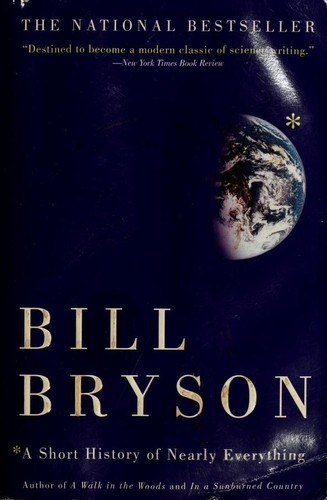
A Short History of Nearly Everything
by Bill Bryson · 2003
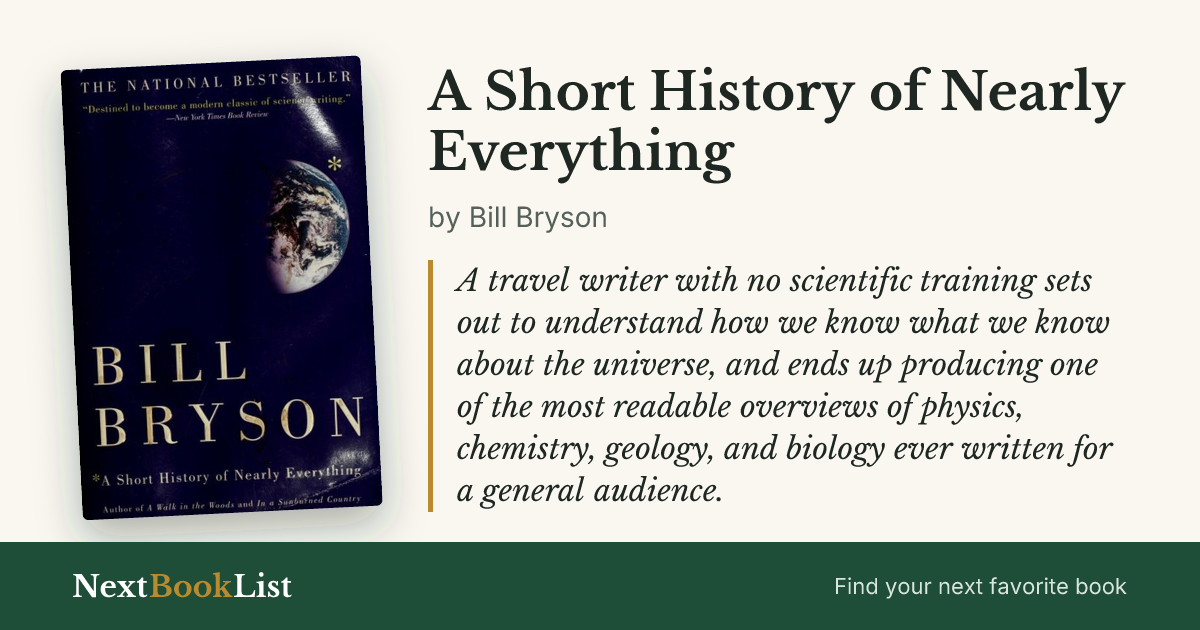
A travel writer with no scientific training sets out to understand how we know what we know about the universe, and ends up producing one of the most readable overviews of physics, chemistry, geology, and biology ever written for a general audience.
Worth reading? A Short History of Nearly Everything succeeds because Bryson stays a curious outsider the whole way through, which is exactly what makes it readable to people who'd normally avoid a science book entirely. The book's real subject isn't just science, it's the often petty, competitive, and accident-prone process by which scientific knowledge actually got built.
| Author | Bill Bryson |
|---|---|
| Published | 2003 |
| Publisher | Broadway Books |
| Category | Science & Nature |
| Favorite quote | “It is a slightly arresting notion that if you were to pick yourself apart with tweezers, one atom at a time, you would produce a mound of fine atomic dust, none of which had ever been alive but all of which had once been you.” |
The Verdict
Bryson’s outsider status is the whole engine of the book – he asks the questions a specialist would consider too basic to bother with, and the answers turn out to be genuinely interesting precisely because he doesn’t take any of it for granted.
The scientist-rivalry anecdotes are what keep 500-plus pages of science moving. Watching credentialed experts spend decades confidently wrong, or sabotage a rival out of pure ego, does more to humanize the scientific process than any straight recitation of facts would.
Read it if you want a broad, entertaining survey of modern science and the messy human process behind it. Skip it if you want real depth on any single field – this book is built for breadth, not specialization.
you want a broad, entertaining survey of modern science and the often-eccentric scientists behind it, written by someone approaching it as an intelligent outsider rather than an expert
you want technical depth on any single field -- Bryson covers an enormous range at a survey level, and specialists will find each individual topic covered thinly
Book Summary
Bryson sets out to explain how humans came to understand the universe's scale, the earth's age, the origin of life, and the workings of physics and chemistry, approaching each topic as an interested layperson rather than a credentialed scientist.
The book spends as much time on the scientists themselves -- their rivalries, mistakes, and often accidental discoveries -- as it does on the science, arguing that the history of scientific knowledge is messier, more human, and less linear than textbooks usually present it.
Bryson repeatedly highlights how much of what we now consider settled science was arrived at through flawed methods, lucky accidents, or scientists who were confidently wrong for decades before being corrected, using this as a running theme about the provisional nature of scientific consensus.
Top 7 Lessons from A Short History of Nearly Everything
- Many foundational scientific discoveries, from the age of the Earth to the structure of the atom, were arrived at through flawed methods or outright errors that took decades to correct, undercutting the idea that science proceeds in a straight line.
- Bryson repeatedly documents petty personal rivalries between scientists -- credit disputes, sabotaged careers, withheld data -- as a real and underappreciated factor in how and when discoveries became public.
- The book covers an enormous range of fields (cosmology, geology, chemistry, evolutionary biology, paleontology) at a survey level, prioritizing accessibility and connections between fields over technical depth in any one of them.
- Bryson highlights how many important discoveries were accidental or came from amateurs and outsiders rather than the credentialed experts of their era, echoing a recurring theme about who actually advances scientific knowledge.
- The book treats uncertainty and revision as normal features of scientific progress, repeatedly noting where current scientific consensus might itself be provisional or incomplete.
- Bryson uses figures like Charles Darwin, Isaac Newton, and lesser-known scientists to humanize the process of discovery, showing how much personal ambition, error, and circumstance shaped outcomes now taught as settled fact.
- The book's structure moves from the largest scale (the universe) down to the smallest (cells and atoms) before addressing human evolution, giving readers a sense of scientific scale as well as scientific history.
Top 3 Quotes from A Short History of Nearly Everything
"Welcome. And congratulations. I am delighted that you could make it. Getting here wasn't easy, I know."
Bill Bryson, A Short History of Nearly Everything
"It is a slightly arresting notion that if you were to pick yourself apart with tweezers, one atom at a time, you would produce a mound of fine atomic dust, none of which had ever been alive but all of which had once been you."
Bill Bryson, A Short History of Nearly Everything
"Protons give an atom its identity, electrons its personality."
Bill Bryson, A Short History of Nearly Everything
Frequently Asked Questions
Is A Short History of Nearly Everything worth reading?
Yes -- it's one of the most accessible broad surveys of modern science available, and it works especially well for readers who don't normally read science books.
What is A Short History of Nearly Everything about?
Bill Bryson's survey of how humans came to understand the universe's scale, the Earth's age, the origin of life, and the workings of physics and chemistry, told through the often messy and accidental history of the scientists who figured it out.
Do I need a science background to read this book?
No -- Bryson writes as a curious layperson, not a scientist, and explains concepts for a general audience.
How is A Short History of Nearly Everything organized?
It moves roughly from the largest scale, the universe and cosmology, down through geology and chemistry to biology and human evolution.
Did A Short History of Nearly Everything win any awards?
Yes -- it won the 2004 Aventis Prize for Science Books and the 2005 Descartes Prize for science communication.
Ready to read it?
Get A Short History of Nearly Everything on Amazon