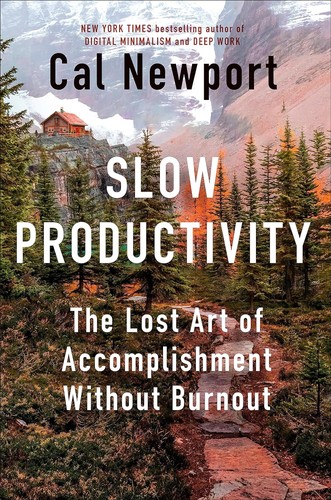
Slow Productivity
by Cal Newport · 2024
Newport's argument that 'busy' and 'productive' got confused, and the fix is doing fewer things, at a natural pace, to a higher standard.
Worth reading? Slow Productivity is Newport's answer to the busyness he diagnosed in Deep Work: pseudo-productivity, using visible activity as a proxy for actual output, is the default failure mode of knowledge work, and it burns people out while producing less that matters. Compared to Deep Work, this is less about focus mechanics and more about pacing and workload at the level of weeks and months, not single sessions. The three principles (do fewer things, work at a natural pace, obsess over quality) are simple enough to sound obvious and hard enough that almost nobody actually practices them. Skip it if you've already restructured your workload around fewer, higher-quality commitments.
| Full Title | Slow Productivity: The Lost Art of Accomplishment Without Burnout |
|---|---|
| Author | Cal Newport |
| Published | 2024 |
| Publisher | Portfolio |
| Category | Self-Improvement & Psychology |
| Favorite quote | “Busyness is not a proxy for productivity, and the sooner we abandon this idea, the better.” |
The Verdict
Newport’s real target is pseudo-productivity: the habit of using a packed calendar as proof of good work. His three principles, fewer things, natural pace, obsess over quality, are simple to state and genuinely rare to see anyone actually practice.
you measure your day by how full your calendar was, not by what you actually finished
you want a habits system -- this is a philosophy of work pace, not a task-management framework
Book Summary
Pseudo-productivity, visible busyness (fast replies, packed calendars, constant activity) used as a stand-in for real output, is the default operating mode of most knowledge work, and it actively works against producing anything that matters.
Newport's three principles: do fewer things (fewer simultaneous obligations, deeper focus on each), work at a natural pace (seasons of intensity and recovery, not permanent sprint), and obsess over quality (spend on craft what others spend on more output).
Historical case studies, Newton, Austen, Darwin, show that meaningful work has always happened at a slower, more variable pace than modern always-on knowledge work assumes. The frantic pace is a recent invention, not a natural law of getting important things done.
Top 8 Lessons from Slow Productivity
- Pseudo-productivity, visible busyness standing in for real output, is the default failure mode of knowledge work.
- Do fewer things: hold fewer simultaneous major obligations so each one gets real depth.
- Work at a natural pace: seasons of intensity followed by real recovery beat permanent sprint mode.
- Obsess over quality: spend the time others spend on volume on craft instead.
- Historical greats worked at a slower, more variable pace than modern always-on norms assume.
- Saying no to good opportunities is required to protect capacity for the few great ones.
- A full calendar is not evidence of good work; it's often evidence of poor prioritization.
- Multitasking across many shallow obligations produces less than fewer, deeper ones, even at the same total hours.
Top 3 Quotes from Slow Productivity
"Busyness is not a proxy for productivity, and the sooner we abandon this idea, the better."
Cal Newport, Slow Productivity
"Do fewer things. Work at a natural pace. Obsess over quality."
Cal Newport, Slow Productivity
"Pseudo-productivity is a poor metric to guide your professional efforts."
Cal Newport, Slow Productivity
Frequently Asked Questions
Is Slow Productivity worth reading?
Yes, especially if your workload is measured by busyness rather than output. It's Newport's clearest statement yet on pacing knowledge work over weeks and months, not just single focus sessions.
What are the three principles of Slow Productivity?
Do fewer things, work at a natural pace, and obsess over quality. Together they replace pseudo-productivity, visible busyness, with a slower path to real output.
How does it relate to Deep Work?
Deep Work is about focus mechanics within a single session. Slow Productivity zooms out to pacing across weeks and months, and to how many obligations you should be carrying at once.
Ready to read it?
Get Slow Productivity on Amazon