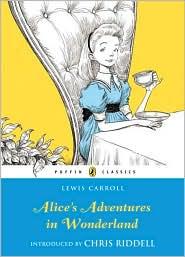
Alice's Adventures in Wonderland
by Lewis Carroll · 1865
A bored girl follows a rabbit down a hole and Victorian logic never fully recovers.
Worth reading? This is the original -- almost every 'wonderland' or dream-logic story since owes it something, from The Phantom Tollbooth to Coraline. It's short, strange, and funnier than its reputation as a kids' classic suggests. Read it for the wordplay, not for a plot with stakes.
| Author | Lewis Carroll |
|---|---|
| Published | 1865 |
| Publisher | Puffin Classics |
| Category | Fiction |
| Favorite quote | “We're all mad here.” |
The Verdict
Carroll was a mathematician, and it shows – half the jokes are logic puzzles wearing a rabbit costume. The Mad Hatter’s tea party and the Queen’s court aren’t just whimsical, they’re pointed jabs at rules that exist for no reason except that someone in charge said so, and a kid is the one calling it out.
Skip it if you’re looking for a story with a clear arc and a lesson at the end – Carroll refuses to give you one, on purpose. But as a short, weird, genuinely funny book that invented an entire genre, it holds up better than most 19th-century children’s literature still does.
you want the original nonsense-literature classic, the book that invented a whole genre of stories that run on dream-logic instead of plot
you need a story to resolve into a clean moral -- Carroll deliberately refuses that, and the episodic structure (one weird encounter after another) can feel aimless if you're reading for plot momentum
Book Summary
Alice falls down a rabbit hole into a world where the normal rules -- of size, of time, of manners, of logic -- don't apply, and nobody around her seems bothered by that. Carroll, a mathematician by trade, is playing games with language and logic throughout: puns, syllogisms that lead nowhere, arguments about words meaning whatever the speaker wants them to mean.
Alice spends the book trying to apply Victorian politeness and adult logic to a world that ignores both, and the comedy comes from her persistence. She keeps asking sensible questions of creatures who have no interest in sensible answers. By the end she stops being surprised and starts pushing back -- which is really a story about a kid learning that adult authority (the Queen's "off with her head," the court's "sentence first, verdict afterward") is often just noise dressed up as rules.
The famous twist -- it was all a dream -- isn't a cop-out so much as the point. Carroll never lets the nonsense resolve into a moral, which is exactly what makes it different from the moralizing children's literature of its era.
Top 9 Lessons from Alice's Adventures in Wonderland
- Wonderland's nonsense logic satirizes adult rules and manners that children are told to follow without ever being told why.
- Alice's repeated size changes mirror the disorientation of growing up and losing a stable sense of self.
- The Mad Hatter's tea party mocks rigid social ritual (time, etiquette) once it's been stripped of any real purpose.
- The Queen of Hearts' court, where 'sentence first, verdict afterward' is normal, satirizes arbitrary authority.
- Alice keeps trying to apply logic and good manners to a world that ignores both, and gradually stops expecting it to make sense.
- The Cheshire Cat's fading grin plays with how much of identity is really just appearance.
- Curiosity, not obedience, drives the plot -- Alice follows the White Rabbit because she's curious, not because anyone told her to.
- The ending reveals it was all a dream, which lets Carroll skip tying the nonsense into a tidy lesson -- unusual for a Victorian children's book.
- Wordplay throughout (the Mock Turtle's puns, the Caterpillar's interrogation) treats language itself as something that can be argued with, not just used.
Top 6 Quotes from Alice's Adventures in Wonderland
"Curiouser and curiouser!"
Lewis Carroll, Alice's Adventures in Wonderland
"Off with her head!"
Lewis Carroll, Alice's Adventures in Wonderland
"We're all mad here."
Lewis Carroll, Alice's Adventures in Wonderland
"Why, sometimes I've believed as many as six impossible things before breakfast."
Lewis Carroll, Alice's Adventures in Wonderland
"It's no use going back to yesterday, because I was a different person then."
Lewis Carroll, Alice's Adventures in Wonderland
"Would you tell me, please, which way I ought to go from here?' ... 'That depends a good deal on where you want to get to,' said the Cat."
Lewis Carroll, Alice's Adventures in Wonderland
Frequently Asked Questions
Is Alice's Adventures in Wonderland worth reading?
Yes -- it's the foundational text of nonsense literature, genuinely funny, and short enough to read in one or two sittings.
Is Alice's Adventures in Wonderland just for kids?
No. The wordplay, logic puzzles, and satire of Victorian manners land better for adults than for young children, even though it's marketed as a children's book.
What is the main theme of Alice's Adventures in Wonderland?
That the adult world's rules -- manners, logic, authority -- are often arbitrary, and a curious kid pushing against them exposes how little sense they actually make.
How long does it take to read Alice's Adventures in Wonderland?
About 3 to 4 hours. It's a short novel with simple sentence structure, even if the ideas inside it aren't simple.
Ready to read it?
Get Alice's Adventures in Wonderland on Amazon