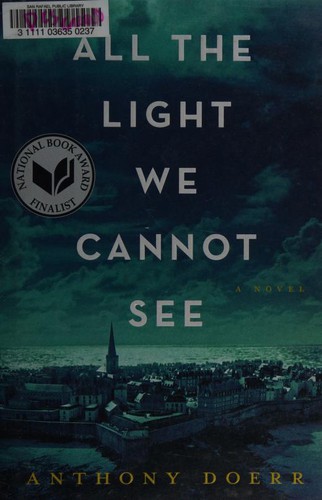
All the Light We Cannot See
by Anthony Doerr · 2014
A blind French girl and a orphaned German boy conscripted into the Hitler Youth have their lives converge in occupied Saint-Malo during World War II, told in short, alternating chapters that build toward one devastating meeting.
Worth reading? All the Light We Cannot See earns its Pulitzer through sheer craft at the sentence level and an unusual structural choice that mostly pays off: two very different WWII childhoods, one blind and French, one conscripted and German, told in short chapters that slowly close the distance between them. Doerr resists easy moral binaries between his two leads, which is the book's real achievement -- Werner isn't a monster, he's a talented kid absorbed by a monstrous system, and the novel makes you sit with that discomfort.
| Author | Anthony Doerr |
|---|---|
| Published | 2014 |
| Publisher | Scribner |
| Category | Fiction |
| Favorite quote | “So how, children, does the brain, which lives without a spark of light, build for us a world full of light?” |
The Verdict
Doerr’s short-chapter structure sounds gimmicky on paper and mostly isn’t in practice, it forces you to hold two very different childhoods in your head at once, and the slow convergence gives the eventual meeting real weight instead of feeling contrived.
Werner is the book’s boldest choice. Doerr refuses to make him either a hero or a straightforward villain, showing exactly how a talented, ordinary kid gets absorbed into a monstrous system one recruitment, one assignment at a time. That refusal to simplify him is what elevates the book past a standard WWII moral fable.
Read it if you want WWII historical fiction with genuine craft and an unusual structural approach. Skip it if fragmented, time-jumping narratives frustrate you more than they intrigue you.
you want WWII fiction that avoids the genre's most familiar beats (no concentration camp narrative, no straightforward resistance-hero arc) and are willing to read a structure built from very short, frequently jumping chapters
you find fragmented, time-jumping structure disorienting -- the novel bounces between years and perspectives in short bursts throughout, and it asks patience before the two leads' timelines actually converge
Book Summary
Marie-Laure LeBlanc, blind since childhood, flees Paris with her father, a locksmith at the Museum of Natural History who may be carrying a legendary cursed diamond, and ends up in the walled coastal city of Saint-Malo under her reclusive great-uncle's care as the Nazi occupation tightens.
Werner Pfennig, an orphaned German boy with a gift for radio engineering, is recruited into a brutal Hitler Youth academy specifically because of that talent, and is eventually deployed to track resistance radio broadcasts, a skill that puts him on a collision course with Marie-Laure's own clandestine radio use.
Doerr structures the novel in short, alternating chapters that jump across roughly a decade of time, deliberately building toward, then past, the moment the two protagonists' paths cross during the Allied bombing of Saint-Malo, rather than treating that meeting as a conventional climax.
The cursed diamond subplot, involving a Nazi gemologist obsessively hunting the stone, threads a note of near-magical realism through an otherwise grounded historical novel, and functions more as a structural device pulling characters together than as a literal supernatural element the book insists you believe.
Top 9 Lessons from All the Light We Cannot See
- Werner's recruitment into the Hitler Youth academy for his radio talent, rather than ideological conviction, is used to show how ordinary talent and ambition can be absorbed into an atrocity-committing system without the person involved seeing themselves as a believer.
- Marie-Laure's blindness is written with genuine sensory specificity, not as a simple metaphor, and her navigation of Saint-Malo by touch and sound is one of the novel's most carefully rendered details.
- The novel resists a clean good-German/bad-German binary, giving Werner real interiority and doubt even as he participates in the machinery of Nazi occupation, which is a harder and more honest choice than a simpler villain would have been.
- Radio technology functions as both weapon and lifeline throughout the book, the same technology Werner uses to hunt resistance broadcasts is the one Marie-Laure and her uncle use to transmit them, tying the two protagonists together mechanically before they ever meet.
- The book's fragmented, time-jumping structure mirrors the disorientation and destruction of war itself, rather than being a purely stylistic flourish, according to how deliberately Doerr withholds and reorders information.
- The diamond subplot's near-mythical quality is used to suggest that people under extreme conditions reach for stories bigger than their circumstances, whether or not those stories are literally true.
- Marie-Laure's great-uncle Etienne, an agoraphobic WWI veteran too traumatized to leave his own house, embodies how the previous war's damage is still shaping the family's response to the new one before a single Nazi soldier appears.
- Von Rumpel's hunt for the cursed diamond is driven as much by his own terminal illness and superstition as by Nazi ideology, making him a different kind of villain than a true believer -- someone using the war's chaos for a private, desperate reason.
- The title refers to the electromagnetic spectrum -- radio waves are literally light no human eye can see -- linking Marie-Laure's blindness, Werner's radio expertise, and the novel's interest in real but invisible forces into one image.
Top 2 Quotes from All the Light We Cannot See
"Open your eyes and see what you can with them before they close forever."
Anthony Doerr, All the Light We Cannot See
"So how, children, does the brain, which lives without a spark of light, build for us a world full of light?"
Anthony Doerr, All the Light We Cannot See
Frequently Asked Questions
Is All the Light We Cannot See worth reading?
Yes -- it's a beautifully written WWII novel that avoids the genre's most familiar tropes, though the fragmented structure requires some patience.
What is All the Light We Cannot See about?
A blind French girl and an orphaned German boy conscripted for his radio talent have their lives converge during the WWII occupation of Saint-Malo, France.
Did All the Light We Cannot See win any awards?
Yes, it won the 2015 Pulitzer Prize for Fiction and was a finalist for the National Book Award.
Is All the Light We Cannot See a slow read?
The short chapters make it move quickly page to page, but the fragmented, non-linear structure means the emotional payoff builds gradually rather than immediately.
Is there a TV adaptation of All the Light We Cannot See?
Yes, a Netflix limited series adaptation was released in 2023.
Ready to read it?
Get All the Light We Cannot See on Amazon