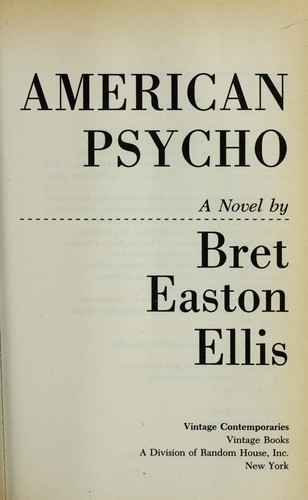
American Psycho
by Bret Easton Ellis · 1991
A Wall Street investment banker narrates his own daily grooming routine, restaurant reservations, and, in unbearable detail, his murders -- and the book dares you to figure out how much of it actually happened.
Worth reading? American Psycho is a much smarter, more disciplined book than its reputation as pure gore suggests, and also a genuinely difficult read for exactly the reason it's famous: Ellis commits fully to a narrator whose voice is flat, brand-obsessed, and horrifying in exactly the same register whether he's describing a business card or a murder.
| Author | Bret Easton Ellis |
|---|---|
| Published | 1991 |
| Publisher | Vintage Contemporaries |
| Category | Fiction |
| Favorite quote | “This is not an exit.” |
The Verdict
The thing the book’s reputation misses is how disciplined it is. Ellis gives Bateman’s murders and his descriptions of a new suit or a restaurant reservation the exact same flat, brand-obsessed tone, and that sameness is the actual argument the novel is making about what this culture has hollowed out of him.
The ambiguity about what’s real is deliberate, and it’s the smartest choice in the book. Other characters misremember or contradict facts about people Bateman claims to have killed, and by the end he can’t even get anyone to take his confession seriously – which suggests the violence, real or imagined, doesn’t register as a rupture in this world at all.
It is genuinely brutal to read. That’s not a criticism dressed as praise; the violence is sustained and detailed enough that skipping the book for that reason is entirely reasonable, not squeamish.
Read it if you want a disciplined, genuinely sharp satire of status and consumer culture and can handle graphic violence in service of it. Skip it if the violence itself, regardless of the satire underneath, is more than you want on the page.
you want a genuinely savage satire of 1980s consumer and status culture, willing to make its reader deeply uncomfortable to make its point about hollow, brand-obsessed masculinity
you're not prepared for extremely graphic violence -- this isn't shock for its own sake, but the violence is sustained and detailed enough that it's a legitimate reason to skip the book, not a failure of nerve
Book Summary
Patrick Bateman, a wealthy Manhattan investment banker in the late 1980s, narrates his life in obsessive, near-identical detail whether he's describing designer suits, restaurant reservations, or the torture and murder of colleagues, sex workers, and acquaintances -- Ellis gives both categories the exact same flat, brand-name-dropping register, which is the novel's central formal choice.
The novel is deliberately ambiguous about how much of the violence is real versus a fantasy projected by a narrator whose grip on reality is clearly deteriorating; other characters seem to misremember or contradict facts about victims, and Bateman himself, by the end, appears unable to get anyone to take his confessions seriously.
Ellis's actual target is the emptiness of 1980s status culture -- a world where identical, interchangeable men obsess over business cards, restaurant reservations, and physical appearance so completely that a serial killer can move through it functionally unnoticed, because no one is paying enough attention to another person to register what he actually is.
Top 10 Lessons from American Psycho
- Ellis gives Bateman's descriptions of murder and of consumer goods the exact same flat, obsessive register, which is the novel's core technique for showing how hollowed-out its narrator actually is.
- The novel's ambiguity about whether the murders are literally real or a projection of Bateman's deteriorating psyche is deliberate, not a plot hole -- other characters' confusion about victims reinforces the uncertainty.
- The book's real target is 1980s status and consumer culture, where interchangeable, appearance-obsessed men are so unable to see each other as individuals that a killer moves among them unnoticed.
- Bateman's inability to get anyone to believe or even register his confessions by the novel's end suggests his violence, real or imagined, changes nothing about the world that produced him.
- The extended brand-name cataloguing (suits, stereo equipment, restaurants) isn't filler -- it's doing the same satirical work as the violence, just at lower volume.
- The novel's graphic content sparked real controversy on publication, including its original publisher dropping it before Vintage picked it up, which is itself part of the book's reception history worth knowing.
- The business-card comparison scene, where Bateman nearly has a panic attack over subtle differences in paper stock and font between identical cards, is the novel's purest distillation of status anxiety over distinctions that mean nothing to anyone but the men obsessing over them.
- Bateman is repeatedly mistaken for other bankers and vice versa throughout the novel, a running joke that isn't just comic relief -- it's the same interchangeability theme as the business cards, played out on the characters themselves.
- The standalone chapters where Bateman earnestly reviews Genesis, Whitney Houston, and Huey Lewis and the News albums are structurally identical to his violence -- obsessive, detailed, delivered in the same flat critical voice -- reinforcing that his psychopathy and his consumerism run on the same track.
- The novel ends without catharsis or consequence -- Bateman's closing narration makes clear the book refuses to offer even fictional justice, since nothing he's done seems to register as real within his own world.
Top 3 Quotes from American Psycho
"This is not an exit."
Bret Easton Ellis, American Psycho
"I have all the characteristics of a human being: flesh, blood, skin, hair, but not a single, clear, identifiable emotion, except for greed and disgust."
Bret Easton Ellis, American Psycho
"I simply am not there."
Bret Easton Ellis, American Psycho
Frequently Asked Questions
Is American Psycho worth reading?
Yes, if you can handle sustained graphic violence -- it's a much sharper satire of 1980s status culture than its shock-value reputation suggests.
What is American Psycho about?
A wealthy Manhattan investment banker narrates his consumer obsessions and graphic murders in the same flat register, satirizing the emptiness of 1980s status culture.
Is American Psycho too graphic to read?
It's genuinely extremely graphic in its violence -- that's a legitimate reason to skip it, not just squeamishness.
Are the murders in American Psycho real within the story?
The novel deliberately leaves this ambiguous -- other characters' confusion and contradictions suggest at least some of it may be Bateman's psychological projection.
How does the book compare to the 2000 film?
The film is more restrained with the violence and leans harder into dark comedy, while the novel sustains a more disturbing, unbroken flatness throughout.
Ready to read it?
Get American Psycho on Amazon