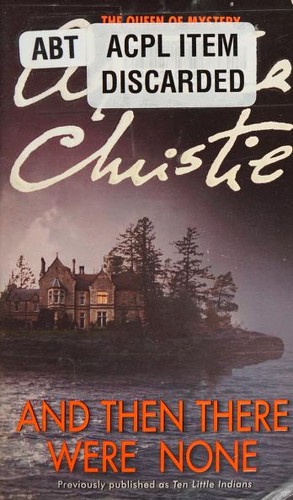
And Then There Were None
by Agatha Christie · 1939
Ten strangers get lured to an island, accused of murders the law never touched, and start dying one by one in the order of an old nursery rhyme -- the best-selling mystery novel ever written, and the one that invented the modern isolated-killer setup.
Worth reading? And Then There Were None earns its status as the best-selling mystery novel of all time because the premise is airtight: ten guilty people, no way off the island, and a killer who has to be one of them. Christie plays completely fair with the clues, which is rarer than it sounds in this genre.
| Author | Agatha Christie |
|---|---|
| Published | 1939 |
| Publisher | William Morrow |
| Category | Fiction |
| Favorite quote | “One little soldier boy left all alone; he went and hanged himself and then there were none.” |
The Verdict
Christie’s real trick here isn’t the killer’s identity, it’s the removal of a safety net. No detective is coming to save these people or explain the plot to you – you’re stuck reasoning alongside ten increasingly desperate strangers, which is a scarier position than watching Poirot work a case from a comfortable distance.
The pacing holds up because the body count keeps the tension mechanical: every death shrinks the suspect pool and raises the stakes for whoever’s left, in a way that never feels padded even eight decades later.
Where it shows its age slightly is in some of the period-typical characterization (class assumptions, a couple of character types drawn in broad strokes), but the plotting itself hasn’t dated at all.
Read it if you want the mystery novel that built the “trapped with a killer” template everything after it borrowed. Skip it if the twist has already been spoiled by one of its many imitators – go in as blind as you can.
you want the mystery novel that basically invented the 'trapped on an island with a killer' setup everyone from slasher films to Knives Out has borrowed since
you've already had the ending spoiled by one of its dozens of imitators -- the twist works best cold, and it's been copied so often the mechanics may feel familiar even if the specific solution isn't
Book Summary
Ten strangers are invited to an isolated island off the English coast under different pretexts, only to discover they've each been accused, via recorded voice, of a death the law never punished them for -- and then they start dying, one at a time, in an order that matches an old nursery rhyme hanging in every room.
Christie's structural trick is that there's no detective on the island working the case for you -- the survivors have to reason it out themselves in real time, which puts the reader in the same position of dwindling trust and mounting paranoia as the characters.
The book's real subject is guilt without legal consequence: each victim did something morally indefensible that the justice system couldn't or wouldn't touch, and the killer has appointed himself judge, jury, and executioner for crimes the law let slide.
Top 7 Lessons from And Then There Were None
- Removing the detective character entirely -- no Poirot, no Marple, just ten suspects reasoning among themselves -- was a genuine structural risk that paid off by putting the reader inside the characters' uncertainty instead of watching a genius solve it from outside.
- The nursery rhyme functioning as both murder method and death countdown gives the book a ticking-clock structure well before that became a genre standard.
- Every victim is guilty of something real but legally untouchable (a hit-and-run, medical negligence, a battlefield decision) -- the book's tension comes from readers half-agreeing with the killer's logic even while being horrified by the method.
- Christie plays fair with the clues in a way a lot of imitators don't -- the solution is genuinely derivable from what's on the page, not sprung from nowhere in the final chapter.
- The isolated setting (an island with no boat access once the storm hits) removes the usual mystery-novel escape valves and forces the plot to be entirely about who's left and who's next.
- Paranoia among the survivors escalates logically -- alliances form and break based on actual evidence, not arbitrary suspicion, which keeps the back half of the book tense instead of repetitive.
- The book's original UK title used a racial epithet from the nursery rhyme it was built around, and most editions since the 1980s (in the US, since first publication) use the alternate title -- worth knowing before you go looking for editions or adaptations.
Top 3 Quotes from And Then There Were None
"Ten little soldier boys went out to dine; one choked his little self and then there were nine."
Agatha Christie, And Then There Were None
"Six little soldier boys playing with a hive; a bumble bee stung one and then there were five."
Agatha Christie, And Then There Were None
"One little soldier boy left all alone; he went and hanged himself and then there were none."
Agatha Christie, And Then There Were None
Frequently Asked Questions
Is And Then There Were None worth reading?
Yes -- it's the best-selling mystery novel ever written for a reason, and the fair-play plotting holds up even now that its setup has been copied constantly.
What is And Then There Were None about?
Ten strangers are lured to an island, each secretly accused of an unpunished death, and then murdered one by one in an order matching a nursery rhyme, with no way off the island and no outside detective to save them.
Is the ending of And Then There Were None satisfying?
Yes -- Christie explains the killer's method and motive in a closing confession that resolves every loophole, which is part of why the book is considered one of the tightest mysteries ever plotted.
Was And Then There Were None always the title?
No -- the original 1939 UK title used a racial slur from the nursery rhyme; US editions used the alternate title from first publication, and it's now the standard title worldwide.
Book vs. adaptations -- which should I watch first?
Read the book first if you can -- several adaptations (including a 2015 BBC miniseries) change the ending, and the book's original conclusion is the tighter, more cynical version.
Ready to read it?
Get And Then There Were None on Amazon