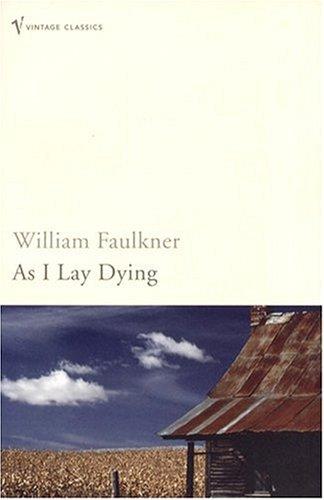
As I Lay Dying
by William Faulkner · 1930
A dirt-poor Mississippi family hauls their mother's decomposing body across the county to bury her as promised, narrated by 15 different voices including, for one unforgettable chapter, the corpse herself.
Worth reading? As I Lay Dying sounds like a grim slog on paper -- a family hauling a rotting corpse across Mississippi in a wagon -- and reads instead like a darkly funny, formally inventive gut-punch. The 15 rotating narrators, including a chapter from the dead mother herself, sound genuinely different from each other, which is harder to pull off than it looks and is exactly what makes the book work. It's shorter and faster-moving than Faulkner's reputation for difficulty suggests.
| Full Title | As I Lay Dying |
|---|---|
| Author | William Faulkner |
| Published | 1930 |
| Publisher | Vintage International |
| Category | Fiction |
| Favorite quote | “My mother is a fish.” |
The Verdict
This book is easier to actually read than its premise makes it sound. Yes, a family hauls their mother’s rotting corpse across the county in a wagon – but the short, rotating chapters move fast, and Faulkner gives each of the 15 narrators a genuinely distinct voice, so you’re never lost for long even when the story gets strange.
The dark comedy is doing real work here, not undercutting the grief but sitting right beside it. Cash narrating his mother’s coffin construction like a carpentry log while she’s dying in the next room is funny and devastating at the same time, and that’s Faulkner’s real skill on display.
Read it as your first Faulkner if you’ve been intimidated by his reputation. Skip it only if fragmented, multi-narrator structure genuinely frustrates you rather than intrigues you – this book asks you to do some assembly work, and if that’s not your kind of reading, it’ll show.
you want to see stream-of-consciousness fiction pushed toward the absurd and the tragic at the same time, in short, propulsive chapters that move faster than the premise suggests
you need a single reliable narrator to orient you -- this book gives you fifteen different, sometimes contradictory perspectives and trusts you to piece the truth together yourself

Book Summary
Addie Bundren dies, having extracted a promise from her family to bury her in Jefferson, Mississippi, forty miles away, and the novel follows the Bundren family's increasingly disastrous journey to fulfill that promise -- flooded rivers, a burned barn, a broken leg treated with concrete, and a corpse that grows more unbearable by the day.
Faulkner tells the story through 59 short chapters narrated by 15 different characters, each with a distinct voice and limited knowledge, so the "truth" of the family's motives (why each Bundren really wants to go to town) only assembles once you've triangulated across multiple unreliable perspectives, including the strikingly modern-sounding one-line chapter from young Vardaman: "My mother is a fish."
Addie's own chapter, delivered from beyond death, reveals a marriage and a life built on words she never trusted (she believed language was a poor substitute for actual experience), retroactively recoloring everything her family has said and done up to that point.
The novel balances genuine tragedy (poverty, grief, a family barely holding together) with dark, absurdist comedy (the corpse's smell drawing buzzards, Cash's matter-of-fact carpentry commentary on his mother's coffin construction even as it's happening), refusing to let either tone cancel the other out.
Top 7 Lessons from As I Lay Dying
- The rotating 15-narrator structure means no single character has the full truth -- you have to actively triangulate motive and fact across contradictory perspectives, which is the book's central formal argument about how family knowledge actually works.
- Addie's own posthumous chapter reveals her distrust of language itself, retroactively complicating every word her family has spoken about her and their motives for the journey.
- Each family member's real reason for wanting to reach Jefferson turns out to be more selfish and specific than 'honoring mother' -- Anse wants new teeth, Dewey Dell needs an abortion, and the ostensible mission is really a cover for private agendas.
- Vardaman's one-line chapter, 'My mother is a fish,' is often cited as one of the boldest, most compressed expressions of a child's grief in American fiction.
- The novel refuses to let tragedy and dark comedy cancel each other out -- the buzzards circling the decomposing body and Cash's deadpan carpentry commentary sit right next to real grief without undercutting it.
- Faulkner reportedly wrote the novel in about six weeks without revision, and its propulsive, almost breathless pacing across short chapters reflects that speed.
- The book is frequently used as the entry point into Faulkner's work precisely because its chapters are so short, making the difficulty of his style more digestible than in a novel like The Sound and the Fury.
Top 3 Quotes from As I Lay Dying
"My mother is a fish."
William Faulkner, As I Lay Dying
"I could just remember how my father used to say that the reason for living was to get ready to stay dead a long time."
William Faulkner, As I Lay Dying
"That was when I learned that words are no good; that words don't ever fit even what they are trying to say at."
William Faulkner, As I Lay Dying
Frequently Asked Questions
Is As I Lay Dying worth reading?
Yes -- it's darker and stranger on paper than in practice, and its short, rotating chapters make it more approachable than Faulkner's reputation suggests.
What is As I Lay Dying about?
The Bundren family's disaster-plagued journey to bury their mother's body in Jefferson, Mississippi, narrated through 15 rotating, sometimes contradictory perspectives.
Is As I Lay Dying a good introduction to Faulkner?
Yes, often recommended as the entry point -- its short chapters make his dense style more manageable than The Sound and the Fury.
Who narrates As I Lay Dying?
Fifteen different characters narrate across 59 chapters, including most of the Bundren family and several neighbors, plus one chapter from Addie Bundren after her death.
Why does 'My mother is a fish' matter in As I Lay Dying?
It's young Vardaman's entire one-line chapter, widely cited as one of the most compressed, striking expressions of childhood grief in American fiction.
Ready to read it?
Get As I Lay Dying on Amazon