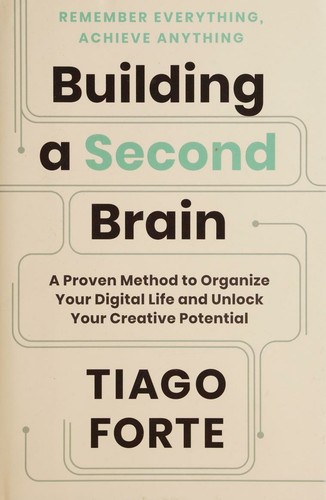
Building a Second Brain
by Tiago Forte · 2022
Forte's system for turning scattered notes, links, and half-ideas into a searchable external memory you actually use, instead of a graveyard of clippings.
Worth reading? Building a Second Brain formalizes note-taking into a full pipeline: CODE (Capture, Organize, Distill, Express) for the workflow, and PARA (Projects, Areas, Resources, Archives) for the folder structure. Compared to a Zettelkasten-style system, PARA organizes by actionability rather than topic, which makes it faster to set up but arguably weaker for deep, connected thinking over years. It's the most approachable "external brain" system for people who've never had one, rather than the most sophisticated for people who already have opinions about note-taking. Skip it if your current system already gets used, this solves the problem of starting, not of optimizing an existing practice.
| Full Title | Building a Second Brain: A Proven Method to Organize Your Digital Life and Unlock Your Creative Potential |
|---|---|
| Author | Tiago Forte |
| Published | 2022 |
| Publisher | Atria Books |
| Category | Self-Improvement & Psychology |
| Favorite quote | “You don't need to be a different kind of person to be organized. You just need the right system.” |
The Verdict
Forte’s real fix is retrieval, not capture: most people’s notes systems fail because nothing gets looked at again, not because nothing gets saved. PARA (organize by actionability) and CODE (capture, organize, distill, express) are the two frameworks worth taking, even if you build your own system around them later.
you save articles, highlights, and notes you never look at again and want an actual retrieval system
you already run a working notes system (Zettelkasten, PARA, or your own) that you trust -- this replaces the theory you've likely already solved
Book Summary
Most people's note-taking fails at retrieval, not capture. They save plenty, articles, quotes, ideas, but almost never resurface any of it, so the system becomes a write-only graveyard instead of a usable memory.
The CODE method (Capture, Organize, Distill, Express) turns raw notes into finished output: capture what resonates, organize it by where it'll be used (PARA), distill it down (progressive summarization) so future-you can scan it fast, and express it by actually shipping something with it.
Organize by actionability, Projects, Areas, Resources, Archives, not by topic or source. A note's home should be determined by what you're going to do with it, not by what category it intellectually belongs to.
Top 7 Lessons from Building a Second Brain
- Note-taking fails at retrieval, not capture; the goal is a system you actually revisit, not one that just collects.
- CODE: Capture what resonates, Organize by actionability, Distill for future scanning, Express by shipping something.
- PARA organizes notes by actionability (Projects, Areas, Resources, Archives), not by topic.
- Progressive summarization, bolding and highlighting on each revisit, compresses a note so future-you can scan it in seconds.
- Capture selectively; saving everything you encounter is the same failure mode as saving nothing, just noisier.
- A note's home is determined by what you'll use it for, not by which subject it intellectually belongs to.
- Finished output (an essay, a deck, a decision) is the actual test of whether your notes system works.
Top 3 Quotes from Building a Second Brain
"You don't need to be a different kind of person to be organized. You just need the right system."
Tiago Forte, Building a Second Brain
"A Second Brain is a system for turning that constant stream of information into knowledge that is easy to find and put to use."
Tiago Forte, Building a Second Brain
"Organize your notes based on where they are going, not where they came from."
Tiago Forte, Building a Second Brain
Frequently Asked Questions
Is Building a Second Brain worth reading?
Yes, if you save notes and articles you never revisit. It's the most approachable entry point into an external notes system, especially the CODE and PARA frameworks.
What is PARA in Building a Second Brain?
Projects, Areas, Resources, Archives, a folder structure organized by actionability (what you'll use a note for) rather than by topic or source.
Is this the same as a Zettelkasten system?
No. PARA organizes by actionability; Zettelkasten organizes by linked ideas for deep, connected thinking. PARA is faster to set up, Zettelkasten arguably compounds better for long-term original thinking.
Ready to read it?
Get Building a Second Brain on Amazon