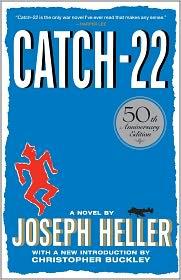
Catch-22
by Joseph Heller · 1961
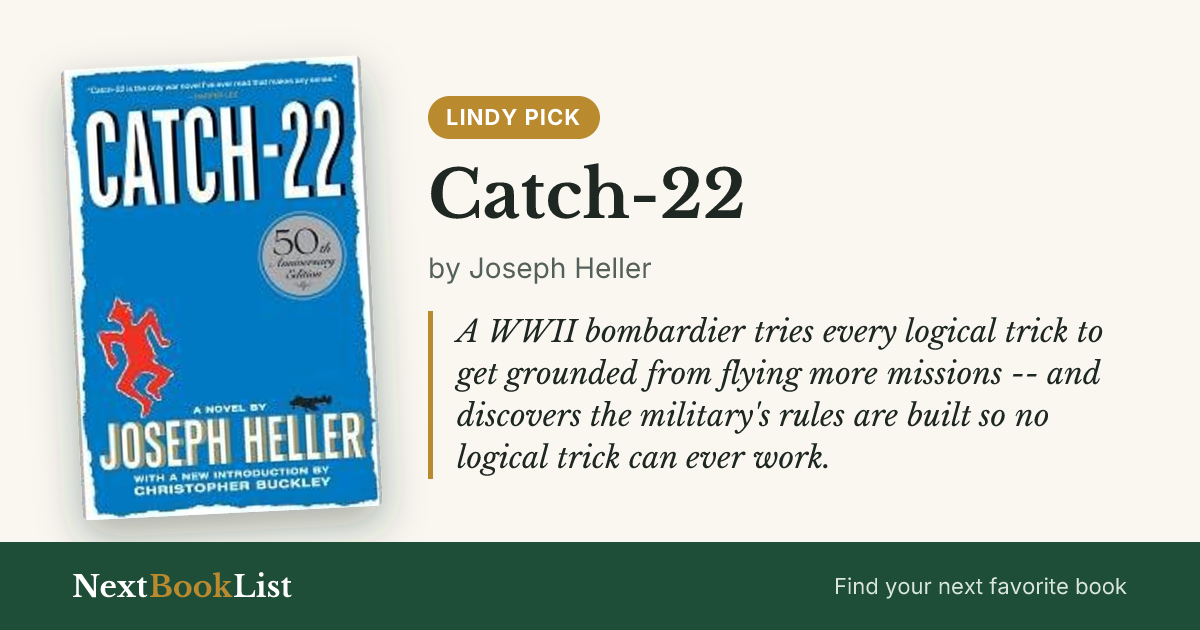
A WWII bombardier tries every logical trick to get grounded from flying more missions -- and discovers the military's rules are built so no logical trick can ever work.
| Author | Joseph Heller |
|---|---|
| Published | 1961 |
| Category | Fiction |
The Verdict
The trick nobody talks about is how the book earns its ending – 400 pages of farce that quietly accumulate into real grief once you realize how many of the funny early scenes ended in a death you’re only now understanding.
you want the sharpest satire of bureaucratic insanity ever written -- the book that gave the language its own word for a no-win rule
you need a linear plot -- this jumps in time and repeats scenes from different angles on purpose, which some readers find disorienting rather than funny
Book Summary
The novel's title concept -- you can be grounded for insanity, but asking to be grounded proves you're sane -- is Heller's model for how institutions trap people in rules that only exist to protect the institution, never the individual inside it.
Yossarian's growing paranoia isn't a character flaw; it's the only rational response to a system that keeps raising the number of required missions specifically so no one ever finishes. The book argues that in an absurd system, sanity looks like panic.
The comedy gets darker as the book goes on -- what starts as farce (Milo Minderbinder's syndicate, the endless bureaucratic doublespeak) ends in real deaths, and Heller's structure makes you feel the shift from funny to horrifying without ever changing tone.
Top 8 Lessons from Catch-22
- A catch-22 is a rule structured so that following it proves you don't qualify for the exception you're seeking.
- Bureaucracies optimize for self-preservation, not for the people they claim to serve.
- Escalating, arbitrary requirements (the ever-rising mission count) are a common trick for making an exit permanently unreachable.
- Profit motive taken to its logical extreme (Milo bombing his own base for a contract) exposes war's absurd economics.
- Comic repetition of a scene from different characters' perspectives can build dread instead of humor over time.
- Paranoia can be the sanest reaction to a genuinely insane environment.
- Language itself gets weaponized by institutions -- circular logic dressed up as official policy.
- Individual survival instinct is treated as heroic, not cowardly, when the cause itself is absurd.
Top 4 Quotes from Catch-22
"That's some catch, that Catch-22."
Joseph Heller, Catch-22
"It was a catch-22 ... Catch-22 stated that a concern for one's own safety in the face of dangers that were real and immediate was the process of a rational mind."
Joseph Heller, Catch-22
"Just because you're paranoid doesn't mean they aren't after you."
Joseph Heller, Catch-22
"The enemy is anybody who's going to get you killed, no matter which side he's on."
Joseph Heller, Catch-22
Frequently Asked Questions
Is Catch-22 worth reading?
Yes -- it's the sharpest satire of institutional absurdity in print, and its central concept became a permanent part of the language for a reason.
Is Catch-22 hard to read?
It's disorienting on purpose -- the timeline loops and repeats scenes from different angles, which trips up readers expecting a straight chronology.
What is the main theme of Catch-22?
That bureaucratic institutions build rules to protect themselves, not the individuals inside them, and that sane people can be trapped in genuinely insane systems.
Who should read Catch-22?
Anyone who wants the classic satire on military and institutional absurdity, with the patience for a nonlinear, repetitive structure that pays off.
Ready to read it?
Get Catch-22 on Amazon