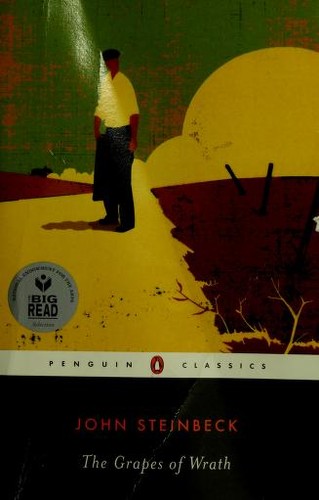
The Grapes of Wrath
by John Steinbeck · 1939
A dust-bowl family loses their farm, drives to California on a promise of work, and finds out the promise was a lie designed to keep wages low.
Worth reading? The Grapes of Wrath is the best novel written about the Depression because Steinbeck refuses to make it a story about bad luck -- he makes it a story about a system that profits from displaced people staying desperate. It's angrier and more structurally ambitious than most migration fiction that followed it, alternating the Joads' story with wide-lens chapters about the Dust Bowl migration as a whole. Skip it if you want the Joads' story alone without the interchapters -- but the interchapters are half of what makes the book great.
| Author | John Steinbeck |
|---|---|
| Published | 1939 |
| Publisher | Penguin Classics |
| Category | Fiction |
| Favorite quote | “In the souls of the people the grapes of wrath are filling and growing heavy, growing heavy for the vintage.” |
The Verdict
Steinbeck doesn’t let you read this as a story about one unlucky family. Every few chapters he pulls back to show the machinery doing the same thing to everyone – a used-car lot fleecing desperate buyers, a tractor driver evicting a farm he doesn’t even hate, a labor market deliberately oversupplied so wages collapse. That structural anger is what separates it from lesser Dust Bowl fiction that settled for sentiment.
It earns its reputation as a classic by refusing comfort at every turn, right up to its startling final image. If you want Depression-era fiction with teeth instead of nostalgia, this is still the one to read.
you want the definitive American novel about economic dispossession -- what happens to a family, and a country, when the land stops paying
you want fast plotting -- Steinbeck alternates story chapters with slower, essayistic 'interchapters' about the migration as a whole, and some readers find those a drag
Book Summary
The Joad family's eviction from their Oklahoma farm isn't framed as bad luck -- it's the direct result of banks and landowners treating land as a balance sheet entry rather than a place people live. Steinbeck spends real page count on the mechanics of foreclosure and tractor-driven eviction specifically so the reader can't read it as a natural disaster story.
California, sold to migrants as the promised land through handbills advertising plentiful work, turns out to be running the oldest trick in the book: recruit far more workers than jobs exist, so desperate people underbid each other and wages collapse. The novel's real villain isn't a person, it's this deliberately engineered oversupply of labor.
Against that system, Steinbeck poses one answer: solidarity between the dispossessed, even strangers, is the only thing that keeps people from being fully ground down. Ma Joad's insistence on family (and eventually a wider 'family' of fellow migrants) as the unit that survives, and the novel's famous, startling final image of a stranger nursing another stranger, are Steinbeck's thesis stated as plainly as fiction allows.
Top 9 Lessons from The Grapes of Wrath
- The Joads' eviction is systemic, not personal -- banks foreclose because the balance sheet demands it, with no one individual to blame or appeal to.
- California's handbills advertising abundant fruit-picking work are a deliberate lie, designed to oversupply labor and crash wages.
- Tom Joad's arc, from self-interested ex-con to a man willing to organize migrant workers, is the novel's clearest statement that individual survival isn't enough.
- Ma Joad holds the family together through sheer will, and the novel treats her as the moral center more than any male character.
- The interchapters (a turtle crossing a road, a used-car salesman fleecing desperate families, a landowner explaining foreclosure) widen the Joads' story into a portrait of the whole migration.
- Casy's arc, from disillusioned preacher to labor organizer to martyr, argues that the only 'holy' work left is fighting for people's material conditions.
- Migrant camps run by the migrants themselves (like the Weedpatch camp) are shown working better than anything imposed on them -- self-governance beats charity.
- The novel's title comes from the idea that mistreatment compounds -- 'the grapes of wrath are filling and growing heavy' -- until it eventually has to be harvested by someone.
- The final scene, Rose of Sharon nursing a starving stranger after her own baby is stillborn, is Steinbeck's argument that solidarity with strangers is what's left when institutions fail everyone.
Top 4 Quotes from The Grapes of Wrath
"Wherever they's a fight so hungry people can eat, I'll be there."
John Steinbeck, The Grapes of Wrath
"In the souls of the people the grapes of wrath are filling and growing heavy, growing heavy for the vintage."
John Steinbeck, The Grapes of Wrath
"How can you frighten a man whose hunger is not only in his own cramped stomach but in the wretched bellies of his children?"
John Steinbeck, The Grapes of Wrath
"A fella ain't got a soul of his own, just a little piece of a big soul, the one big soul that belongs to ever'body."
John Steinbeck, The Grapes of Wrath
Frequently Asked Questions
Is The Grapes of Wrath worth reading?
Yes -- it's the defining American novel of economic displacement, and its anger at exploited labor still lands. Skip it only if the alternating interchapter structure genuinely breaks your momentum.
What is the main theme of The Grapes of Wrath?
That systemic economic forces, not individual failure, destroy families like the Joads, and that solidarity among the dispossessed is the only real counterweight.
Is The Grapes of Wrath hard to read?
The prose itself is plain and direct. What slows readers down is the structure -- Steinbeck alternates the Joads' story with wider 'interchapters' about the migration as a whole.
Why is it called The Grapes of Wrath?
The title comes from a line late in the novel about mistreatment compounding until it has to be harvested -- borrowed from the Battle Hymn of the Republic's 'grapes of wrath' imagery.
Ready to read it?
Get The Grapes of Wrath on Amazon