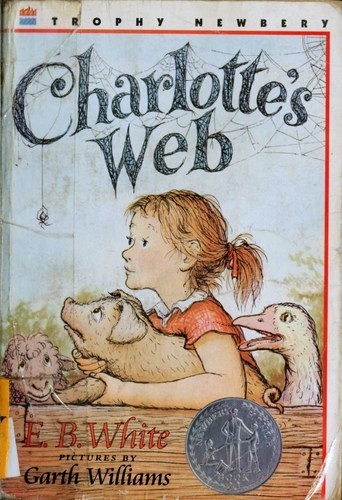
Charlotte's Web
by E.B. White · 1952
A runt pig named Wilbur is saved from slaughter twice -- once by a girl, once by a spider who writes -- in a children's book that talks about death more honestly than most books written for adults.
Worth reading? Charlotte's Web works on two levels at once, which is the entire reason it's still in print seventy-plus years later. A young reader gets a friendship story with a pig, a spider, and a fair full of animals. An adult reading it aloud notices White's prose doing something much harder: talking plainly about mortality, loyalty, and what a friend actually owes you, without a wasted sentence anywhere in the book.
| Author | E.B. White |
|---|---|
| Published | 1952 |
| Publisher | Harper & Row |
| Category | Fiction |
| Favorite quote | “It is not often that someone comes along who is a true friend and a good writer.” |
The Verdict
The trick of Charlotte’s Web is that it never talks down to a kid, and it never pads itself out for an adult either. Every sentence is doing work. White was a professional stylist (co-author of The Elements of Style) before he wrote this, and it shows in how little fat is on the prose.
Charlotte’s death is the reason this book still gets handed to kids specifically, not despite it. It’s presented plainly, as something that happens because spiders have short lives, not as a moral lesson or a plot twist to be softened. That’s harder to write well than a sad ending dressed up in metaphor, and White pulls it off without sentimentality.
If you’re reading this as an adult for the first time, don’t expect a book that needs the excuse of nostalgia to hold up. It doesn’t.
Read it if you’re reading to a kid who’s old enough to handle a friend dying on the page, or if you want to see what a genuinely well-crafted children’s book looks like. Skip it if you’re specifically looking to avoid the subject of death with a young reader – this book won’t dodge it for you.
you're reading it to (or with) a kid roughly age 6-10, or you're an adult who wants proof that a children's book can be genuinely well-written, not just competent
you want a story that avoids death entirely -- Charlotte dies at the end, on the page, and the book doesn't soften it for younger readers who might need a heads-up
Book Summary
Wilbur, the runt of a litter, is saved from being killed as a piglet by Fern, a farm girl who raises him by hand. When he's moved to her uncle's barn and faces slaughter again as a full-grown pig, a barn spider named Charlotte decides to save him -- not with sentiment, but by weaving words like "Some Pig" into her web to convince the farmer Wilbur is worth keeping alive.
The book's structure quietly shifts its central relationship: Fern, the human girl, fades into the background as she gets older and more interested in the fair's Ferris wheel than the barn, while Charlotte, a spider Wilbur barely trusted at first, becomes the actual emotional center of the story.
White doesn't flinch from Charlotte's death after she lays her egg sac at the fair -- she dies alone, her work done, and Wilbur carries her children's egg sac home himself. The book treats her death as a fact of a short natural lifespan, not a tragedy to be avoided, which is precisely what generations of parents and teachers have found so useful for introducing kids to loss.
Top 7 Lessons from Charlotte's Web
- Charlotte saves Wilbur not through sentiment but through skill -- she writes words in her web that manipulate how the humans around the farm perceive Wilbur's worth, a very practical kind of friendship.
- Fern, the human protagonist for the book's first third, deliberately fades from the story's center as she grows older and more interested in the fair than in barn animals -- the book lets a child's attention naturally move on without treating it as betrayal.
- The book doesn't hide that Charlotte's lifespan is naturally short and that she will die after laying her eggs -- her death is presented as a fact of being a spider, not an avoidable tragedy.
- Templeton the rat helps Wilbur only when there's something in it for him, and the book never redeems him into a nicer character -- not every animal in a children's book needs a moral arc.
- Wilbur's fear of death drives the entire plot, and the book treats a child's fear of dying as a legitimate, serious thing worth an entire novel's answer, rather than something to brush past.
- Charlotte's actual gift to Wilbur isn't saving his life once -- it's her insistence that true friendship requires real work and sometimes real sacrifice, which she demonstrates rather than states.
- The book ends with Wilbur caring for Charlotte's surviving children, showing that what a friend leaves behind can outlast the friendship itself.
Top 5 Quotes from Charlotte's Web
"It is not often that someone comes along who is a true friend and a good writer."
E.B. White, Charlotte's Web
"You have been my friend. That in itself is a tremendous thing."
E.B. White, Charlotte's Web
"Where's Papa going with that ax?"
E.B. White, Charlotte's Web
"You're terrific as far as I'm concerned, and that's what counts. You're my best friend, and I think you're sensational."
E.B. White, Charlotte's Web
"Wilbur never forgot Charlotte. Although he loved her children and grandchildren dearly, none of the new spiders ever quite took her place in his heart."
E.B. White, Charlotte's Web
Frequently Asked Questions
Is Charlotte's Web worth reading?
Yes -- it's a genuinely well-written children's book, not just a competent one, and it handles death and friendship honestly enough that adults get as much out of it as kids do.
What age is Charlotte's Web appropriate for?
Generally ages 6-10 for independent reading, though it works well as a read-aloud for younger kids, with the understanding that Charlotte dies on the page near the end.
Does Charlotte die in Charlotte's Web?
Yes -- Charlotte dies at the fair after laying her egg sac, and the book doesn't skip past it, which is part of why it's used so often to help kids process the idea of loss.
Is Charlotte's Web only for kids?
No -- it's short enough and well-crafted enough that adults reading it for the first time, or rereading it, generally find more in the prose than they expected from a children's book.
How is Charlotte's Web different from the movie versions?
The book is quieter and more restrained than the animated or live-action adaptations, without added songs or subplots, and Charlotte's death is handled with less spectacle and more plainness.
Ready to read it?
Get Charlotte's Web on Amazon