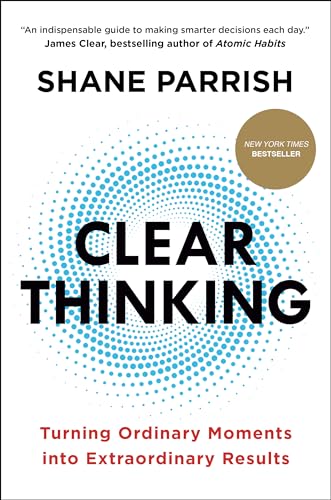
Clear Thinking
by Shane Parrish · 2023
Parrish's case that extraordinary results come from protecting your judgment in ordinary moments, before your emotions and ego take the wheel.
Worth reading? Clear Thinking reframes the whole self-improvement genre around one underrated idea: the moment that decides your outcome isn't the big one, it's the small, ordinary one right before it, when your default state is still in charge. Parrish's four threats to clear thinking, ego, emotion, social friction, and inertia, are the most useful part, and his advice to design your environment so the right choice is the easy one beats any willpower pep talk. Skip it if you came for a fresh list of biases; read it if you want to actually perform when it counts.
| Full Title | Clear Thinking: Turning Ordinary Moments into Extraordinary Results |
|---|---|
| Author | Shane Parrish |
| Published | 2023 |
| Category | Self-Improvement & Psychology |
| Favorite quote | “Clear Thinking is about recognizing the pivotal moments between stimulus and response, and learning to deploy our full cognitive capacity to them.” |
The Verdict
Clear Thinking reframes the whole self-improvement genre around one underrated idea: the moment that decides your outcome isn’t the big one, it’s the small, ordinary one right before it, when your default state is still in charge. Parrish’s four threats are the useful core, and his environmental fix beats any willpower pep talk.
knowledge workers, founders, and anyone whose day is a chain of small decisions that quietly compound into a life
you want a bias catalog, this is about building systems and environments that keep you clear, not naming every cognitive glitch
Book Summary
Parrish's central claim: you don't rise to the level of your goals, you fall to the level of your systems, and the system that matters most is the one guarding your judgment in ordinary moments. Four forces hijack clear thinking: ego (defending over deciding), emotion (reacting over reasoning), social friction (fitting in over finding truth), and inertia (defaulting over choosing). Naming them is half the defense. The fix is environmental, not heroic: arrange your life so the clear choice is the path of least resistance, because in the moment your deliberate mind is slow and your defaults are fast.
Top 8 Lessons from Clear Thinking
- Protect the moment before the moment, your ordinary default state, not the crisis, decides your result.
- Name the four hijackers, ego, emotion, social friction, inertia, so you can catch them in real time.
- Design your environment so the right call is the easy one; don't rely on willpower in the heat of the moment.
- Separate the decision from the noise, slow the inputs before a big choice, not after.
- Ego is the most expensive tax on judgment; winning the argument is rarely worth losing the decision.
- Build a 'rules for myself' list in advance, when you're calm, so you don't negotiate with yourself under pressure.
- Inertia is the silent killer, most bad outcomes are just unexamined defaults left to run.
- Surround yourself with people who raise your standard of thinking, not just your comfort.
Top 5 Quotes from Clear Thinking
"One reason the best in the world make consistently good decisions is they rarely find themselves forced into a decision by circumstances."
Shane Parrish, Clear Thinking
"You don't need to be smarter than others to outperform them if you can out-position them."
Shane Parrish, Clear Thinking
"Anyone looks like a genius when they're in a good position, and even the smartest person looks like an idiot when they're in a bad one."
Shane Parrish, Clear Thinking
"It's easy to believe we're thinking clearly when it matters, but that's not true."
Shane Parrish, Clear Thinking
"Clear Thinking is about recognizing the pivotal moments between stimulus and response, and learning to deploy our full cognitive capacity to them."
Shane Parrish, Clear Thinking
Frequently Asked Questions
Is Clear Thinking worth reading?
Yes, if the description fits you, knowledge workers, founders, and anyone whose day is a chain of small decisions that compound into a life. Skip it if you want a bias catalog; this is about building environments that keep you clear.
What is the main idea of Clear Thinking?
That extraordinary results come from protecting your judgment in ordinary moments, before emotion, ego, and inertia take the wheel, not from heroic effort at the point of crisis.
Who should read Clear Thinking?
People whose work is mostly decisions: operators, investors, founders, and anyone who wants to perform when it counts rather than just know more. Skip it for a pure catalog of cognitive biases.
What will you get out of Clear Thinking?
A short framework for the four forces that hijack judgment and a set of environmental tricks so the clear choice is the default, plus the sharpest lessons pulled into a list so you don't have to read the whole book to decide.
Ready to read it?
Get Clear Thinking on Amazon