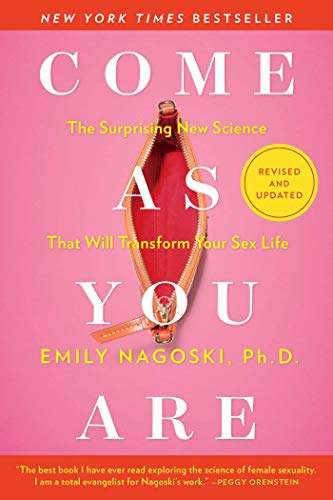
Come As You Are
by Emily Nagoski · 2015
A sex educator with a Kinsey Institute background makes the case that most sexual 'problems' are normal variation, not dysfunction, and gives you the science to prove it.
Worth reading? Come As You Are is the best popular-science book on female sexuality because Nagoski backs every claim with actual research instead of vibes, and reframes 'low desire' or 'slow arousal' as normal variation rather than a problem to fix. It's more rigorous than most sex-advice books and more usable than a straight academic text. Read the dual control model chapter alone and you'll understand more than a decade of magazine advice got right.
| Full Title | Come As You Are: Revised and Updated: The Surprising New Science That Will Transform Your Sex Life |
|---|---|
| Author | Emily Nagoski |
| Published | 2015 |
| Publisher | Simon & Schuster |
| Category | Science & Nature |
| Favorite quote | “Emotions are tunnels. You have to go all the way through the darkness to get to the light at the end.” |
The Verdict
Nagoski’s real contribution isn’t a new technique, it’s a new mental model: accelerator and brakes instead of a single dial. Once you understand that most “desire problems” are the brakes staying on – stress, self-judgment, feeling unsafe – rather than a broken accelerator, a lot of well-meaning advice about spicing things up stops making sense as a fix.
It’s a longer, denser read than most books shelved next to it, closer to a textbook with jokes than a quick self-help read. Worth the time if you actually want to understand your own responses instead of copying someone else’s checklist.
you want an evidence-based, judgment-free explanation of how sexual desire and arousal actually work, especially if you've been told your normal is broken
you want a technique-focused how-to guide -- this is closer to a biology and psychology text than a manual, though it changes how you'd approach technique
Book Summary
Nagoski's central model is "dual control": every person has both an accelerator (things that turn you on) and brakes (things that turn you off, often stress, self-monitoring, or perceived risk), and sexual problems are far more often an overactive brake than an underpowered accelerator. Most advice focuses on the accelerator and misses the brake entirely.
She argues desire comes in two flavors -- spontaneous (wanting sex out of nowhere) and responsive (desire that shows up after arousal starts, in response to a partner or context) -- and that responsive desire is completely normal, not a lesser or broken version of spontaneous desire, even though pop culture treats spontaneous desire as the default.
The book leans heavily on the idea that context matters more than anatomy: stress, body image, relationship trust, and the emotional state of your nervous system determine sexual response far more than any innate wiring, which is why the same body can respond completely differently in different circumstances.
Top 10 Lessons from Come As You Are
- Everyone has a sexual accelerator and brakes -- most low-desire problems are an overactive brake, not a weak accelerator.
- Desire comes in spontaneous and responsive forms, and responsive desire (arousal before wanting) is normal, not broken.
- Context -- stress, body image, trust, safety -- changes sexual response more than anatomy does.
- Comparing your sexual response to a partner's or to a cultural 'normal' creates its own brake through anxiety.
- Genital arousal (physical wetness or swelling) and subjective arousal (feeling turned on) don't always match, and that mismatch is normal.
- Stress has to be actively completed, not just removed, to fully turn off the brakes -- Nagoski calls this closing the stress cycle.
- Self-compassion, not self-esteem, is framed as the more useful foundation for sexual confidence.
- Nonconcordance between what your body does and what you consciously want is common and not evidence of dishonesty or dysfunction.
- Cultural messages about 'good' bodies and 'normal' desire function as brakes for a huge number of people, independent of biology.
- The goal of the book is to help you understand your own particular sexuality, not conform to a population average.
Top 5 Quotes from Come As You Are
"Self-compassion is emphatically not self-esteem. Self-esteem is about self-evaluation... Self-compassion, by contrast, is unconditional and nonevaluative."
Emily Nagoski, Come As You Are
"It's not about weight or size or fat -- weight is a measure of gravity and nothing else -- it's about living joyfully inside your body, as it is, today."
Emily Nagoski, Come As You Are
"I am done living in a world where women are lied to about their bodies; where women are objects of sexual desire but not subjects of sexual pleasure."
Emily Nagoski, Come As You Are
"Love is having. Desire is wanting. And you can want only what you don't already have."
Emily Nagoski, Come As You Are
"Emotions are tunnels. You have to go all the way through the darkness to get to the light at the end."
Emily Nagoski, Come As You Are
Frequently Asked Questions
Is Come As You Are worth reading?
Yes, especially if you've been told your desire or arousal is 'wrong.' It's the most evidence-based popular book on the subject.
What is the dual control model in Come As You Are?
The idea that sexual response depends on both an accelerator (turn-ons) and brakes (turn-offs like stress or self-judgment), and that most low-desire issues come from an overactive brake, not a weak accelerator.
Is Come As You Are only for women?
It's written primarily around female sexuality and research, but the underlying accelerator/brakes model and stress-cycle concept apply more broadly.
Who should read Come As You Are?
Anyone who wants a judgment-free, research-backed explanation of sexual desire and arousal. Skip it if you want a quick technique guide rather than the underlying science.
Ready to read it?
Get Come As You Are on Amazon