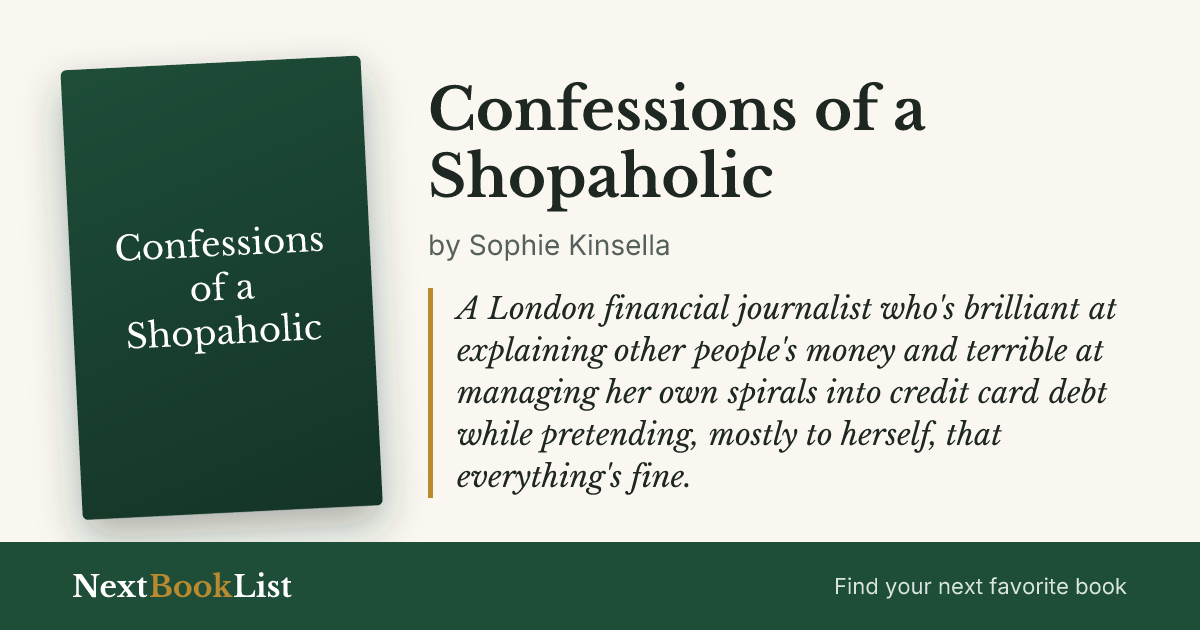
Confessions of a Shopaholic
by Sophie Kinsella · 2000
A London financial journalist who's brilliant at explaining other people's money and terrible at managing her own spirals into credit card debt while pretending, mostly to herself, that everything's fine.
Worth reading? Confessions of a Shopaholic sells itself on premise more than plot -- a financial journalist who can't manage her own money is a genuinely funny irony -- and Kinsella milks it for exactly as much as it's worth without overstaying its welcome.
| Author | Sophie Kinsella |
|---|---|
| Published | 2000 |
| Publisher | Dial Press |
| Category | Fiction |
The Verdict
Kinsella knows exactly what kind of book she’s writing, and the pacing reflects it: short chapters, a lot of internal monologue, and a plot that moves fast enough that you don’t dwell on how implausible some of Becky’s rationalizations are.
The financial-journalist irony is the whole engine, and it’s a good one. Watching someone explain sound money advice to readers in chapter one and then buy a designer scarf on credit in chapter two never really stops being funny, even once you’ve clocked the pattern.
Read it if you want a fast, funny read that turns financial denial into comedy instead of tragedy. Skip it if you want the book’s ending to actually reckon with the habits that got Becky into debt in the first place.
you want light, funny chick-lit with a genuinely relatable financial-denial premise and don't need the humor to be subtle
you want realistic consequences for reckless spending -- the plot resolution leans convenient, and the book is more interested in charm than in a hard look at debt
Book Summary
Rebecca Bloomwood writes about personal finance for a living while drowning in her own credit card debt, maintaining an elaborate system of avoidance: unopened bills, dodged phone calls from her bank, and a running internal monologue that reframes every purchase as somehow necessary or inevitable.
The comedy comes from the gap between Becky's professional voice (confident, competent, telling readers how to save money) and her actual behavior (impulsive, self-deceiving, buying a scarf she can't afford to avoid thinking about a bill she can't pay). Kinsella structures whole chapters around Becky's internal justifications, which is where the book's satire of consumer culture actually lands.
The plot eventually pushes Becky toward a public reckoning with her debt, and the book's ending leans on a career pivot that resolves things more neatly than her financial habits alone would. It's a comedy, not a cautionary tale, and it plays by comedy's rules.
Top 10 Lessons from Confessions of a Shopaholic
- Becky's debt-avoidance rituals -- unopened envelopes, dodged calls, mental reframing of purchases as 'investments' -- are exaggerated for comedy but land because the underlying denial pattern is real.
- The gap between professional expertise and personal behavior is the book's engine: Becky can explain compound interest to readers while ignoring her own credit card statements.
- Retail therapy in the novel functions as anxiety management, not greed -- Becky shops hardest when she's avoiding something else, usually a bill or a hard conversation.
- Kinsella satirizes early-2000s consumer culture and credit card marketing without turning the book into a lecture about debt.
- The plot resolution relies on a convenient career opportunity rather than Becky actually changing her spending habits, which is a fair thing to go in expecting from this genre.
- The humor works best in the internal monologue chapters, where Becky's justifications for a purchase run several absurd steps past where a reasonable person would stop.
- Becky's cat-and-mouse routine with Derek Smeath, the debt collector chasing her overdue bank balance, escalates across the book into some of its broadest comic set pieces, turning avoidance itself into a running physical joke.
- Becky's roommate Suze, wealthy and generous without judgment, is used as a foil who never questions Becky's spending, which lets the book show how an enabling friendship can make financial denial easier to sustain.
- The turning point comes when Becky, put on live television to comment on a financial story, improvises genuinely sound advice on the spot, showing her expertise was real all along even though she never applied it to herself.
- Becky's habit of buying things she never uses (a bread maker, a pasta machine, a wall of unworn clothes) is a recurring visual gag that makes her denial concrete rather than just something she narrates.
Frequently Asked Questions
Is Confessions of a Shopaholic worth reading?
Yes, if you want light, funny fiction with a relatable premise -- it's fast and charming, not a serious treatment of debt.
Is the book part of a series?
Yes -- it's the first of several Shopaholic novels following Becky Bloomwood.
Is the movie faithful to the book?
The 2009 film loosely combines plot elements from the first two books and changes the setting from London to New York.
Does Becky actually fix her spending habits by the end?
The book resolves her immediate debt crisis more through a career opportunity than through changed spending behavior -- don't expect a tidy financial-discipline arc.
Is this a good book to read about managing debt?
No -- read it for the comedy and the premise, not for practical financial advice.
Ready to read it?
Get Confessions of a Shopaholic on Amazon