Crime and Punishment
by Fyodor Dostoevsky · 1866
A broke ex-student in St. Petersburg murders a pawnbroker to prove he's exempt from ordinary morality -- then spends 500 pages finding out he isn't.
Worth reading? Crime and Punishment has stayed in print for over 150 years because it got something right that most crime fiction still gets wrong: the psychological aftermath is more compelling than the crime itself. It's slower and more interior than modern readers expect from a novel with 'murder' in the premise, but the payoff -- watching a man's self-justification collapse in real time -- is still unmatched. Go in expecting a character study with a police procedural wrapped around it, not a thriller.
| Full Title | Crime and Punishment (Pevear & Volokhonsky Translation) |
|---|---|
| Author | Fyodor Dostoevsky |
| Published | 1866 |
| Category | Fiction |
| Favorite quote | “Pain and suffering are always inevitable for a large intelligence and a deep heart.” |
The Verdict
What holds up best isn’t the murder plot – it’s Porfiry Petrovich, the detective who never needs to catch Raskolnikov in a lie because he understands his psychology better than Raskolnikov understands himself. That cat-and-mouse dynamic, built entirely on conversation rather than evidence, is the template a lot of modern psychological thrillers are still copying without crediting the source.
you want the foundational psychological novel, the one that basically invented the modern crime-and-guilt narrative before Freud had a name for any of it
you're not ready for a genuine commitment -- this is a long, dense 19th-century Russian novel with a wall of patronymic names (Rodion Romanovich, Sofya Semyonovna) and a slow, interior first third; it rewards patience more than it grabs you
Book Summary
Raskolnikov's crime isn't really about money. He's built a theory (extraordinary men are permitted to break moral law if the outcome justifies it, a proto-Nietzschean idea Dostoevsky is directly arguing against) and murders the pawnbroker partly to test whether he's one of those extraordinary men. He isn't, and the novel is 500 pages of him discovering that the hard way.
The book's real subject is the gap between moral theory and lived conscience. Raskolnikov can construct a airtight intellectual justification for murder and still be destroyed by guilt his body registers before his mind admits it -- fever, isolation, compulsive half-confessions. Dostoevsky is arguing that conscience isn't a belief you can theorize away.
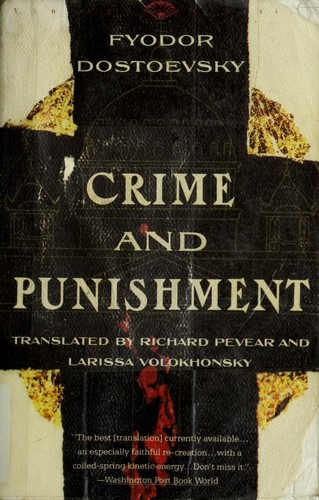
This edition (Pevear & Volokhonsky) is the widely-recommended modern translation -- closer to Dostoevsky's actual rhythm and repetition than the older Constance Garnett translation, which smoothed a lot of that out. Translation choice matters more with Dostoevsky than with most authors; this is the one to start with.
Top 10 Lessons from Crime and Punishment
- Intellectual justification for wrongdoing doesn't neutralize conscience -- guilt operates below the level of argument.
- Isolation compounds guilt; Raskolnikov's worst spirals happen when he cuts himself off from people who care about him.
- Redemption in the novel comes through confession and connection (Sonya), not through cleverer reasoning.
- Poverty and desperation don't excuse the crime, but Dostoevsky refuses to let you ignore how much they shape it.
- The detective Porfiry doesn't need hard evidence -- he wins by understanding Raskolnikov's psychology better than Raskolnikov does.
- Svidrigailov works as Raskolnikov's dark double -- a man who acts on the same amoral logic without any capacity for guilt, and ends in suicide rather than confession.
- Razumikhin is the road not taken: honest work and loyal friendship as a counterweight to Raskolnikov's isolating pride.
- The recurring dream of the beaten horse foreshadows the murder and exposes the cruelty underneath the theory Raskolnikov claims justifies it.
- Dunya's near-marriage to Luzhin mirrors her brother's crime -- a transaction dressed up as virtue that both siblings refuse once they see it clearly.
- The epilogue's exile and slow rebuilding in Siberia insists that real change follows the theorizing stopping, not a single dramatic confession.
Top 5 Quotes from Crime and Punishment
"Pain and suffering are always inevitable for a large intelligence and a deep heart."
Fyodor Dostoevsky, Crime and Punishment
"To go wrong in one's own way is better than to go right in someone else's."
Fyodor Dostoevsky, Crime and Punishment
"Your worst sin is that you have destroyed and betrayed yourself for nothing."
Fyodor Dostoevsky, Crime and Punishment
"Taking a new step, uttering a new word, is what people fear most."
Fyodor Dostoevsky, Crime and Punishment
"It takes something more than intelligence to act intelligently."
Fyodor Dostoevsky, Crime and Punishment
Frequently Asked Questions
Is Crime and Punishment worth reading?
Yes, if you want the original psychological crime novel and are willing to commit to its pace. It's dense and long, but the character study of guilt at its center hasn't been matched since.
Is Crime and Punishment hard to read?
Yes, relative to most fiction -- long sentences, a large cast of Russian names with patronymics and nicknames, and a slow first third. The Pevear & Volokhonsky translation is the easiest entry point among major English editions.
What translation of Crime and Punishment should I read?
Pevear & Volokhonsky is the most widely recommended modern translation -- it stays closer to Dostoevsky's original rhythm than the older Constance Garnett version most public-domain copies use.
What is the main theme of Crime and Punishment?
That intellectual theories justifying immoral acts collapse against the reality of lived guilt and conscience -- and that redemption comes through honest confession and human connection, not cleverer reasoning.
Ready to read it?
Get Crime and Punishment on Amazon