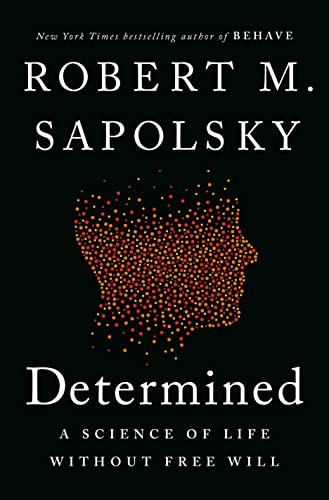
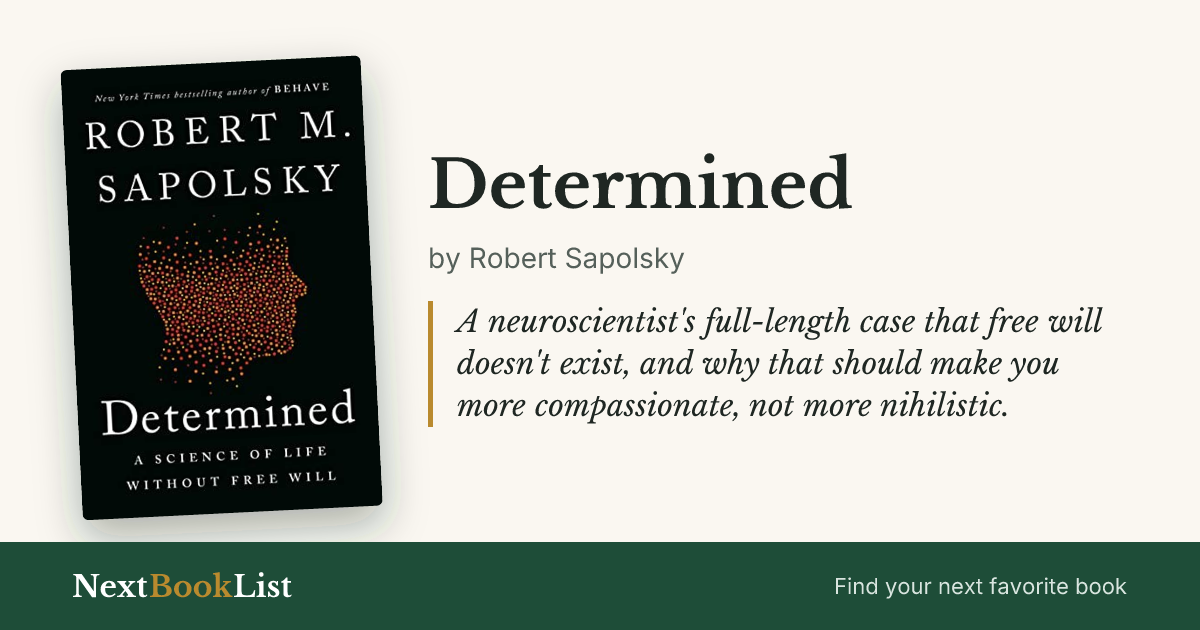
Determined
by Robert Sapolsky · 2023
A neuroscientist's full-length case that free will doesn't exist, and why that should make you more compassionate, not more nihilistic.
Worth reading? Determined is Sapolsky at his most uncompromising: every decision, he argues, is the output of biology, environment, and history stacked on top of each other, with no room left for a free-floating "you" that chooses independently of those causes. Compared to Thinking, Fast and Slow, this goes further and harder, Kahneman shows biased shortcuts, Sapolsky argues there's no "chooser" behind them at all. It's long, dense, and genuinely difficult in places. Skip it if you want something breezy. Read it if you want the strongest, most rigorous version of the "no free will" argument and its implications for blame, punishment, and merit.
| Full Title | Determined: A Science of Life without Free Will |
|---|---|
| Author | Robert Sapolsky |
| Published | 2023 |
| Publisher | Penguin Press |
| Category | Self-Improvement & Psychology |
| Favorite quote | “We are nothing more or less than the sum of our biology and its interactions with the environment.” |
The Verdict
Sapolsky doesn’t soften the thesis: there’s no free will, full stop, and the usual philosophical escape hatches don’t hold up under his scrutiny. It’s long and demanding, but the practical payoff, more compassion for people whose choices were shaped by causes they never picked, is worth the effort.
you want your assumptions about willpower, blame, and merit stress-tested by someone who actually studies brains
you want a quick, practical read -- this is a dense, argument-heavy science book, not a self-help title
Book Summary
Every behavior is the product of what happened a second before (neurons firing), seconds to minutes before (sensory triggers and hormones), hours to days before (stress and sleep), years before (development and adolescence), and generations before (genes and culture). Trace any decision back far enough and there's no gap left for uncaused free choice.
Sapolsky spends much of the book dismantling the usual rebuttals, quantum indeterminacy, emergent complexity, compatibilism, arguing each one smuggles free will back in through a side door rather than actually defending it.
If free will doesn't exist, moral responsibility and merit need rethinking, not abandoning. Sapolsky argues a world that stops moralizing about "bad" people and "good" people in favor of understanding causes would be both more accurate and more humane, particularly toward criminal justice and inequality.
Top 7 Lessons from Determined
- Trace any single decision back through neurons, hormones, development, and genes, and there's no gap left for a free chooser.
- The usual rebuttals to determinism (quantum randomness, emergent complexity, compatibilism) each smuggle free will back in without defending it directly.
- Believing less in free will doesn't have to mean nihilism -- it can mean more compassion for people whose 'choices' were shaped by causes they didn't pick.
- Praise and blame make sense as social tools even without libertarian free will, but they should be applied with more humility about causation.
- Criminal justice built on 'they chose evil' looks different once you take seriously that biology and circumstance did most of the choosing.
- Meritocracy assumes a level playing field of free choices; Sapolsky argues that playing field never existed.
- You can act as if you have free will practically while intellectually accepting you probably don't -- the two aren't fully reconcilable, and Sapolsky admits it.
Top 3 Quotes from Determined
"We are nothing more or less than the sum of our biology and its interactions with the environment."
Robert Sapolsky, Determined
"There is no free will, and this changes everything and nothing."
Robert Sapolsky, Determined
"The world does not need to have less hate in it. It needs to have less of the belief that hate is freely chosen."
Robert Sapolsky, Determined
Frequently Asked Questions
Is Determined worth reading?
Yes, if you want the most rigorous version of the free will debate from a working neuroscientist. It's long and dense, not a quick self-help read.
What's the main argument of Determined?
Every decision traces back to prior causes, neurons, hormones, development, genes, with no room left for an uncaused free choice. Sapolsky argues this should make us more compassionate, not more fatalistic.
Is this a self-help book?
No. It's closer to Thinking, Fast and Slow in register, a science-heavy argument book, though its conclusions have practical implications for how you view blame and merit.
Ready to read it?
Get Determined on Amazon