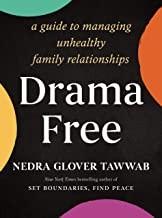
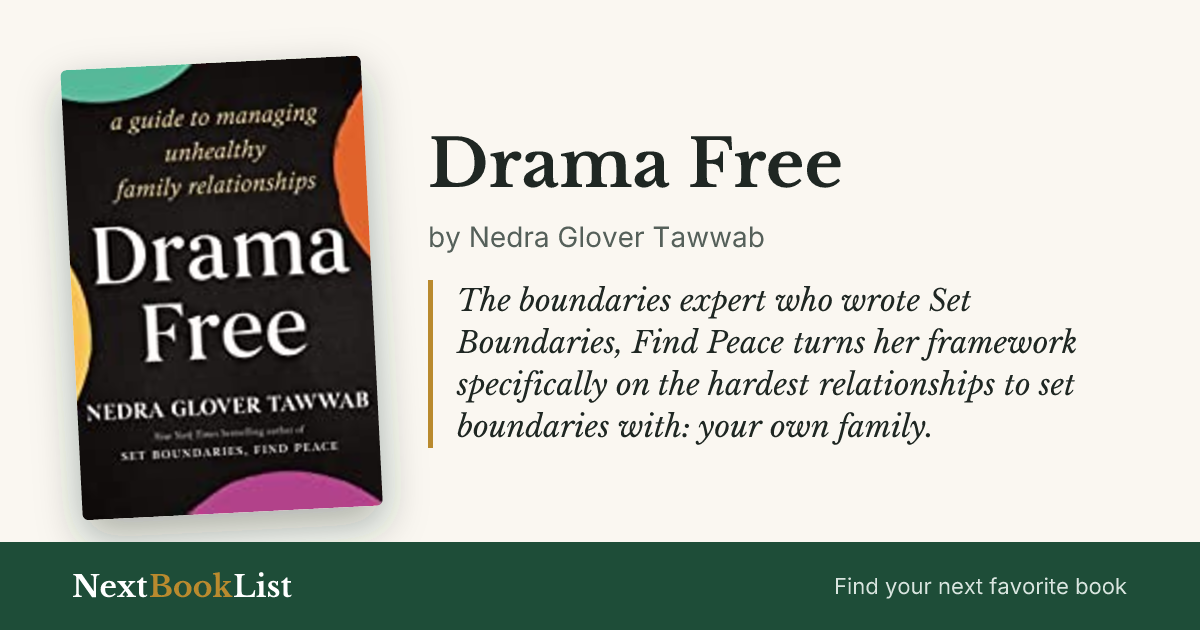
Drama Free
by Nedra Glover Tawwab · 2023
The boundaries expert who wrote Set Boundaries, Find Peace turns her framework specifically on the hardest relationships to set boundaries with: your own family.
Worth reading? Drama Free is the better book if your boundary problems are specifically with family, since Tawwab dedicates the whole book to family-of-origin patterns (enmeshment, scapegoating, parentification) that her first book only touched on. If your issues are more general (work, friends, partners), start with Set Boundaries, Find Peace instead -- this one assumes you already buy the framework and want it applied deeply to one context.
| Full Title | Drama Free: A Guide to Managing Unhealthy Family Relationships |
|---|---|
| Author | Nedra Glover Tawwab |
| Published | 2023 |
| Category | Self-Improvement & Psychology |
The Verdict
Tawwab’s real value is specificity – she doesn’t just tell you to “set a boundary,” she gives you the actual script for the actual conversation with the actual difficult relative. If Set Boundaries, Find Peace gave you the theory, this is the family-specific field manual. Worth owning both if family is where your boundary problems concentrate.
you have a recurring family dynamic (enmeshment, a difficult parent, a toxic sibling relationship) you've never been able to name or fix
you've already read Set Boundaries, Find Peace closely and applied it to your family -- this is a deeper, more specific application of the same core framework, not a new one
Book Summary
Family dysfunction often has names and patterns -- enmeshment, scapegoating, the golden child/black sheep dynamic, parentification -- and naming the pattern is often the first step to breaking out of an automatic role you've played since childhood.
Boundaries with family are harder than boundaries anywhere else because family relationships carry lifelong history, guilt, and often an unspoken rule that you owe unconditional access regardless of how you're treated. The book argues that love and boundaries aren't opposites -- healthy families have both.
You can't fix or heal a family member who won't participate in change, but you can change your own role in the pattern -- your response, your access, your expectations -- and that alone often shifts the whole system, even if imperfectly.
Top 8 Lessons from Drama Free
- Name your family role (scapegoat, golden child, peacekeeper, parentified child) to see the pattern instead of living inside it unconsciously.
- Enmeshment -- where family members' identities and emotions are overly tangled -- is presented as a common root of guilt around setting limits.
- Boundaries are not punishments; they are a form of respect toward yourself and, often, toward the relationship's long-term health.
- You can love someone and still limit how much access, time, or vulnerability you give them.
- Explaining or justifying a boundary excessively often invites more argument -- a clear, short boundary statement works better than a defense.
- Family gatherings and holidays are common flashpoints where old roles reassert themselves; planning ahead reduces the automatic slide back into them.
- Estrangement or reduced contact, while painful, is framed as a legitimate boundary option rather than a moral failure.
- Healing doesn't require a parent or sibling's apology or change -- your own boundary work can proceed independent of their willingness.
Frequently Asked Questions
Is Drama Free worth reading?
Yes, if your boundary struggles are specifically with family -- it goes deeper into family-of-origin patterns than Tawwab's first book. If your issues are more general, start with Set Boundaries, Find Peace.
Do I need to read Set Boundaries, Find Peace first?
No, Drama Free stands alone, though it builds on the same core boundary-setting framework and readers of the first book will recognize the structure.
What is Drama Free about?
It's about identifying unhealthy family patterns -- enmeshment, scapegoating, parentification -- and applying boundary-setting specifically to parents, siblings, and extended family.
Who should read Drama Free?
Anyone with a recurring, painful family dynamic they've never been able to name or change, especially around holidays, caretaking, or a difficult parent.
Ready to read it?
Get Drama Free on Amazon