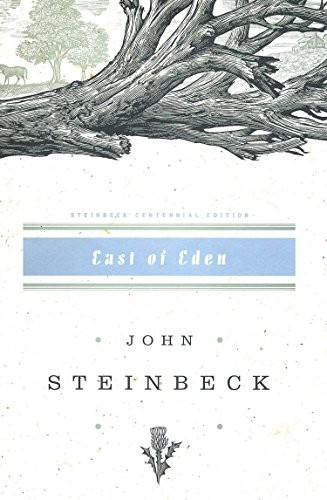
East of Eden
by John Steinbeck · 1952
Two families in California's Salinas Valley replay the Cain and Abel story across generations -- and the whole 600-page argument boils down to one Hebrew word Steinbeck decided could save everyone: timshel, 'thou mayest.'
Worth reading? East of Eden is Steinbeck swinging for something bigger than any of his other novels, and mostly connecting. The Trask and Hamilton families retell Cain and Abel across two generations in the Salinas Valley, but the book's real engine is its argument against determinism: that people aren't fated to repeat their parents' sins, they have a choice. Cathy Ames, the novel's genuinely evil matriarch, is the one place the book overreaches, she reads more like a symbol than a person.
| Author | John Steinbeck |
|---|---|
| Published | 1952 |
| Publisher | Penguin Books |
| Category | Fiction |
| Favorite quote | “And now that you don't have to be perfect, you can be good.” |
The Verdict
The Trask half of the book is where the biblical parallel does real work, especially once Cal starts to understand he’s been cast as the “bad” son before he’s done anything to earn it. The Hamilton family thread, looser and more autobiographical, gives the book room to breathe between the heavier symbolic material.
Cathy Ames is the one character who doesn’t quite hold up. Steinbeck wanted a figure of pure, unexplained evil to prove his free-will argument, and she ends up reading more like a device than a person, even by the standards of a novel this openly allegorical.
Read it if you want Steinbeck at his most philosophically ambitious, with a real argument underneath the family drama. Skip it if 600 pages of a slow-building, symbol-heavy saga isn’t what you’re after – Of Mice and Men will get you Steinbeck’s prose without the commitment.
you want Steinbeck's most ambitious novel, a multigenerational family saga with real philosophical weight behind the plot, not just regional color
you want tight, economical Steinbeck like Of Mice and Men -- this is his longest, most sprawling book, and it takes its biblical parallels seriously enough to slow down for them
Book Summary
Adam Trask moves his family to California's Salinas Valley, and his sons Cal and Aron grow up locked in a rivalry for their father's approval that deliberately echoes the biblical story of Cain and Abel, while the Hamilton family, based on Steinbeck's own maternal relatives, runs parallel to their story.
The novel's central philosophical argument centers on the Hebrew word timshel, 'thou mayest,' which Steinbeck's characters interpret as proof that the biblical Cain wasn't commanded or doomed to sin, he was given a choice, a reading Steinbeck uses to argue against any inherited or predetermined fate, including his characters' own family patterns.
Cathy Ames, Adam's wife and the boys' mother, is written as close to purely malevolent, abandoning her family after shooting Adam, and her extremity functions less as realistic characterization than as the novel's proof that evil exists independent of nurture, sharpening the free-will argument the rest of the book makes.
Top 7 Lessons from East of Eden
- The novel structures the Trask family's second generation, brothers Cal and Aron, as a direct retelling of Cain and Abel, down to their father's unequal approval of them.
- The Hebrew word timshel ('thou mayest'), debated at length by the Chinese servant Lee, is the book's thesis: that people have a genuine choice over whether to do good, not a predetermined fate.
- Cathy Ames is written as one of American fiction's starkest villains, abandoning her newborn sons and later running a brothel, functioning more as a symbol of unmotivated evil than a psychologically realistic character.
- Lee, the Trask family's Chinese-American servant, is given more moral and intellectual authority than nearly any other character in the book, notable for a 1950s novel.
- Adam Trask's inability to see his son Cal as anything other than the 'bad' twin drives Cal toward the same resentment that, biblically, led Cain to kill Abel.
- The Hamilton family thread, drawn from Steinbeck's own maternal ancestors, gives the novel a grounded, semi-autobiographical counterweight to the more symbolic Trask storyline.
- The novel's final word, 'Timshel,' delivered by Adam to Cal on his deathbed, is Steinbeck's explicit statement that the cycle of inherited sin can be broken by choice.
Top 3 Quotes from East of Eden
"And now that you don't have to be perfect, you can be good."
John Steinbeck, East of Eden
"But the Hebrew word, the word timshel -- 'Thou mayest' -- that gives a choice."
John Steinbeck, East of Eden
"I believe there is one story in the world, and only one, that has frightened and inspired us, so that we live in a Pearl White serial of continuing thought and wonder."
John Steinbeck, East of Eden
Frequently Asked Questions
Is East of Eden worth reading?
Yes -- it's Steinbeck's most ambitious novel, and the Cain-and-Abel retelling gives the family saga real philosophical stakes beyond the regional storytelling he's known for elsewhere.
What is East of Eden about?
Two families, the Trasks and the Hamiltons, in California's Salinas Valley across two generations, centered on a rivalry between brothers that deliberately echoes the biblical story of Cain and Abel.
What does timshel mean in East of Eden?
It's a Hebrew word meaning roughly 'thou mayest,' which the novel's characters interpret as proof humans have real free will over sin, not a predetermined fate -- it's the book's central argument.
Is East of Eden based on Steinbeck's own family?
Partly. The Hamilton family is based on Steinbeck's own maternal relatives, though the Trask family and the main plot are fictional.
Is East of Eden Steinbeck's best book?
Steinbeck himself called it his most important work. Whether it beats Grapes of Wrath is subjective, but it's his most personally ambitious novel by his own account.
Ready to read it?
Get East of Eden on Amazon