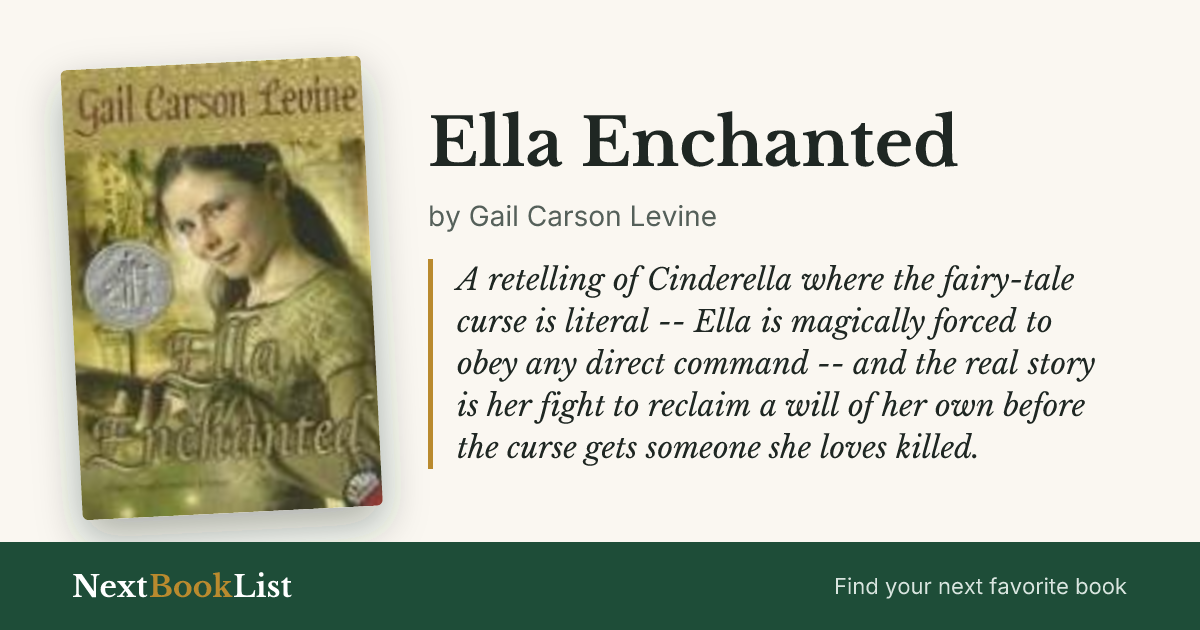
Ella Enchanted
by Gail Carson Levine · 1997
A retelling of Cinderella where the fairy-tale curse is literal -- Ella is magically forced to obey any direct command -- and the real story is her fight to reclaim a will of her own before the curse gets someone she loves killed.
Worth reading? Ella Enchanted takes the most passive fairy tale in the canon and gives its heroine an active, specific problem to solve -- literal magical obedience -- which turns Cinderella's niceness into something Ella has to actively resist rather than just embody.
| Author | Gail Carson Levine |
|---|---|
| Published | 1997 |
| Publisher | HarperCollins |
| Category | Fiction |
The Verdict
The obedience curse is the whole trick, and it’s a genuinely clever one – it takes a trait fairy tales usually treat as virtuous (a compliant, good-natured heroine) and turns it into a literal threat Ella has to out-maneuver constantly. That’s smarter than most fairy-tale retellings bother to be.
Levine also doesn’t shy away from making the curse scary. Scenes where other characters realize what Ella is and start testing the limits of it carry real tension for a book aimed at middle-grade readers, and the book earns that tension rather than manufacturing it.
Read it if you or your kid wants a fairy-tale retelling with an actual brain and some teeth. Skip it if you’re looking for the straightforward, faithful Cinderella story – this one has its own agenda.
middle-grade readers (roughly 8-12) who want a smart, funny fairy-tale retelling with an actual feminist backbone -- the curse of obedience is used to interrogate obedience itself
readers who want a straightforward, faithful Cinderella story -- Levine changes and complicates enough of the original that purists may find it distracting
Book Summary
A fairy named Lucinda gives infant Ella the 'gift' of obedience, meaning Ella must do whatever she is directly ordered to do, with no ability to refuse. Levine treats this not as a cute quirk but as a genuine danger: anyone who realizes Ella's curse can weaponize it, forcing her to hurt herself or others.
The novel restructures the Cinderella plot around Ella's active quest to break the curse, sending her out to find Lucinda and reverse the spell rather than waiting passively at home for a fairy godmother to intervene. Along the way she has to learn languages, navigate real danger, and repeatedly outsmart people trying to exploit her obedience.
The stepmother-and-stepsisters plot stays recognizable, but the emotional stakes shift: Ella's real fear isn't missing the ball, it's that her curse will eventually force her to harm Prince Char, the person she loves, which reframes obedience itself as the villain of the story rather than any single character.
Top 7 Lessons from Ella Enchanted
- The obedience curse turns a passive fairy-tale trait (a 'good,' compliant heroine) into an active plot problem Ella has to solve, which is the book's central inversion of the Cinderella formula.
- Levine treats forced obedience as genuinely dangerous, not whimsical -- other characters can and do use it to control or endanger Ella, and the book doesn't soften those scenes.
- Ella's arc is defined by learning to find loopholes and workarounds within her curse rather than simply waiting to be rescued from it.
- The romance with Prince Char is complicated directly by the curse: Ella avoids getting close to him specifically because she fears being ordered to hurt him.
- The stepmother and stepsisters are given more petty, human motivations (status anxiety, jealousy) rather than pure cartoon villainy.
- The book's ending requires Ella to break the curse through her own choice and effort, not through outside rescue -- a deliberate departure from the original tale's passive resolution.
- Levine builds out a real fantasy world (multiple kingdoms, languages, magical creatures) around the fairy-tale skeleton, giving the book more texture than a straight retelling.
Frequently Asked Questions
Is Ella Enchanted worth reading?
Yes, especially for middle-grade readers -- it's a smart, well-plotted fairy-tale retelling with real stakes and an active heroine.
What age is Ella Enchanted appropriate for?
Roughly 8-12. There's peril and some scary moments, but nothing graphic.
Is the movie faithful to the book?
No -- the 2004 film with Anne Hathaway changes the plot significantly and plays much more for comedy. The book is more serious and better plotted.
Do you need to know the original Cinderella story first?
No, but familiarity helps you appreciate how much Levine changes -- this isn't a simple retelling, it's a real reinvention of the premise.
Is there a sequel to Ella Enchanted?
Levine wrote other fairy-tale retellings set in the same world, but Ella Enchanted stands complete on its own.
Ready to read it?
Get Ella Enchanted on Amazon