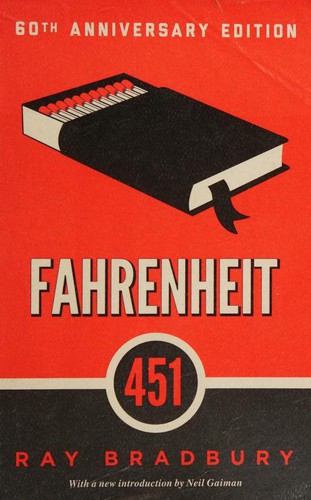
Fahrenheit 451
by Ray Bradbury · 1953
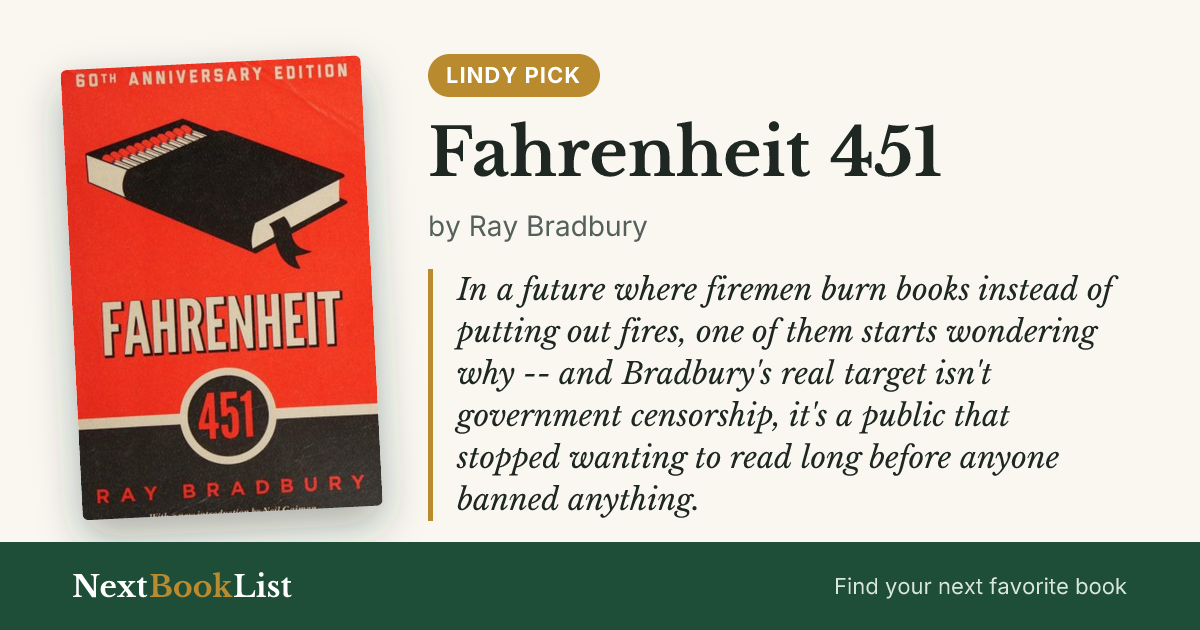
In a future where firemen burn books instead of putting out fires, one of them starts wondering why -- and Bradbury's real target isn't government censorship, it's a public that stopped wanting to read long before anyone banned anything.
Worth reading? Fahrenheit 451 gets misread constantly as a book about government censorship, and Bradbury himself pushed back on that reading for years -- the real villain here is a culture that chose distraction, speed, and comfort over depth, and only needed firemen to formalize a decision it had already made. It's shorter and looser than 1984, but the central image, a fireman who starts questioning why he burns books, still lands.
| Full Title | Fahrenheit 451 |
|---|---|
| Author | Ray Bradbury |
| Published | 1953 |
| Publisher | Simon & Schuster |
| Category | Fiction |
| Favorite quote | “It was a pleasure to burn.” |
The Verdict
Read this one for the argument, not the worldbuilding. It’s thinner on political mechanics than 1984, and if you go in expecting that level of detail you’ll be disappointed. Bradbury’s interested in something more diffuse and, honestly, scarier: a society that got bored of reading before anyone had to force it to stop.
Mildred is the character to watch, more than Montag. Her addiction to television “families” and sedation is Bradbury’s real warning, and it lands harder now than it probably did in 1953.
Skip it if you want a tightly mapped dystopian society with clear rules and institutions. Read it if you want a fast, unsettling parable about attention, comfort, and what gets lost when a culture stops valuing depth.
you want a fast, propulsive dystopia that's less about an oppressive government and more about a society that numbed itself into not caring
you want the deep worldbuilding of 1984 or Brave New World -- this is shorter and more impressionistic, closer to an extended parable than a fully mapped society
Book Summary
Guy Montag is a fireman in a future America where firemen burn books instead of extinguishing fires, because books have come to be seen as dangerous, upsetting, or simply irrelevant in a culture obsessed with wall-sized television "families" and constant sedative entertainment. A conversation with his curious young neighbor Clarisse cracks his certainty about his job.
Bradbury has repeatedly said the novel is less about government censorship and more about a public that voluntarily stopped reading -- television, speed, and the desire to avoid anything upsetting or complex did more to kill books in his imagined future than any law did. The firemen exist to clean up a cultural choice already made.
Montag's wife Mildred, sedated and absorbed by her television "family" and sleeping pills, represents the mass-culture endpoint Bradbury feared: comfort and stimulation replacing genuine connection and thought, to the point where Mildred can't remember how she met her own husband.
The ending, where Montag joins a community of exiles who've each memorized a book to preserve it after society burns itself down in a nuclear war, offers a cautiously hopeful image: culture survives not through institutions but through individual people willing to carry it.
Top 7 Lessons from Fahrenheit 451
- Bradbury insisted the book is about a culture that stopped wanting to read, not primarily about government censorship -- the firemen formalize a decision the public already made.
- Mildred's addiction to television 'families' and sedatives represents mass entertainment as a replacement for real connection, not just a distraction from it.
- Clarisse's simple, curious questions ('are you happy?') are enough to destabilize Montag's entire worldview, showing how fragile enforced conformity actually is once someone asks a real question.
- The 'firemen burn books' premise inverts a trusted institution (fire departments exist to save, not destroy) to dramatize how easily protective roles can be repurposed for control.
- Captain Beatty, Montag's boss, is written as someone who once loved books and chose to hate them instead -- his cynicism is presented as more dangerous than simple ignorance.
- The novel's ending locates hope in individuals memorizing books to preserve them, arguing that culture survives through people, not institutions, when institutions fail.
- Bradbury wrote the book worried specifically about television's effect on reading and attention span, a concern that reads as strikingly early given how much media theory came after it.
Top 7 Quotes from Fahrenheit 451
"It was a pleasure to burn."
Ray Bradbury, Fahrenheit 451
"There must be something in books, things we can't imagine, to make a woman stay in a burning house; there must be something there. You don't stay for nothing."
Ray Bradbury, Fahrenheit 451
"You don't have to burn books to destroy a culture. Just get people to stop reading them."
Ray Bradbury, Fahrenheit 451
"We need not to be let alone. We need to be really bothered once in a while. How long is it since you were really bothered? About something important, about something real?"
Ray Bradbury, Fahrenheit 451
"If you don't want a man unhappy politically, don't give him two sides to a question to worry him; give him one. Better yet, give him none."
Ray Bradbury, Fahrenheit 451
"Everyone must leave something behind when he dies, my grandfather said. A child or a book or a painting or a house or a wall built or a pair of shoes made. Or a garden planted. Something your hand touched some way so your soul has somewhere to go when you die."
Ray Bradbury, Fahrenheit 451
"Stuff your eyes with wonder, he said, live as if you'd drop dead in ten seconds. See the world. It's more fantastic than any dream made or paid for in factories."
Ray Bradbury, Fahrenheit 451
Frequently Asked Questions
Is Fahrenheit 451 worth reading?
Yes -- it's a fast, propulsive dystopia, and its real argument (a culture that chose distraction over depth) has aged in an uncomfortably relevant direction.
What is Fahrenheit 451 about?
Guy Montag, a fireman whose job is burning books, starts questioning why in a society that has largely stopped wanting to read, preferring television and sedative entertainment instead.
Is Fahrenheit 451 about censorship?
It's often read that way, but Bradbury said repeatedly the book is more about a public that voluntarily abandoned reading for television and comfort -- censorship formalizes a cultural choice already made.
What temperature does Fahrenheit 451 refer to?
451 degrees Fahrenheit is the temperature Bradbury believed paper catches fire and burns, giving the book its title.
Is Fahrenheit 451 similar to 1984?
Both are foundational dystopias, but 1984 is denser and more focused on government surveillance and control, while Fahrenheit 451 is shorter, more impressionistic, and more focused on cultural apathy.
Ready to read it?
Get Fahrenheit 451 on Amazon