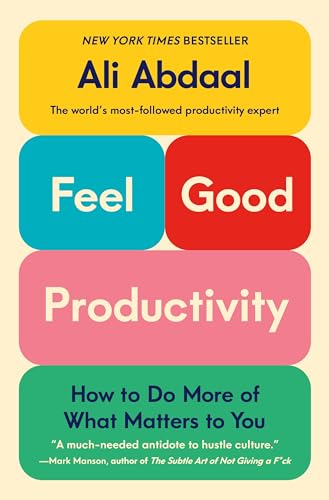
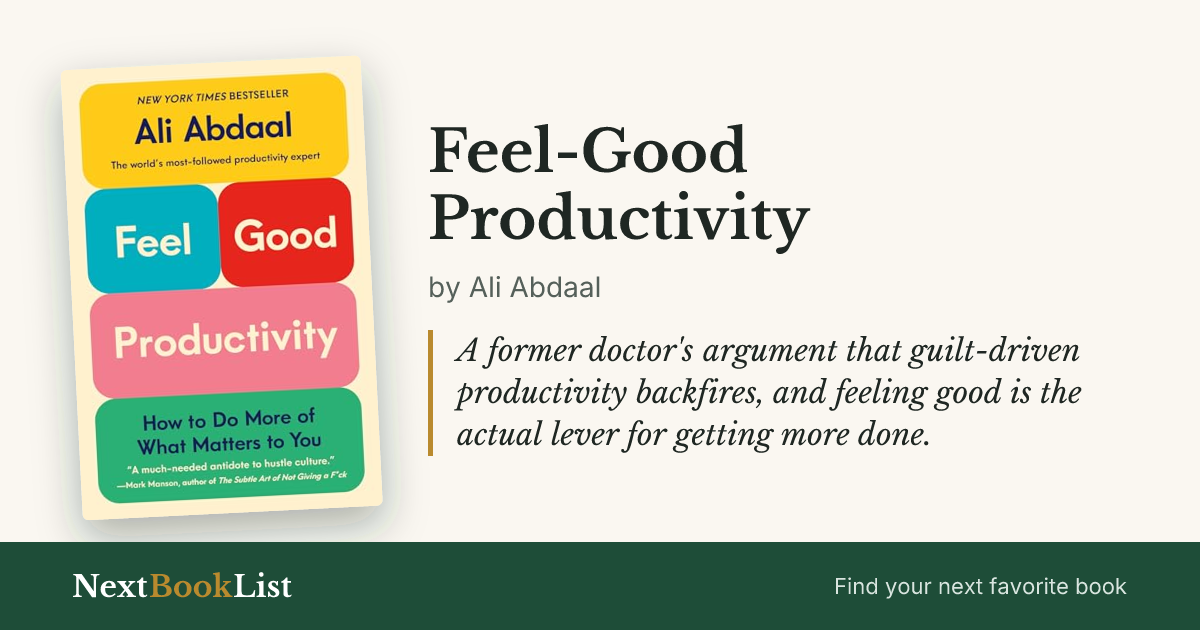
Feel-Good Productivity
by Ali Abdaal · 2023
A former doctor's argument that guilt-driven productivity backfires, and feeling good is the actual lever for getting more done.
Worth reading? Ali Abdaal, a former doctor turned YouTuber, built Feel-Good Productivity around a simple inversion: stress-driven output is fragile and burns you out, so chase the feeling first and let productivity follow as a side effect. It's a useful counterweight if you've already got the systems from Atomic Habits or the focus discipline from Deep Work but still feel dread opening your laptop -- Abdaal is addressing the energy problem those books mostly assume you've solved. It's lighter on rigor than either of those two, closer to a friendly synthesis of research and YouTube-era self-help than a dense original framework, so treat it as the motivation layer, not a replacement for a real system.
| Full Title | Feel-Good Productivity: How to Do More of What Matters to You |
|---|---|
| Author | Ali Abdaal |
| Published | 2023 |
| Category | Self-Improvement & Psychology |
| Favorite quote | “Success doesn't lead to feeling good. Feeling good leads to success.” |
The Verdict
Ali Abdaal was a doctor before he became a YouTuber, and Feel-Good Productivity carries that hybrid voice: research-referenced but casual, built for people who already know they should be more productive and just can’t make themselves start. His inversion is simple – stop trying to guilt yourself into output and chase the feeling of enjoying the work instead.
It won’t replace the systems in Atomic Habits or the focus discipline in Deep Work, and it doesn’t try to. Read this when the problem is dread and burnout, not a missing system.
you're burnt out on discipline-and-grind advice and want a framework built around energy and motivation instead of another system to maintain
you already have a solid habit or focus system and just need better execution -- this is more about why you're stalling than how to build the mechanics
Book Summary
Productivity driven by fear, guilt, or self-criticism ('grind culture') tends to produce burnout and inconsistency. Sustainable output comes from positive emotion -- play, curiosity, and energy -- not from punishing yourself into action.
Abdaal organizes his approach around three energizers (play, power, people) that make work feel good, three de-energizers (fear, doubt, inertia) that block it, and a set of tactics for handling burnout when it happens anyway.
Small experiments and 'ten-minute starts' lower the activation energy for hard tasks more reliably than willpower or deadline pressure. Getting started is usually the actual blocker, not motivation itself.
Confidence and competence build each other in a loop -- doing a small version of the scary task builds the confidence to do a bigger one, which is more reliable than waiting to feel ready first.
Top 9 Lessons from Feel-Good Productivity
- Chase the feeling of enjoying the work first; output tends to follow rather than lead.
- Guilt-driven productivity works short-term but reliably produces burnout.
- Use a ten-minute start to lower the activation energy on tasks you're avoiding.
- Turn dry tasks into games or add playful constraints to make them feel less like a chore.
- Power (autonomy and control over your work) is an energizer -- look for where you can add small choices back into rigid tasks.
- Social accountability (people) boosts follow-through more than solo willpower does.
- Notice fear and doubt as de-energizers and name them directly instead of pushing through silently.
- Confidence comes from doing a small, scary version of the task, not from waiting to feel ready.
- Recovery isn't optional -- treat rest as part of the system, not a reward for finishing it.
Top 4 Quotes from Feel-Good Productivity
"Success doesn't lead to feeling good. Feeling good leads to success."
Ali Abdaal, Feel-Good Productivity
"Play is our first energiser. Life is stressful. Play makes it fun. If we can integrate the spirit of play into our lives, we'll feel better -- and do more too."
Ali Abdaal, Feel-Good Productivity
"Shoshin refers to a state of mind in which we approach every task and situation with the curiosity, openness and humility of a beginner."
Ali Abdaal, Feel-Good Productivity
"By letting go of the idea that we know everything, or somehow should, we actually feel more powerful."
Ali Abdaal, Feel-Good Productivity
Frequently Asked Questions
Is Feel-Good Productivity worth reading?
Yes, if you already have habit or focus systems but still feel dread or burnout doing the work. It's weaker as a standalone system than Atomic Habits or Deep Work, but strong as a motivation layer on top of one.
What is the main idea of Feel-Good Productivity?
Stress and guilt-driven productivity burns you out. Abdaal argues you get more done sustainably by chasing positive emotion -- play, power, people, praise, purpose -- and letting output follow.
How is Feel-Good Productivity different from Atomic Habits or Deep Work?
Atomic Habits gives you a habit-building system and Deep Work gives you focus discipline. Feel-Good Productivity addresses the energy and motivation problem underneath both -- why you avoid starting in the first place.
Who should read Feel-Good Productivity?
Readers burnt out on grind-culture advice who want a gentler, energy-first approach. Skip it if you need a rigorous system rather than a motivational reframe.
Ready to read it?
Get Feel-Good Productivity on Amazon