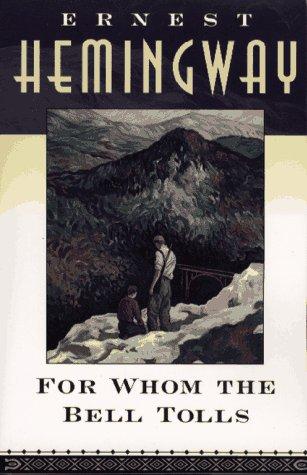
For Whom the Bell Tolls
by Ernest Hemingway · 1940
An American demolitions expert has four days to blow a bridge during the Spanish Civil War, fall in love, and reckon with whether any cause is worth what it costs the people fighting for it.
Worth reading? For Whom the Bell Tolls is Hemingway's most fully realized novel, longer and more structurally ambitious than A Farewell to Arms, and it earns that length. Robert Jordan's mission gives the book a ticking clock, but the real material is what war does to the people conscripted, by ideology or circumstance, into carrying it out. It's also Hemingway's clearest statement that no cause, however just, escapes moral cost.
| Author | Ernest Hemingway |
|---|---|
| Published | 1940 |
| Publisher | Scribner |
| Category | Fiction |
| Favorite quote | “The world is a fine place and worth the fighting for and I hate very much to leave it.” |
The Verdict
The bridge mission gives the book real momentum, but the strongest material is in the guerrilla camp itself, especially Pilar, who does more to carry the moral weight of the novel than Robert Jordan does. Hemingway writing a woman this fully is rare enough in his catalog to be worth noting on its own.
The Maria romance is the part that ages least well, compressed and idealized in a way that can feel more convenient than earned, especially set against the novel’s otherwise clear-eyed treatment of violence and ideology.
Read it if you want Hemingway’s fullest treatment of what a cause actually costs the people fighting for it. Skip it if you’re looking for the leaner, faster Hemingway of his short stories or A Farewell to Arms – this one takes its time.
you want Hemingway's most ambitious, most political novel, with a tighter, more suspenseful structure than his shorter works and real moral weight behind the action
you want fast pacing throughout -- large stretches are interior reflection and guerrilla-camp dialogue, and the countdown-to-the-bridge structure doesn't rush to get there
Book Summary
Robert Jordan, an American volunteer fighting for the Republican side in the Spanish Civil War, is assigned to blow up a strategically vital bridge with the help of a small band of guerrilla fighters, and the novel unfolds over the three days he spends preparing the operation.
Hemingway uses the guerrilla camp, especially Pablo's cowardice, Pilar's authority, and Jordan's own doubts, to interrogate whether ideological commitment survives contact with the actual cost of violence, refusing to romanticize the Republican cause even while sympathizing with it.
The novel's title, drawn from a John Donne meditation on shared mortality, signals its central theme: that individual deaths in a collective struggle are never truly isolated, every death diminishes everyone connected to the cause, on both sides.
Top 7 Lessons from For Whom the Bell Tolls
- Robert Jordan's mission, destroying a bridge to support a Republican offensive, is given a hard deadline, which structures the entire novel as a countdown rather than an open-ended narrative.
- Pablo, the guerrilla band's original leader, has grown cowardly and unreliable through years of violence, showing how prolonged combat can hollow out even a once-committed fighter.
- Pilar, Pablo's wife, effectively runs the camp in his place, one of Hemingway's more fully realized and powerful female characters.
- Jordan's love affair with Maria, a young woman traumatized by fascist violence against her family, compresses an entire relationship into days, heightened precisely because both know the mission may kill him.
- The novel doesn't hide the Republican side's own brutality, a flashback to Pablo's massacre of fascist prisoners is rendered with the same unflinching detail Hemingway gives fascist atrocities.
- Jordan's internal debates about the war's purpose reflect Hemingway's own complicated relationship with the Spanish Civil War, which he covered as a journalist and supported without full ideological certainty.
- The book's ending, deliberately, denies Jordan a clean heroic death, mirroring the novel's larger refusal to romanticize the war it depicts.
Top 3 Quotes from For Whom the Bell Tolls
"The world is a fine place and worth the fighting for and I hate very much to leave it."
Ernest Hemingway, For Whom the Bell Tolls
"There is nothing else than now. There is neither yesterday, certainly, nor is there any tomorrow. How old must you be before you know that? There is only now, and if now is only two days, then two days is your life and everything in it will be in proportion."
Ernest Hemingway, For Whom the Bell Tolls
"It is only those who never do any actual work who feel always that they are doing something."
Ernest Hemingway, For Whom the Bell Tolls
Frequently Asked Questions
Is For Whom the Bell Tolls worth reading?
Yes -- it's Hemingway's most structurally ambitious novel, with a tight countdown premise and more moral complexity about war and ideology than his earlier work.
What is For Whom the Bell Tolls about?
An American volunteer fighting for the Republican side in the Spanish Civil War spends three days preparing to demolish a bridge, falling in love and confronting the cost of the cause he's fighting for.
Where does the title For Whom the Bell Tolls come from?
From a John Donne meditation on shared mortality ('never send to know for whom the bell tolls; it tolls for thee'), which Hemingway uses as an epigraph reflecting the novel's theme of connected loss.
Is For Whom the Bell Tolls based on real events?
It's fiction, but Hemingway drew heavily on his own experience as a journalist covering the Spanish Civil War, and the historical and political backdrop is accurate to the conflict.
Is For Whom the Bell Tolls hard to read?
Not difficult prose-wise, Hemingway's style stays plain, but it's slower-paced than his shorter novels, with long stretches of dialogue and internal reflection between action.
Ready to read it?
Get For Whom the Bell Tolls on Amazon