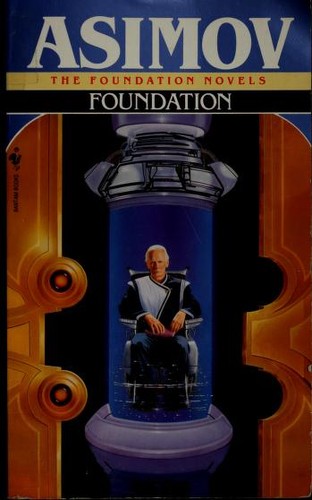
Foundation
by Isaac Asimov · 1951
A mathematician predicts the fall of a Galactic Empire and engineers a plan to shorten the coming dark age, the book that gave Elon Musk his blueprint for civilizational thinking.
Worth reading? Asimov's premise, a mathematician named Hari Seldon develops 'psychohistory,' a science for predicting the mass behavior of civilizations, and uses it to foresee the Galactic Empire's collapse and engineer a 1,000-year plan to shorten the resulting dark age, is one of science fiction's most influential ideas. Musk has cited it repeatedly as formative, and it's easy to see why: it's a book about long-term civilizational planning dressed as space opera. Read it as the foundational text (literally) for big-picture, long-horizon thinking. Skip it if you want action-driven sci-fi, this is dialogue and ideas, not spaceship battles.
| Author | Isaac Asimov |
|---|---|
| Published | 1951 |
| Category | Fiction |
| Favorite quote | “Violence is the last refuge of the incompetent.” |
The Verdict
This is the book Musk points to when explaining his own long-horizon thinking, and it’s not hard to see the throughline: a mathematician engineering a centuries-long plan to keep civilization’s knowledge alive. Read it as much for the big idea as for the story.
readers who want big-idea, civilization-scale science fiction with almost no action, all ideas
you want fast-paced space opera, this is closer to political and historical theory in space-opera costume
Book Summary
Asimov's core conceit, psychohistory, imagines a mathematical science capable of predicting the broad behavior of vast populations (though not individuals) with enough precision to foresee a galactic empire's decline centuries in advance, and to engineer interventions that shorten the resulting dark age from 30,000 years to 1,000.
The novel's structure, following a Foundation of scientists tasked with preserving civilizational knowledge across generations, foregrounds ideas over action: political maneuvering, economic leverage, and information control matter more to the plot than combat. It's less a story about individual heroes and more about the mechanics of civilizational survival across centuries.
Top 7 Lessons from Foundation
- Long-horizon planning (centuries, not quarters) can meaningfully change a civilization's trajectory.
- Predicting exact individual behavior is different from predicting aggregate, large-scale trends, psychohistory only claims the latter.
- Preserving and consolidating knowledge can be as strategically powerful as military force.
- Political and economic leverage often accomplish more than direct confrontation.
- A civilization's decline can be foreseen structurally, without needing a single dramatic collapse event.
- Ideas-driven fiction can carry as much narrative tension as action-driven fiction, if the stakes are made concrete enough.
- Engineering a shorter, more survivable dark age is a more realistic goal than preventing collapse entirely.
Top 4 Quotes from Foundation
"Violence is the last refuge of the incompetent."
Isaac Asimov, Foundation
"Never let your sense of morals prevent you from doing what is right."
Isaac Asimov, Foundation
"It pays to be obvious, especially if you have a reputation for subtlety."
Isaac Asimov, Foundation
"To succeed, planning alone is insufficient. One must improvise as well."
Isaac Asimov, Foundation
Frequently Asked Questions
Is Foundation worth reading?
Yes, especially if you want big-idea, civilization-scale science fiction focused on long-term planning rather than action. It's one of the most influential sci-fi novels ever written.
What is Foundation about?
A mathematician predicts a Galactic Empire's collapse using 'psychohistory,' a science of large-scale societal prediction, and engineers a centuries-long plan to shorten the resulting dark age.
Why does Elon Musk recommend Foundation?
Musk has cited the Foundation series repeatedly as formative to his thinking about long-term civilizational planning and the importance of preserving and advancing knowledge across generations.
Ready to read it?
Get Foundation on Amazon