Glucose Revolution
by Jessie Inchauspé · 2022
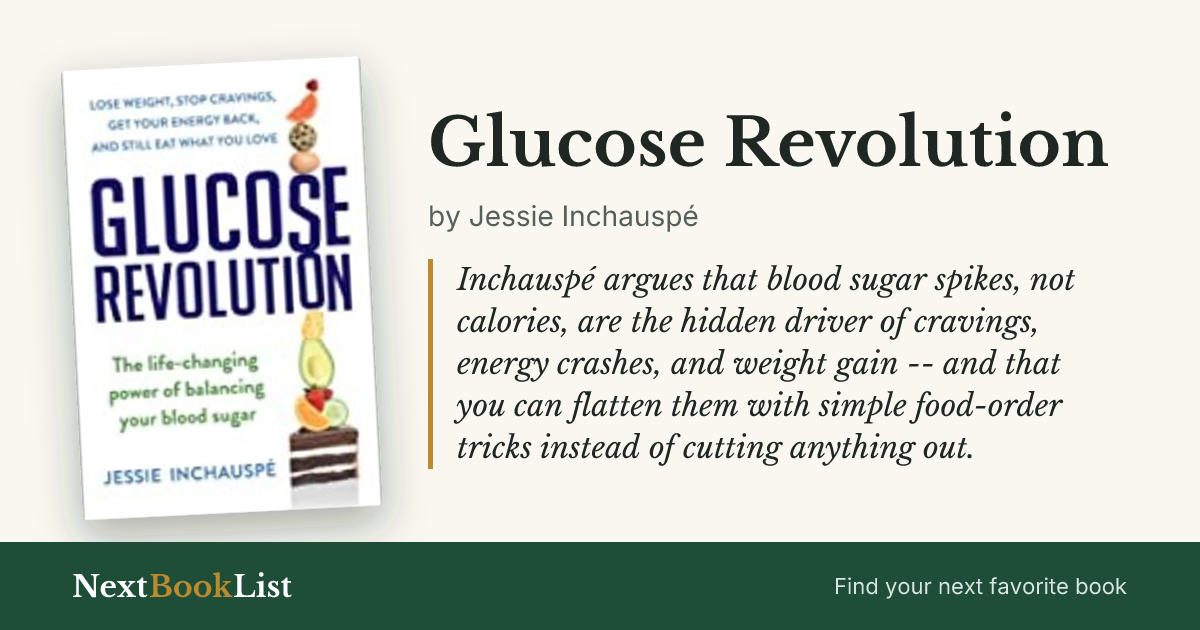
Inchauspé argues that blood sugar spikes, not calories, are the hidden driver of cravings, energy crashes, and weight gain -- and that you can flatten them with simple food-order tricks instead of cutting anything out.
Worth reading? Inchauspé's real contribution is reframing 'eat less sugar' as 'manage your glucose curve,' which turns out to be a much easier sell: you don't give anything up, you just change the order and pairing of what's already on your plate. The ten 'hacks' (savory breakfast, veggie starter, vinegar before meals, move after eating) are genuinely low-effort and grounded in real glucose physiology. Where it overreaches is implying a flatter glucose curve is the master key to nearly every modern health complaint -- mood, skin, fertility, aging -- when the evidence base is much stronger for some of those claims than others.
| Full Title | Glucose Revolution: The Life-Changing Power of Balancing Your Blood Sugar |
|---|---|
| Author | Jessie Inchauspé |
| Published | 2022 |
| Publisher | Simon & Schuster |
| Category | Health & Fitness |
| Favorite quote | “It's not about eating less. It's about eating smarter.” |
The Verdict
Inchauspé’s pitch works because it asks for almost nothing. You don’t quit sugar, you don’t count anything, you just reorder what’s already on your plate and add a walk. That’s a genuinely rare thing in diet writing, and the ten hacks hold up: eating veggies before carbs, a vinegar shot before a meal, and a ten-minute walk after eating are all real, testable interventions with real glucose data behind them, not vibes.
The strain shows up once the book leaves “flatten your spike” territory and starts linking glucose volatility to skin, fertility, aging, and mood with the same confident tone it uses for the core claims. Some of those links are plausible and under active research; others are a much longer reach than the food-order hacks that opened the book, and it doesn’t always flag the difference.
Read it if you want simple, sustainable tweaks to your eating order that don’t require cutting anything out. Skip it if you’re looking for a rigorously cited clinical case rather than a hacks-and-habits book built on the author’s own self-tracking.
you want practical, no-elimination tweaks (eat veggies first, add vinegar, walk after meals) backed by continuous-glucose-monitor data, without giving up carbs or sugar entirely
you want a rigorously sourced clinical deep-dive -- this is a hacks-and-habits book aimed at a general reader, not a textbook, and it leans hard on the author's own self-tracking experiments
Book Summary
Inchauspé's central claim is that glucose spikes -- the sharp rise and crash you get from eating fast carbs on an empty stomach -- are a bigger driver of cravings, fatigue, and fat storage than total calories or even total sugar, and that flattening the curve (not eliminating carbs) is the more sustainable lever.
The book converts that physiology into ten concrete "hacks": eat food in the right order (fiber and protein before carbs), add a vinegar-based dressing before a meal, favor savory breakfasts over sweet ones, and take a ten-minute walk after eating -- each framed as a small swap rather than a restriction, which is why the book reads more like a toolkit than a diet plan.
The back half extends the glucose-spike frame outward to skin, sleep, fertility, and aging, arguing that chronic glucose volatility (not any single food) is an underappreciated common driver across a wide range of complaints -- the section where the evidence gets noticeably thinner than the core "flatten your spikes" argument.
Top 9 Lessons from Glucose Revolution
- Glucose spikes -- not total calories or total sugar -- are framed as the more useful lever for cravings, energy crashes, and fat storage.
- Eating food in the right order (vegetables and protein first, starches and sugars last) measurably blunts the same meal's glucose spike, even with identical ingredients.
- A tablespoon of vinegar in water or dressing before a carb-heavy meal is presented as one of the simplest, best-evidenced spike-blunting tricks in the book.
- A savory breakfast (eggs, protein) produces a flatter glucose curve than a sweet, carb-heavy one, and sets a calmer glucose trend for the rest of the day.
- A ten-minute walk within an hour after eating meaningfully lowers the glucose spike from that meal by helping muscles pull glucose out of the bloodstream.
- Fruit is treated as fine to eat, but better paired with fat, fiber, or protein (nuts, yogurt) than eaten alone on an empty stomach, which spikes harder.
- Cravings are reframed as a downstream symptom of the glucose crash that follows a spike, not a willpower failure -- flattening the spike is presented as reducing the craving at its source.
- None of the ten hacks require cutting out a food group entirely, which is presented as the reason they're easier to sustain than most restrictive diets.
- Sweet and starchy foods eaten on their own, first, and on an empty stomach are the worst-case combination for glucose spikes -- the book frames this as the default modern eating pattern worth interrupting.
Top 3 Quotes from Glucose Revolution
"Glucose spikes are the root cause of a shocking number of health issues, from diabetes to hormonal issues to acne."
Jessie Inchauspé, Glucose Revolution
"It's not about eating less. It's about eating smarter."
Jessie Inchauspé, Glucose Revolution
"The order in which you eat your food matters more than you think."
Jessie Inchauspé, Glucose Revolution
Frequently Asked Questions
Is Glucose Revolution worth reading?
Yes, if you want low-effort, no-elimination tweaks to flatten blood sugar spikes -- the core hacks (food order, vinegar, post-meal walks) are practical and grounded in real glucose physiology, though the later health claims stretch further than the evidence.
What is Glucose Revolution about?
Jessie Inchauspé argues that blood sugar spikes drive cravings, energy crashes, and fat storage more than calories or sugar alone do, and lays out ten simple hacks -- like eating vegetables first and walking after meals -- to flatten those spikes.
Do you need a continuous glucose monitor to use Glucose Revolution's advice?
No -- the hacks (food order, vinegar, savory breakfast, post-meal walks) work without any device. A CGM just lets you see your own spikes, which is how the author built the book's core evidence.
Does Glucose Revolution tell you to cut out sugar or carbs?
No -- that's the book's main selling point. It reframes the goal as flattening the glucose curve through food order and pairing, not eliminating any food group.
How does Glucose Revolution compare to The Obesity Code?
Different angle on similar territory -- The Obesity Code makes the theoretical case for insulin and fasting; Glucose Revolution skips the theory for ten practical, no-elimination hacks aimed at flattening blood sugar spikes meal by meal.
Ready to read it?
Get Glucose Revolution on Amazon