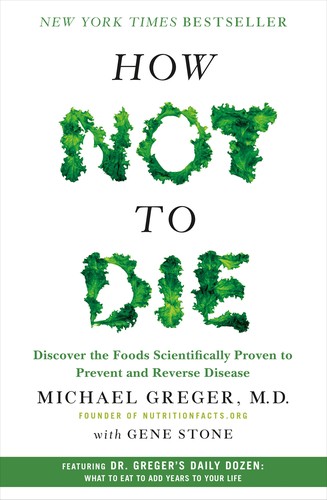
How Not to Die
by Michael Greger, M.D. · 2015
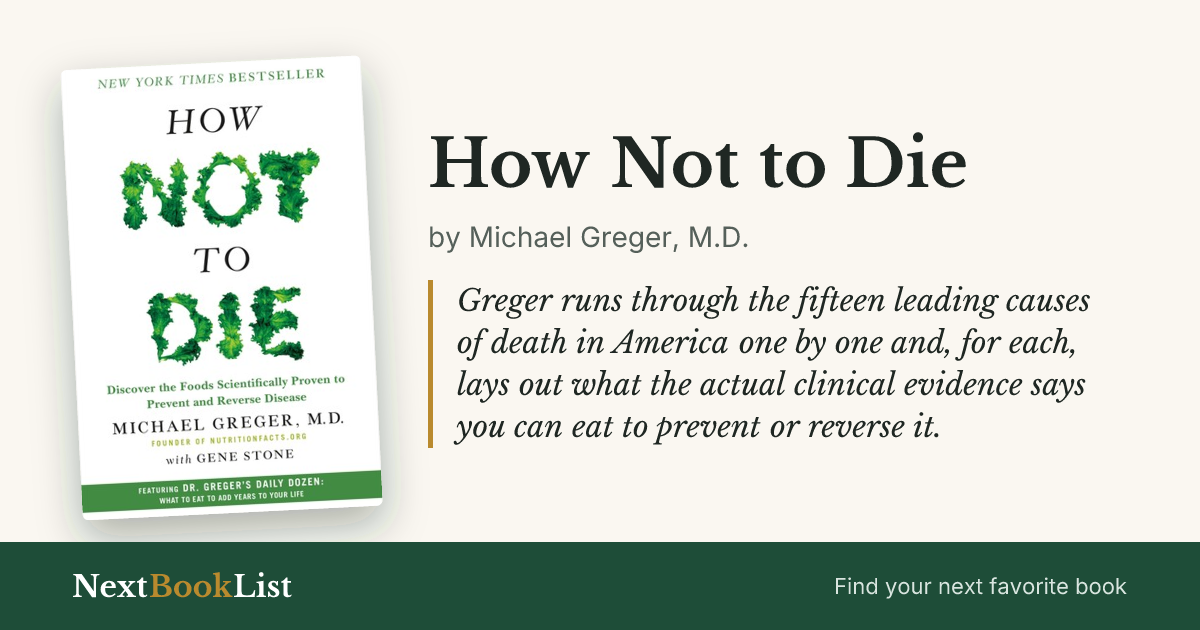
Greger runs through the fifteen leading causes of death in America one by one and, for each, lays out what the actual clinical evidence says you can eat to prevent or reverse it.
Worth reading? Greger's real contribution isn't a diet plan, it's the structure: take heart disease, then diabetes, then cancer, and for each one show what the randomized trials and cohort studies actually support. It's one of the most rigorously sourced cases for eating more plants you'll find in a mainstream diet book, but the 'eat more whole plants' answer repeats disease after disease until it stops feeling like new information, and the book asks you to trust its reading of the studies rather than walking you through the debate.
| Full Title | How Not to Die: Discover the Foods Scientifically Proven to Prevent and Reverse Disease |
|---|---|
| Author | Michael Greger, M.D. |
| Published | 2015 |
| Publisher | Flatiron Books |
| Category | Health & Fitness |
| Favorite quote | “Type 2 diabetes is almost always preventable, often treatable, and sometimes even reversible through diet and lifestyle changes.” |
The Verdict
Greger’s format is the book’s strongest asset. Instead of one general theory of eating, you get fifteen separate cases, one per leading cause of death, each backed by its own stack of citations. That’s a genuinely different structure from most diet books, and it means you can skip straight to the chapter on whatever’s actually worrying you (your cholesterol, your family history of diabetes) and get a focused answer.
The catch is that the focused answer is almost always the same answer: eat more whole plants, less meat and dairy, less processed food. By chapter ten that repetition stops reading like rigor and starts reading like a thesis in search of confirming evidence, and the book doesn’t spend much time steelmanning the studies or experts who land somewhere more moderate.
Read it if you want the most heavily-cited version of the “eat more plants” argument, organized by the disease you’re actually trying to avoid. Skip it if you’re looking for a flexible, moderate eating plan – this one argues hard for near-total plant-based eating and won’t meet you in the middle.
you want a heavily-cited, disease-by-disease case for eating more whole plant foods and you don't mind reading past the footnotes
you want a moderate, flexible eating plan -- Greger's conclusions push hard toward all-in whole-food, plant-based eating, and he doesn't spend much time defending middle-ground positions
Book Summary
Greger organizes the book around the fifteen leading causes of death in the US -- heart disease, lung disease, brain disease, diabetes, high blood pressure, cancers, kidney disease -- and dedicates a chapter to each, reviewing the clinical and epidemiological evidence for which foods measurably move the needle on that specific condition.
The throughline is that most of these "top killers" are diseases of dietary affluence, driven substantially by the same handful of factors (excess meat, dairy, processed food, refined carbs, oil) and substantially preventable, and in some cases reversible, by the same handful of interventions (whole plant foods, fiber, specific micronutrients), which is why the same recommendations recur chapter after chapter.
The back half converts the disease-by-disease case into Greger's "Daily Dozen" -- a practical checklist of food groups (beans, berries, other fruits, cruciferous vegetables, greens, other vegetables, flaxseed, nuts, spices, whole grains, beverages, exercise) meant to translate the evidence review into something you can actually act on daily, rather than just information you nod along to.
Top 9 Lessons from How Not to Die
- Most of the top killers in the US (heart disease, stroke, diabetes, several cancers) share a common set of dietary drivers, so the same handful of interventions shows up as protective across many different chapters.
- LDL cholesterol under roughly 70 mg/dL is presented as the threshold associated with essentially arresting further arterial plaque buildup, a stricter target than most people are told to aim for.
- Type 2 diabetes is framed as usually preventable, often treatable, and in a meaningful subset of cases reversible through diet and weight change, not a one-way, lifelong diagnosis.
- Diseases running in families is often as much about shared diets and shared habits passed down as it is about shared genes.
- The 'Daily Dozen' checklist (beans, berries, greens, cruciferous vegetables, nuts, flaxseed, whole grains, spices) is Greger's attempt to compress the entire evidence review into a daily, actionable habit rather than a one-time takeaway.
- Processed meat is treated in the book as carrying cancer risk closer to tobacco and asbestos in classification terms (a Group 1 carcinogen), even though the absolute risk increase per serving is smaller than that comparison makes it sound.
- Fiber intake is repeatedly tied not just to digestion but to lower risk across cardiovascular, metabolic, and some cancer outcomes -- one of the most consistent threads across chapters.
- How doctors get paid shapes what gets treated: a reimbursement system built around procedures and prescriptions has little built-in incentive to address the lifestyle causes sitting upstream of the diagnosis.
- Antioxidant-rich, colorful produce is presented as generally protective, but the book is careful to note this is a rule of thumb with exceptions, not a strict rule for ranking foods.
Top 4 Quotes from How Not to Die
"The primary reason diseases tend to run in families may be that diets tend to run in families."
Michael Greger, M.D., How Not to Die
"To become virtually heart-attack proof, you need to get your LDL cholesterol at least under 70 mg/dL."
Michael Greger, M.D., How Not to Die
"If doctors were instead paid for performance, there would be a financial incentive to treat the lifestyle causes of disease. Until the model of reimbursement changes, I don't expect great changes in medical care or medical education."
Michael Greger, M.D., How Not to Die
"Type 2 diabetes is almost always preventable, often treatable, and sometimes even reversible through diet and lifestyle changes."
Michael Greger, M.D., How Not to Die
Frequently Asked Questions
Is How Not to Die worth reading?
Yes, if you want the evidence case for a whole-food, plant-based diet laid out disease by disease -- it's one of the more heavily cited mainstream diet books, though the same conclusion (eat more plants) repeats across nearly every chapter.
What is How Not to Die about?
Michael Greger reviews the clinical and epidemiological evidence behind the fifteen leading causes of death in the US and, for each one, lays out which foods the research says help prevent or reverse it, ending with his 'Daily Dozen' checklist.
What is Dr. Greger's Daily Dozen?
A checklist of food groups -- beans, berries, other fruits, cruciferous vegetables, greens, other vegetables, flaxseed, nuts, spices, whole grains, beverages, and exercise -- meant to translate the book's evidence review into a daily habit.
Is How Not to Die only for vegans?
The book's conclusions lean strongly toward whole-food, plant-based eating, but it's framed around disease prevention rather than a strict vegan philosophy -- you don't need to be vegan to use the evidence, though Greger's own recommendation is close to it.
How does How Not to Die compare to The Obesity Code?
Different focus -- Greger's book is a broad, disease-by-disease case for what to eat across all major chronic diseases, while The Obesity Code narrows in specifically on insulin, fasting, and weight gain.
Ready to read it?
Get How Not to Die on Amazon