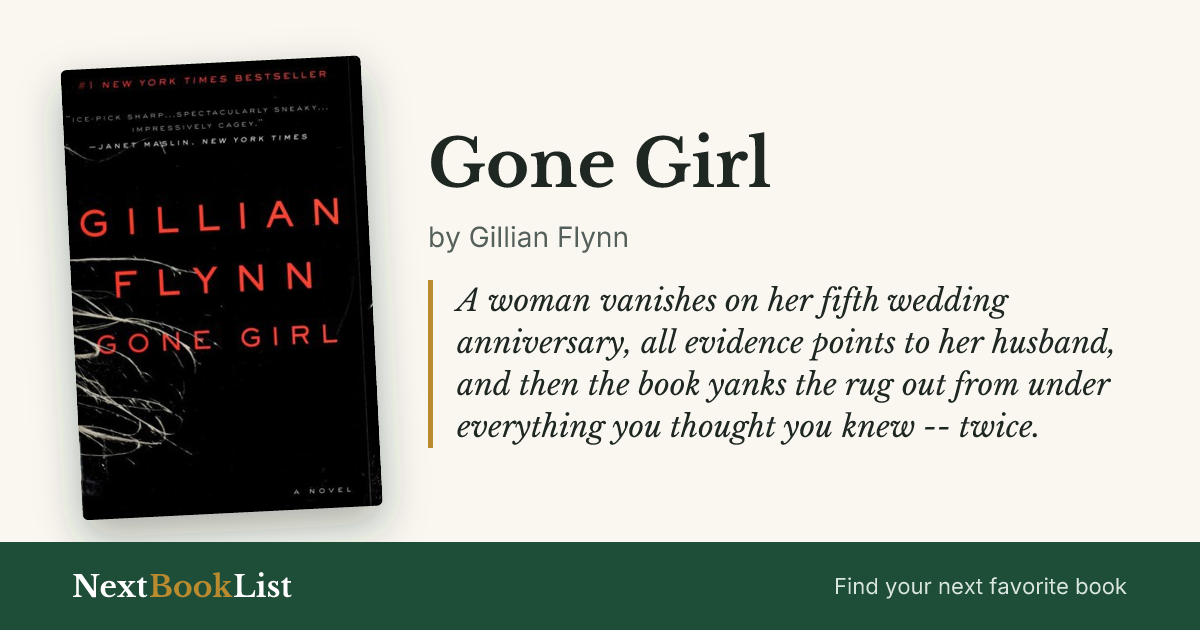
Gone Girl
by Gillian Flynn · 2012
A woman vanishes on her fifth wedding anniversary, all evidence points to her husband, and then the book yanks the rug out from under everything you thought you knew -- twice.
Worth reading? Gone Girl earns its status as the thriller that reset the genre for a decade. The dual, dueling narration between Nick and Amy is engineered precisely to manipulate the reader's sympathy and then punish you for extending it, and the mid-book reveal is one of the cleanest structural twists in modern popular fiction. It's a nasty, cynical book about marriage, and it knows exactly what it's doing.
| Author | Gillian Flynn |
|---|---|
| Published | 2012 |
| Publisher | Crown Publishing |
| Category | Fiction |
| Favorite quote | “When I think of my wife, I always think of her head.” |
The Verdict
The dual narration is the whole show, and Flynn plays it with real precision, feeding you exactly enough sympathy for each character before yanking it away. The midpoint reveal isn’t a gimmick tacked onto a straight thriller, it’s the structural spine the entire book was built around from page one.
The “Cool Girl” passage is the piece everyone remembers, and it earns the attention, a sharp, angry piece of social commentary that lands harder because it comes from a character you’re not supposed to fully trust or like.
Read it if you want a nasty, well-constructed thriller with no interest in giving you a character to root for. Skip it if you need at least one likable lead to stay engaged, because neither Nick nor Amy is offering that.
you want a thriller built around genuinely unreliable narrators and a mid-book twist that recontextualizes everything before it, and you don't need either lead character to be likable to stay invested
you need a protagonist to root for -- both Nick and Amy are deeply unpleasant people by design, and the book has zero interest in giving you someone to fully trust
Book Summary
On Nick and Amy Dunne's fifth wedding anniversary, Amy disappears from their home under circumstances that increasingly implicate Nick, and the novel alternates between Nick's present-day first-person account and Amy's diary entries chronicling their marriage's decline.
Roughly at the book's midpoint, Flynn reveals that Amy's diary has been an elaborate fabrication and that she is alive, having staged her own disappearance and framed Nick for murder as revenge for his infidelity and the marriage's failures, a twist that forces a complete reread of everything presented as fact up to that point.
The novel uses its dual unreliable narrators to interrogate the performance built into modern marriage, both Nick and Amy have spent years curating false versions of themselves for each other and for the public, and the "Cool Girl" monologue Amy delivers becomes the book's most quoted piece of social commentary on performed femininity.
The ending, in which Amy returns, manipulates the media and legal system to avoid consequences, and effectively holds the marriage hostage through a fabricated pregnancy, denies the reader any conventional justice or resolution, leaving Nick and Amy locked together in mutual, permanent manipulation.
Top 10 Lessons from Gone Girl
- The novel structures its two narrators to manipulate reader sympathy deliberately, Nick's sections make him seem guilty, Amy's diary makes her seem like a victim, then reverses both readings at the midpoint reveal.
- Amy's 'Cool Girl' monologue is the book's most direct thesis statement: an indictment of the performed, accommodating femininity women adopt to be desirable, and what happens when that performance is finally dropped.
- The marriage at the center of the book is presented as built on mutual performance from the start, both Nick and Amy curated false selves for each other during courtship, which the novel argues is a common, quietly corrosive practice, not an aberration.
- Media coverage of Amy's disappearance, and how easily public opinion is manipulated by a sympathetic narrative, is used as a parallel critique alongside the marriage plot, showing how the same performative instincts play out at a societal scale.
- The ending's refusal of conventional justice, Amy suffers no real consequence and effectively traps Nick in the marriage via pregnancy, is a deliberate rejection of thriller-genre catharsis in favor of a bleaker, more cynical statement about power in relationships.
- Nick's own narration, while more sympathetic in hindsight, is never fully trustworthy either -- his infidelity and self-serving omissions mean the book gives you no character whose account you can take entirely at face value.
- The novel plays against classic missing-woman thriller conventions, revealing partway through that the 'victim' orchestrated her own disappearance and is, in fact, the book's true antagonist.
- Amy's elaborate frame job -- planted evidence, a fabricated pregnancy, a staged diary -- functions as the novel's argument that meticulous premeditation, not passion, is the most dangerous form of rage.
- Nick's affair with a younger graduate student is used less as a twist and more to establish his own self-serving blindness before the midpoint reveal recontextualizes who's really the villain.
- The novel treats the marriage itself as a genre: both Nick and Amy are shown performing 'husband' and 'wife' for an audience, first each other, then the media, well before either one openly turns against the other.
Top 3 Quotes from Gone Girl
"When I think of my wife, I always think of her head."
Gillian Flynn, Gone Girl
"I'm a big fan of the lie of omission."
Gillian Flynn, Gone Girl
"Men always say that as the defining compliment, don't they? She's a cool girl. Being the Cool Girl means I am a hot, brilliant, funny woman who adores football, poker, dirty jokes, and burping, who plays video games, drinks cheap beer, loves threesomes and anal sex, and jams hot dogs and hamburgers into her mouth like she's hosting the world's biggest culinary gang bang while somehow maintaining a size 2, because Cool Girls are above all hot. Hot and understanding. Cool Girls never get angry; they only smile in a chagrined, loving manner and let their men do whatever they want."
Gillian Flynn, Gone Girl
Frequently Asked Questions
Is Gone Girl worth reading?
Yes -- it's one of the most structurally effective thrillers of the last two decades, built around a twist that genuinely changes how you read everything before it.
What is Gone Girl about?
A woman's staged disappearance and elaborate frame-up of her husband, told through dual unreliable narrators, that becomes a broader indictment of performance and manipulation within marriage.
Does Gone Girl have a happy ending?
No -- the ending deliberately denies conventional justice or resolution, leaving both main characters locked in an ongoing, mutually manipulative relationship.
Is Gone Girl a feminist book?
It's widely discussed in that context, particularly the 'Cool Girl' monologue, though critics disagree on whether Amy's portrayal ultimately supports or undercuts a feminist reading.
Should I watch the movie or read the book first?
Read the book first if you want the twist to land as intended -- the 2014 film (co-written by Flynn) follows the novel's structure closely, so knowing the twist in advance changes the experience.
Ready to read it?
Get Gone Girl on Amazon