Good Economics for Hard Times
by Abhijit V. Banerjee & Esther Duflo · 2019
The same Nobel-winning economists who fixed the poverty debate turn their evidence-first method on trade, migration, and inequality in rich countries too.
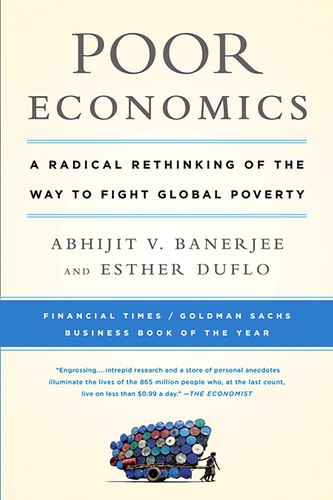
Worth reading? This is Banerjee and Duflo's sequel to Poor Economics, written after they won the Nobel Prize, and the shift in scope is the whole story. Poor Economics stayed narrowly focused on what fights poverty in poor countries. Good Economics for Hard Times takes the same "test it, don't assume it" method and points it at the arguments dominating rich-world politics: does trade destroy jobs, does immigration lower wages, does growth have to keep accelerating forever. If you liked the method in Poor Economics, this is the same rigor applied to arguments you hear on cable news instead of in aid debates. Worth reading if you want the evidence behind (or against) the trade and immigration talking points politicians repeat as fact. Skip it if you want punchy policy answers -- true to form, the authors' answer to almost every big question is "it depends, and here's the data that complicates your assumption."
| Author | Abhijit V. Banerjee & Esther Duflo |
|---|---|
| Published | 2019 |
| Category | Business & Money |
| Favorite quote | “Good economics is more about asking the right questions than having all the answers.” |
The Verdict
Banerjee and Duflo wrote this after the Nobel, and you can feel the confidence to swing at bigger targets – trade wars, immigration panic, the assumption that growth must always accelerate. It’s less tightly focused than Poor Economics, but the same instinct runs through it: check the data before you trust the argument that sounds right.
you want to understand trade, immigration, and inequality debates without the ideological talking points from either side
you already read Poor Economics cover to cover recently and want new territory, not a second helping of the same method
Book Summary
Trade and immigration debates run on assumptions that sound obviously true and mostly aren't, according to the evidence Banerjee and Duflo assemble. Trade doesn't just relocate jobs smoothly to new industries the way economic models promise -- workers displaced by import competition often stay stuck for a decade or more, because labor doesn't move the way capital does. Immigration, in the data, rarely depresses wages for existing workers the way anti-immigration arguments assume, because new arrivals also spend money and create demand.
Economic growth itself gets a harder look than most business books give it: growth in rich countries has slowed for reasons that resist easy fixes, and the assumption that more GDP automatically means more human wellbeing doesn't hold up as cleanly as economists once assumed. The authors are skeptical of both the tax-cuts-solve-everything right and the stimulus-solves-everything left.
Underneath the specific chapters is the same argument that made Poor Economics work: people don't move for jobs, don't adapt to trade shocks, and don't respond to incentives the way frictionless economic models predict, because real life has sticky preferences, local ties, and imperfect information that economists routinely assume away.
Top 10 Lessons from Good Economics for Hard Times
- Trade doesn't relocate workers to new jobs as smoothly as economic models predict.
- Import-competition job losses often last a decade or more, not a quick transition.
- Immigration rarely depresses wages for existing workers the way the debate assumes.
- New immigrants also create local demand, offsetting the labor-supply effect.
- People don't move for better jobs nearly as readily as economic theory assumes.
- GDP growth and human wellbeing don't track each other as tightly as assumed.
- Rich-country growth has slowed for structural reasons with no easy policy fix.
- Neither tax cuts nor stimulus alone reliably deliver the growth politicians promise.
- Local ties and imperfect information make people 'sticky' in ways models ignore.
- Evidence-first economics complicates both left and right talking points equally.
Top 1 Quotes from Good Economics for Hard Times
"Good economics is more about asking the right questions than having all the answers."
Abhijit V. Banerjee & Esther Duflo, Good Economics for Hard Times
Frequently Asked Questions
Is Good Economics for Hard Times worth reading?
Yes if you want evidence on trade, immigration, and growth instead of talking points from either side of the political spectrum.
What is the main idea of Good Economics for Hard Times?
The same rigorous, test-it-don't-assume-it approach from Poor Economics, applied to rich-world debates about trade, immigration, inequality, and growth.
Do I need to read Poor Economics first?
No, but it helps -- Good Economics for Hard Times uses the same method on a broader set of questions, and Poor Economics shows that method at its most focused.
How is this different from Poor Economics?
Poor Economics is specifically about fighting poverty in developing countries. Good Economics for Hard Times, written after the authors won the Nobel Prize, widens the lens to trade, migration, inequality, and growth in both rich and poor economies.
Ready to read it?
Get Good Economics for Hard Times on Amazon