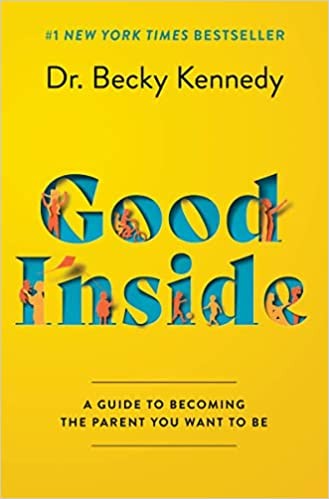
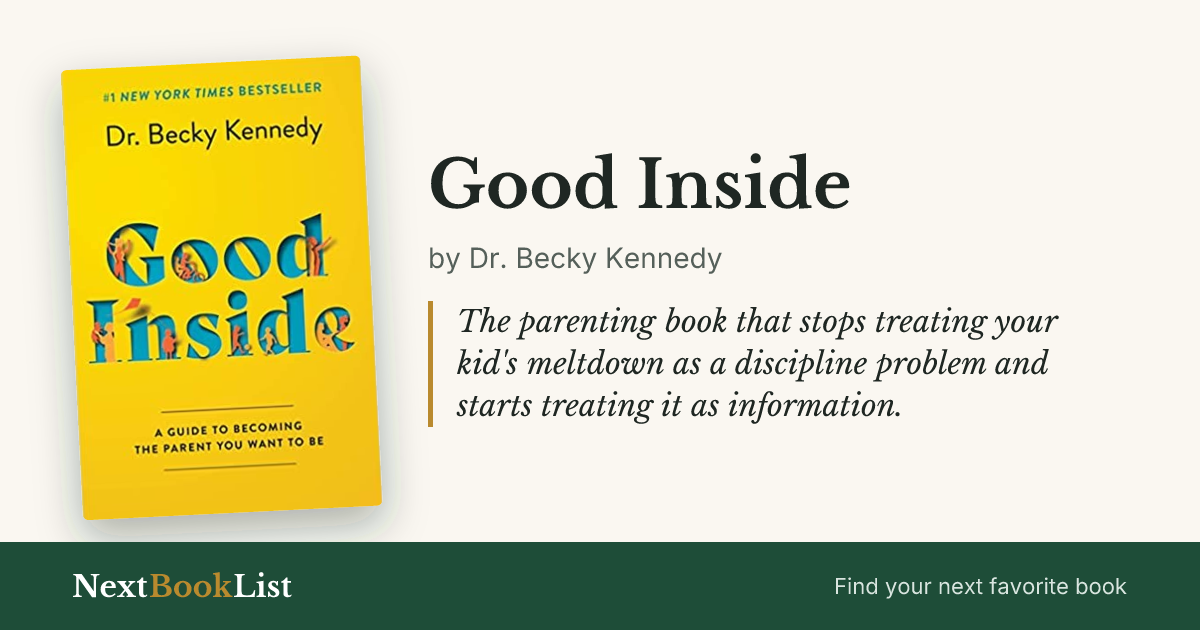
Good Inside
by Dr. Becky Kennedy · 2022
The parenting book that stops treating your kid's meltdown as a discipline problem and starts treating it as information.
Worth reading? Good Inside is a parenting book, full stop -- if you're browsing for general self-improvement, this isn't your title. But if you have kids, Dr. Becky's core reframe (your child is 'good inside' even when the behavior is bad) is genuinely useful because it gives you a script for the moment you're most likely to lose your patience. Her 'two things can be true' framing -- you can hold a boundary and still validate the feeling behind the tantrum -- is more workable day-to-day than most gentle-parenting content, which tends to collapse into permissiveness. Skip it if you want a book about willpower or your own habits; this is entirely about the parent-child relationship.
| Full Title | Good Inside: A Guide to Becoming the Parent You Want to Be |
|---|---|
| Author | Dr. Becky Kennedy |
| Published | 2022 |
| Category | Self-Improvement & Psychology |
The Verdict
Dr. Becky’s whole pitch fits in one line: your kid is good inside, even when the behavior in front of you is bad. That reframe alone changes how you talk during a meltdown, because you stop treating the outburst as something to punish and start treating it as something to understand.
What makes the book usable instead of just comforting is “two things can be true” – you can say no and still validate the feeling. Most parenting advice picks a side (permissive or strict); this one gives you both hands.
parents of young or school-age kids who want a framework for tantrums, boundaries, and discipline that doesn't rely on punishment or permissiveness
you're not raising kids -- this is a parenting book specifically, not general advice about relationships or self-improvement, so don't expect it to generalize
Book Summary
Kids are 'good inside' even when their behavior is bad. Misbehavior is usually a skills gap or an overwhelmed nervous system, not a character flaw, and treating it as the latter damages the relationship without fixing the behavior.
'Two things can be true' -- you can hold a firm boundary ('we don't hit') while also validating the emotion behind the outburst ('you're really mad right now'). Gentle parenting often fails because it drops the boundary; strict parenting fails because it drops the validation.
Connection is the foundation discipline sits on top of. A child who feels securely connected to you is more likely to internalize boundaries; a child who feels shamed or disconnected is more likely to repeat the behavior to get your attention back.
Your own reactivity as a parent usually traces back to your own childhood. Kennedy asks parents to notice when they're responding to their own unresolved stuff rather than to what the child in front of them actually needs.
Top 9 Lessons from Good Inside
- Reframe misbehavior as a skills gap or dysregulation, not defiance.
- Hold the boundary and validate the feeling at the same time -- 'two things can be true.'
- Say what you WILL do, not just what the child can't do ('I won't let you hit me' beats 'stop hitting').
- Connect first, correct second -- a rushed correction without connection rarely sticks.
- Narrate your own calm out loud during a meltdown; kids borrow your regulation.
- Tantrums are often a release of built-up stress, not a manipulation tactic.
- Repair after a hard moment matters more than never having the hard moment.
- Notice when your reaction to your kid is really about your own childhood, not their behavior.
- Boundaries are for the parent to hold, not for the child to agree with.
Frequently Asked Questions
Is Good Inside worth reading?
Yes, for parents specifically. It gives a practical framework for tantrums and discipline that holds both boundaries and empathy, which most parenting books struggle to do at once.
What is the main idea of Good Inside?
Kids are fundamentally good even when their behavior is bad. Discipline works better when you hold a firm boundary while validating the emotion behind the behavior, rather than choosing one or the other.
Is Good Inside just for toddlers?
No -- most examples skew toward toddlers and young kids, but the core framework (boundaries plus connection) applies through the school-age years too.
Is Good Inside a general self-improvement book?
No. It's specifically a parenting book. If you're looking for general self-help about habits or relationships, this isn't the right title.
Ready to read it?
Get Good Inside on Amazon