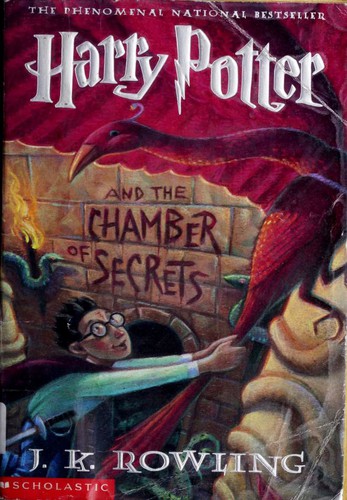
Harry Potter and the Chamber of Secrets
by J.K. Rowling · 1998
Students at Hogwarts start turning up petrified, an ancient legend about a hidden chamber and a monster resurfaces, and a diary that writes back turns out to be the year's real threat.
Worth reading? Chamber of Secrets is a step up in craft from the first book, not just a repeat of the formula. The mystery is darker and better constructed, Ginny Weasley's underused subplot gives the horror real stakes, and Tom Riddle's diary is one of the series' best sustained villain devices.
| Full Title | Harry Potter and the Chamber of Secrets (Harry Potter, Book 2) |
|---|---|
| Author | J.K. Rowling |
| Published | 1998 |
| Publisher | Scholastic |
| Category | Fiction |
| Favorite quote | “It is our choices, Harry, that show what we truly are, far more than our abilities.” |
The Verdict
The Tom Riddle diary is the book’s best idea, and it’s genuinely unsettling: a villain that works by listening, flattering, and slowly taking over someone else’s choices, rather than by direct threat. It’s a smarter mechanism than most children’s fantasy antagonists get.
The mystery structure is tighter than the first book’s, with the petrification pattern giving Harry and his friends real clues to chase rather than just wandering toward the answer.
The weak spot is Ginny – her ordeal is the emotional stakes of the entire plot, but she’s mostly offstage and voiceless until the very end, which is a real cost of how the mystery is built.
Read it if you want the series’ first genuinely creepy, well-constructed mystery. Skip it if Ginny’s underused role as this book’s central victim is going to bother you more than the plot’s craft makes up for.
you want the series' first real horror-tinged mystery, with a genuinely creepy villain mechanism (a possessing, memory-erasing diary) and a satisfying detective structure
you want the series at its most emotionally weighty -- this is still a relatively contained, lighter entry compared to where the later books go
Book Summary
Harry returns to Hogwarts for his second year to find students being mysteriously petrified, and rumors resurface of a legendary "Chamber of Secrets" containing a monster only Salazar Slytherin's heir can control. The mystery structure mirrors the first book but with a darker mechanism and higher stakes, since the petrified victims include Harry's own friends.
A diary belonging to a mysterious "Tom Riddle" surfaces, and Rowling uses it as a genuinely unsettling device: it writes back to whoever confides in it, and is slowly draining the life of Ginny Weasley, who's been using it without telling anyone. The diary's reveal as a piece of Voldemort's own past self is the book's best plot turn.
The novel deepens the series' central theme of identity and choice -- Dumbledore's line to Harry that "it is our choices that show what we truly are, far more than our abilities" becomes the book's thesis, directly addressing Harry's fear that he's more like Voldemort than he wants to admit.
Top 10 Lessons from Harry Potter and the Chamber of Secrets
- The Tom Riddle diary is a stronger villain mechanism than a straightforward antagonist would be -- it works through manipulation and identity theft rather than direct confrontation.
- Ginny Weasley's underused, mostly offstage victimhood in this book is a real structural weakness -- her ordeal drives the plot's stakes without giving her much interiority of her own.
- The mystery structure repeats the first book's clue-and-reveal pattern but raises the stakes by making Harry's own friends the victims, not just an abstract threat.
- Rowling uses the diary reveal to introduce the idea that Voldemort's younger self and Harry share more in common than Harry wants to accept, setting up a theme the series returns to repeatedly.
- The book's darker tone (petrification, a hidden monster, a possessing object) marks a deliberate escalation from the gentler first volume.
- Dobby the house-elf's subplot introduces the series' first sustained look at magical creature servitude, though it's played mostly for comedy at this stage.
- Gilderoy Lockhart is introduced as a fully incompetent, fraudulent celebrity professor, giving the series its first satirical jab at reputation built on stolen credit rather than actual skill.
- The book introduces the 'Mudblood' slur and Draco Malfoy's open use of it, giving the series its first explicit treatment of prejudice within the wizarding world, a theme that escalates significantly in later volumes.
- Harry's discovery that he can speak Parseltongue marks the series' first real crack in his separation from Voldemort, making his classmates suspicious of him well before he understands the connection himself.
- The Chamber's backstory ties directly into Hogwarts's founding history, expanding the world's internal mythology beyond the more self-contained setting of the first book.
Top 3 Quotes from Harry Potter and the Chamber of Secrets
"It is our choices, Harry, that show what we truly are, far more than our abilities."
J.K. Rowling, Harry Potter and the Chamber of Secrets
"Fame's a fickle friend, Harry."
J.K. Rowling, Harry Potter and the Chamber of Secrets
"Age is foolish and forgetful when it underestimates youth."
J.K. Rowling, Harry Potter and the Chamber of Secrets
Frequently Asked Questions
Is Harry Potter and the Chamber of Secrets worth reading?
Yes -- it's a genuine step up in plot construction from the first book, with a darker, better-built mystery.
What is Harry Potter and the Chamber of Secrets about?
Harry investigates why students at Hogwarts are being mysteriously petrified, uncovering a possessed diary and a legendary hidden chamber containing an ancient monster.
Do I need to read Sorcerer's Stone first?
Yes, the series builds sequentially and this book assumes familiarity with the first book's characters and world.
Who is Tom Riddle in Chamber of Secrets?
He's revealed to be a younger version of Voldemort, preserved as a memory inside the diary, manipulating Ginny Weasley through it.
Is Chamber of Secrets scarier than Sorcerer's Stone?
Yes, it leans further into horror elements like petrification and a hidden monster, though it remains appropriate for the same middle-grade audience.
Ready to read it?
Get Harry Potter and the Chamber of Secrets on Amazon