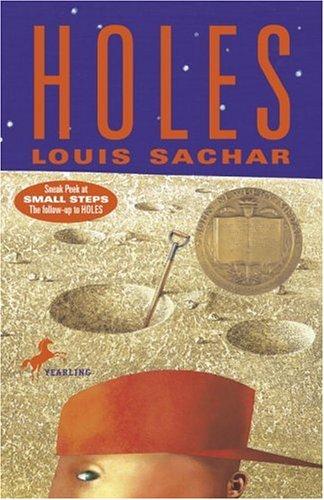
Holes
by Louis Sachar · 1998
A boy wrongly sent to a juvenile detention camp discovers the daily punishment of digging holes in a dried-up lakebed connects to a century-old family curse and a buried fortune, and Sachar braids three timelines together with almost no wasted motion.
Worth reading? Holes is a plotting clinic disguised as a kids' book -- Sachar sets up dozens of seemingly throwaway details across three interwoven timelines and pays off nearly every one of them, which is rarer in adult fiction than it is here.
| Author | Louis Sachar |
|---|---|
| Published | 1998 |
| Publisher | Yearling |
| Category | Fiction |
The Verdict
The thing that separates Holes from most plot-twist-driven fiction is restraint: Sachar never oversells a planted detail. A jar of peaches or a specific shoe size just sits there quietly until the moment it matters, and by the end you realize almost nothing in the book was actually random.
The camp itself is the sharpest piece of social commentary – ‘building character’ through pointless, punishing labor is exactly the kind of institutional cruelty that gets dressed up in wholesome language, and Sachar lets young readers see through it without ever lecturing them about it.
Read it if you want tight, purposeful plotting and don’t mind tracking three timelines to get there. Skip it if you want a simple, single-thread story – this one asks you to hold pieces in your head until they click.
readers of any age (the book is shelved middle grade, roughly 9-13, but reads well as adult fiction too) who want tight, purposeful plotting where every seemingly random detail eventually pays off
readers who want a straightforward contemporary story -- the interwoven historical timelines require patience, and if you resist tracking three plots at once, the payoff won't land the same way
Book Summary
Stanley Yelnats, from a family that believes it's cursed by a broken promise to a Latvian fortune-teller, is wrongly convicted of theft and sent to Camp Green Lake, a juvenile detention facility where boys spend every day digging five-foot holes in a dried lakebed under the pretense of 'building character.'
Sachar interweaves Stanley's present-day story with two historical threads: the story of Kissin' Kate Barlow, an outlaw who buried treasure in the same lakebed a century earlier, and the story of Stanley's great-great-grandfather, whose broken promise to Kate's ancestor supposedly cursed the family. Each timeline seems disconnected until the details start locking together.
What makes the book work is how deliberately Sachar plants and returns to small details -- a jar of peaches, a pair of sneakers, a specific spot in the lakebed -- so that the eventual resolution feels earned rather than coincidental, even though the plot depends on a century-spanning coincidence to function at all.
Top 7 Lessons from Holes
- Nearly every seemingly minor detail introduced early in the book -- a specific object, a name, a location -- gets deliberately paid off later, which is the book's core structural achievement.
- The 'character-building' pretense of the camp's digging is exposed as a cover story for something else entirely, a sharp critique of institutions that dress up cruelty as discipline.
- The three interwoven timelines (Stanley's present, Kate Barlow's past, the Yelnats family curse) aren't separate stories bolted together -- they're one story told out of order on purpose.
- Stanley's friendship with Zero, another camper, becomes the emotional core once the plot mechanics are in motion, grounding the puzzle-box structure in a real relationship.
- The book doesn't shy away from real injustice -- Stanley's wrongful conviction and the camp's exploitative labor are treated as genuinely unjust, not just plot setup.
- Sachar plants racial and historical context (Kate Barlow's story involves a lynching-adjacent injustice) with more weight than a typical middle-grade adventure novel usually carries.
- The curse framing lets the book explore fate versus coincidence without ever fully resolving which one is actually operating -- it works either way.
Frequently Asked Questions
Is Holes worth reading?
Yes -- it's a tightly plotted novel where nearly every detail pays off, and it works for both middle-grade readers and adults.
What age is Holes appropriate for?
Roughly 9-13, though the plotting and themes hold up well for adult readers too.
Is the movie a good adaptation?
The 2003 film, with a script by Sachar himself, is a faithful and well-regarded adaptation.
Do the three timelines actually connect?
Yes -- every historical thread ties directly into the present-day plot by the end, and almost nothing is left unresolved.
Did Holes win any awards?
Yes -- it won the 1999 Newbery Medal and the National Book Award for Young People's Literature.
Ready to read it?
Get Holes on Amazon