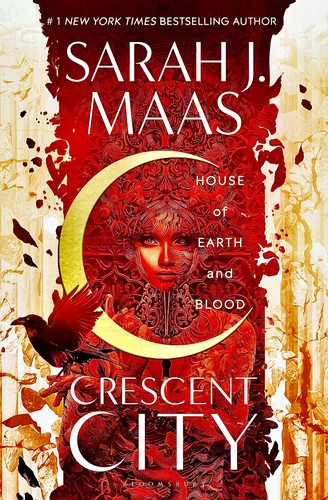
House of Earth and Blood
by Sarah J. Maas · 2020
A half-fae party girl in a modern fantasy city loses everything when her friends are murdered -- then teams up with a fallen angel assassin to hunt the killer through a world of gods, demons, and corporate-run magic.
Worth reading? Maas's most ambitious worldbuilding to date, though it asks for real patience before the plot and romance both kick into gear.
| Author | Sarah J. Maas |
|---|---|
| Published | 2020 |
| Publisher | Bloomsbury Publishing |
| Category | Fiction |
| Favorite quote | “I've got you. Sweetheart, I've got you.” |
The Verdict
The worldbuilding is genuinely the most ambitious thing Maas has attempted – a modern city with phones and nightclubs sitting directly on top of gods, demons, and enslaved fallen angels is a harder combination to pull off than a traditional secondary-world fantasy, and mostly it works.
The cost is pace. The opening stretch spends real time establishing Lunathion’s rules, hierarchy, and history before the murder investigation and the Bryce-Hunt partnership both find their footing, and readers used to Maas’s earlier series may find the slow burn here genuinely slow, not just a marketing description.
Skip it if you want a tight, fast-moving fantasy – this is a long investment even before the plot fully clicks into gear. Read it if you want Maas’s most layered world yet and are willing to trust that the payoff, once the larger conspiracy surfaces, is worth the setup.
you want a genre-blending urban fantasy that mixes phones and nightclubs with angels, demons, and gods, and are fine with a slow-burn romance embedded in a much longer investigation plot
you want a tight, fast-paced book -- this runs long even by Maas's standards, and the worldbuilding-heavy opening chapters take real patience before the plot fully engages
Book Summary
Bryce Quinlan is a half-human, half-Fae party girl living in Lunathion, a modern fantasy city where magic, technology, and multiple supernatural species coexist under an uneasy peace enforced by the ruling Archangels. When her best friend and the rest of her friend group are brutally murdered, Bryce is partnered with Hunt Athalar, a legendary fallen angel enslaved as an Archangel's personal assassin, to find the killer -- a hunt that pulls both of them into a much larger conspiracy involving the gods themselves.
Maas builds an unusually dense fantasy world here, one that layers modern conveniences (phones, nightclubs, corporate hierarchies) directly against ancient gods, demons, and angelic slavery, and spends a long opening stretch establishing that world before the plot's central mystery picks up real momentum. Both Bryce and Hunt are carrying real trauma -- her friends' murders, his history of enslavement and violence -- and the slow-burn partnership between them is built on genuine emotional recovery, not just attraction.
The book's structural gamble is holding its true stakes back for a long time; what looks initially like a grief-driven murder mystery reveals itself, gradually, to be about a much larger power struggle among the city's ruling gods and angels.
Top 8 Lessons from House of Earth and Blood
- Bryce's grief over her murdered friends is the emotional engine of the book's first half, and Maas refuses to let her simply move past it quickly for the sake of plot momentum.
- Hunt's history as an enslaved assassin for the Archangels is treated as ongoing trauma, not just tragic backstory, and it directly shapes how carefully he has to navigate his forced partnership with Bryce.
- The modern-meets-mythological worldbuilding (phones and nightclubs alongside gods and demons) is used to make ancient power structures like angelic slavery feel uncomfortably present-tense rather than safely historical.
- Bryce being underestimated as a shallow party girl by nearly everyone in her orbit is deliberately set up as a misdirection the plot slowly dismantles as her competence and history are revealed.
- The slow-burn relationship between Bryce and Hunt is built through shared trauma recovery and forced proximity during the investigation, not instant attraction, which the book takes real time to earn.
- Institutional power in Lunathion, held by the Archangels, is shown as casually brutal to the vulnerable species beneath it, and the murder investigation keeps surfacing how normalized that brutality has become.
- The book's late reveal that the murders connect to a far larger conspiracy among the gods reframes the personal grief of the opening chapters as the visible edge of a much bigger power struggle.
- Found family, formed between Bryce, Hunt, and a small circle of allies, becomes the source of safety neither of them has had within the city's official power structures.
Top 2 Quotes from House of Earth and Blood
"I've got you. Sweetheart, I've got you."
Sarah J. Maas, House of Earth and Blood
"This sunball-watching person doesn't fit with my mental image of the Shadow of Death."
Sarah J. Maas, House of Earth and Blood
Frequently Asked Questions
Is House of Earth and Blood worth reading?
Yes, if you're willing to invest in a slow opening -- the worldbuilding is Maas's most ambitious yet, blending modern city life with gods and angels, but it takes real patience to pay off.
Is House of Earth and Blood part of a series?
Yes, it's the first book in the Crescent City series, with the plot's larger conspiracy setting up further installments.
How long is House of Earth and Blood?
It's long even by fantasy standards, over 800 pages, with a lengthy worldbuilding-heavy opening before the central mystery gains full momentum.
Does House of Earth and Blood have spice or is it a clean fantasy?
It includes explicit content -- this is written for adult fantasy romance readers, not a young-adult crossover.
Ready to read it?
Get House of Earth and Blood on Amazon