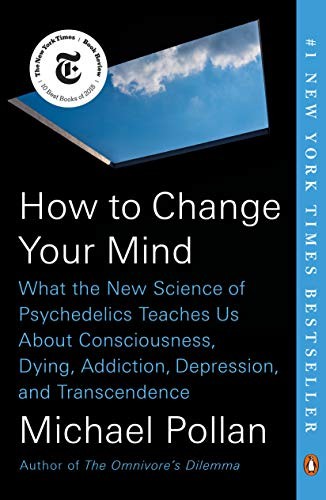
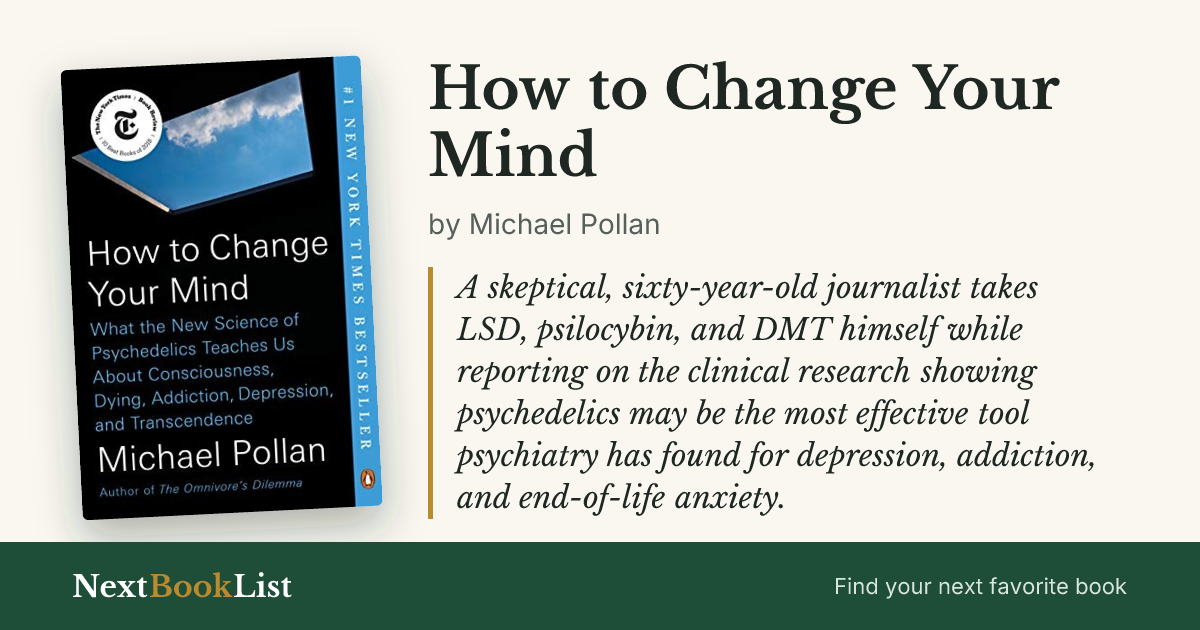
How to Change Your Mind
by Michael Pollan · 2018
A skeptical, sixty-year-old journalist takes LSD, psilocybin, and DMT himself while reporting on the clinical research showing psychedelics may be the most effective tool psychiatry has found for depression, addiction, and end-of-life anxiety.
Worth reading? How to Change Your Mind is the best entry point into psychedelic science because Pollan comes in a skeptic, not an advocate, and treats his own trips as data points rather than proof. It beats older countercultural texts (Timothy Leary, even parts of Huxley) by grounding the trip reports in current clinical trials at Johns Hopkins and NYU, giving the book real credibility with readers who'd otherwise dismiss the topic.
| Full Title | How to Change Your Mind: What the New Science of Psychedelics Teaches Us About Consciousness, Dying, Addiction, Depression, and Transcendence |
|---|---|
| Author | Michael Pollan |
| Published | 2018 |
| Publisher | Penguin Press |
| Category | Science & Nature |
| Favorite quote | “We think we see with our eyes, but it is actually our brains that do the seeing, and in some ways perception can be a kind of controlled hallucination.” |
The Verdict
What sets this apart from decades of psychedelics writing is Pollan’s refusal to perform either evangelism or dismissal – he goes in doubting the hype and comes out reporting real, replicated clinical results alongside his own unresolved discomfort with what he experienced. That tension is what makes the book credible. If Fantastic Fungi left you curious but wanting more rigor, this is the next stop.
you want a rigorously reported, skeptic's-eye account of the psychedelic research renaissance -- history, neuroscience, and Pollan's own guided trips -- rather than a countercultural manifesto
you're looking for a practical how-to guide on dosing or sourcing psychedelics -- this is journalism and cultural history, not a usage manual, and Pollan is explicit about the risks and legal issues
Book Summary
A new wave of clinical research, largely suppressed for decades after the 1960s backlash, is showing that psilocybin and other psychedelics can produce durable improvements in treatment-resistant depression, end-of-life anxiety, and addiction, often from a single or handful of guided sessions rather than daily medication.
Psychedelics appear to work by temporarily quieting the brain's Default Mode Network, the neural system associated with the ego and habitual self-referential thought, which may explain both the "dissolution of self" reported in trips and the durable shift in perspective some patients experience afterward.
Pollan structures the book around his own guided experiences with LSD, psilocybin, and 5-MeO-DMT as a sixty-something skeptic, using his own reactions -- awe, fear, unexpected insight -- as a check against both the hype of psychedelic evangelists and the dismissal of mainstream psychiatry.
Top 9 Lessons from How to Change Your Mind
- Clinical trials at Johns Hopkins and NYU found single or few-dose psilocybin sessions produced lasting reductions in depression and end-of-life anxiety for many participants.
- The 'set and setting' of a psychedelic experience -- mindset going in and the physical/social environment -- heavily shapes whether the experience is therapeutic or distressing.
- Psychedelics appear to quiet the brain's Default Mode Network, potentially explaining both ego dissolution and lasting shifts in perspective.
- The 1960s countercultural association of psychedelics with Timothy Leary and campus radicalism contributed directly to decades of research suppression.
- Guided, professionally supervised sessions with trained facilitators are shown as critical to safety and positive outcomes, distinguishing clinical use from recreational use.
- Psilocybin-assisted therapy shows particular promise for addiction (notably smoking cessation and alcohol use disorder) in early trials.
- Pollan's own trip reports repeatedly surprise him -- moments of confronting mortality and ego that he didn't anticipate going in as a skeptic.
- The book distinguishes between the mystical-type experience (often correlated with the best therapeutic outcomes) and simple perceptual hallucination.
- Indigenous and pre-1960s medical use of psychedelics (peyote, psilocybin mushrooms) predates and complicates the drugs' modern countercultural reputation.
Top 2 Quotes from How to Change Your Mind
"We think we see with our eyes, but it is actually our brains that do the seeing, and in some ways perception can be a kind of controlled hallucination."
Michael Pollan, How to Change Your Mind
"The experience of awe, whether occasioned by nature, art, or drugs, has the effect of shrinking the ego."
Michael Pollan, How to Change Your Mind
Frequently Asked Questions
Is How to Change Your Mind worth reading?
Yes -- it's the most credible, well-reported entry point into modern psychedelic science, written by a skeptic rather than an advocate.
Did Michael Pollan actually take psychedelics for this book?
Yes -- Pollan describes his own guided experiences with LSD, psilocybin, and 5-MeO-DMT as part of his research, alongside reporting on clinical trials and their history.
Is How to Change Your Mind pro-drug propaganda?
No -- Pollan is explicitly skeptical going in and treats both the risks and the legal status of these substances seriously rather than advocating casual recreational use.
Who should read How to Change Your Mind?
Anyone curious about the clinical research on psychedelics for depression, addiction, or end-of-life anxiety, or interested in consciousness and the neuroscience of the self.
Ready to read it?
Get How to Change Your Mind on Amazon